
David had been a business analyst for eleven years when his director pulled him aside after a Tuesday standup. The company had bought a shiny new AI requirements tool, the kind that drafts user stories from a transcript, and the plan was to cut two analyst roles to pay for it. David was not one of the two. He was the one asked to make the tool work. So he fed it the stakeholder notes, watched it produce forty crisp user stories in a few minutes, and thought, honestly, that maybe his director was right. Then the spec shipped. Three weeks later operations was in a war room, because the tool had built exactly what the prompt described and nothing that the warehouse floor actually needed. The gap was not in the code. It was in a conversation that never happened.
That is the real story of AI and the business analyst, and it is not the story the headlines tell. The headline is replacement. The reality is a split. The job had two halves all along, and most of us only ever noticed one of them.
Will AI replace your business analyst?
No. It replaces the documentation half of the job, not the analyst who does it. Here is the cleaner way to say it: AI is now very good at writing down requirements and genuinely bad at discovering them. Those are two different skills that happened to live in one job title for thirty years, and we confused them because the same person did both. Tools today report requirements gathering running about 60% faster and user stories coming out roughly three times more detailed (SyncSkills, 2026). All true. All on the half that was never the bottleneck.
The bottleneck was always the other half. Figuring out what the operation actually needs, which is rarely what the loudest stakeholder says it needs. I changed my mind on this twice while writing it, so let me be precise. At first I thought AI would shrink the analyst job by maybe a third. Then I watched a few of these tools in the wild and realized something stranger: AI does not shrink the job. It exposes which part of it was ever the real work. The typing was never the work. The asking was.
What part of the business analyst job does AI actually automate?
The mechanical, output-side half. Turning a messy interview into structured requirements. Drafting acceptance criteria. Reformatting a backlog at midnight so it is presentable by nine. Summarizing a forty-minute call into the six decisions that mattered. Catching the obvious gap in a written spec, the field that has no validation rule, the status with no transition out of it. AI is excellent at all of this, and I mean genuinely excellent, the kind of help that gives an analyst back hours every week. This is the part people point to when they say the role is dying.
But look closely at that list. Every item starts from something that already exists: a transcript, a draft, a backlog, a spec. AI is a phenomenal second pass. It restructures, accelerates, and polishes what is already on the table. What it cannot do is conjure the thing that was never put on the table, because no model can summarize a conversation that nobody had. The 60% time saving is real. It is also a saving on the cheap half. The expensive half, the discovery, does not get faster just because the writing did. If anything, when teams pocket the saved time and skip the interviews, the expensive half gets quietly worse.
AI made the writing of requirements almost free. It did nothing for the finding of them. And the finding was always where projects were won or lost.
What can a one-line prompt never do that a human analyst can?
It cannot ask the question nobody thought to write down. That is the whole thing, right there. A good analyst hears a stakeholder say "and then it just goes to fulfillment" and stops, because the word "just" is hiding three exceptions and a handoff that two departments each assume the other owns. The analyst follows the vague answer until it turns concrete. An AI accepts "it just goes to fulfillment" as a complete requirement and builds exactly that, cleanly, confidently, wrongly.
There is a second thing, and it is even harder to automate: noticing conflict that nobody has voiced. In most discovery sessions the real risk is not a stakeholder who disagrees out loud. It is two stakeholders who agree on the words and mean completely different things, and have never once been in the same room to find out. A human catches the flicker of hesitation, the glance across the table, the "well, that depends." A prompt catches none of it, because a prompt is given the words and never the room.
One of the most expensive requirements in software history was a single button. A large online retailer required first-time shoppers to register before they could buy. The spec was clear, the requirement was documented, and everyone honored it. An AI handed that spec would have built the registration wall without blinking, because the spec said to. The requirement itself was the mistake, and nobody on the team could see it, because it was written down and therefore felt true.
It took usability work, watching real people fail at the checkout, to surface the obvious-in-hindsight truth: shoppers did not want an account, they wanted their order. The team replaced "Register" with a "Continue" button and let people check out as guests. Purchases rose 45%. That was an extra $15 million in the first month, and an additional $300 million over the first year (Jared Spool, The $300 Million Button).
No prompt asked for that change, because the prompt would have been built from the spec, and the spec was the problem. A human watching the discovery found a $300 million question that nobody had written down. That is the job. That has always been the job.
I have sat in enough discovery rooms over 25 years in enterprise software delivery to tell you the pattern is boringly consistent. The requirement that sinks the project is almost never the one being argued about. It is the one everyone assumed was settled, the "obviously it works like that" that turns out to mean two incompatible things to two teams. You do not find those with a faster pencil. You find them by being a stubborn human who refuses to accept "just" as an answer.
How is the business analyst role changing instead of disappearing?
It is moving up the stack, from doc-writer to discovery facilitator and AI orchestrator. Think about the demand curve here. Gartner's 2026 CIO survey found that only 17% of organizations have actually deployed AI agents, while more than 60% expect to within two years, the most aggressive adoption curve of any technology they measured (Gartner, 2026 CIO Agenda). Read that gap. A flood of agents is coming, and almost nobody has them in production yet. Somebody has to decide what all those agents are supposed to do, feed them requirements worth building from, and check their output against a reality the agents have never seen.
So the analyst who tries to win a typing race against AI loses, and deserves to. The analyst who moves up wins big. Discovery facilitator: the person who runs the structured conversations that surface the exceptions, the conflicts, and the reasons. AI orchestrator: the person who briefs the agents, governs what goes in, and verifies what comes out before it ships. This is the same shift we wrote about in why AI agents need the right questions, not just the right code, and it points at the same root cause we keep coming back to in your specs are the problem, not your AI agent. The structure was never the hard part. The discovery was.
What does requirements intelligence give the new business analyst?
A toolset built for the half of the job that survives. Requirements intelligence is structured, multi-expert discovery run on purpose instead of by accident. Instead of hoping a curious analyst stumbles into the missing exception at minute fifty-five of an interview, it interrogates the why deliberately, surfaces the conflict between stakeholders before a line of code is written, and captures the reasoning behind each requirement as a first-class artifact. Then it hands the AI a brief that already contains the things a one-line prompt would have skipped.
That is the partnership that actually works. The AI drafts the forty user stories in four minutes, and it should, that is a great use of four minutes. The analyst spends the time it saved doing the thing only a human can: sitting with the warehouse supervisor, watching the real checkout, asking the $300 million question. For a fuller picture of what that discovery layer is and how it feeds the agents, see what requirements intelligence actually is. The point is not AI versus the analyst. It is the analyst, holding the discovery, pointing the AI at the truth.
Stop asking if AI replaces the analyst. Ask which half it replaces.
AI automates the documentation half: faster requirements, more detailed user stories, cleaner backlogs. That half was real work, but it was never the work that decided whether a project succeeded. The discovery half, asking the unwritten question and surfacing the conflict nobody voiced, is exactly what a one-line prompt cannot do.
So the business analyst who competes with AI on output loses. The one who moves up to discovery facilitator and AI orchestrator becomes more valuable than ever, because a flood of agents is coming and somebody has to tell them the truth. Requirements intelligence is the toolset for that new job. The analyst holds the discovery. The AI does the typing. Both, finally, doing what they are actually good at.
David kept his job, by the way. He stopped trying to out-draft the tool and started running the discovery sessions it could not. The next spec shipped without a war room. Same analyst. Different half of the job. The one that was always the point.
Which half of the analyst's job does Specira actually take?
The typing. The export package is the documentation half done at machine speed, with deliverables grouped by the agent that owns each one, which is the part of the job that used to eat the analyst's week. The discovery half stays human, and the session is built for it: five agents raise the questions, and a person decides which answer is right. Delegation is the clearest tell, because the analyst is the one who decides which stakeholder gets which open question and when the session moves on without them.
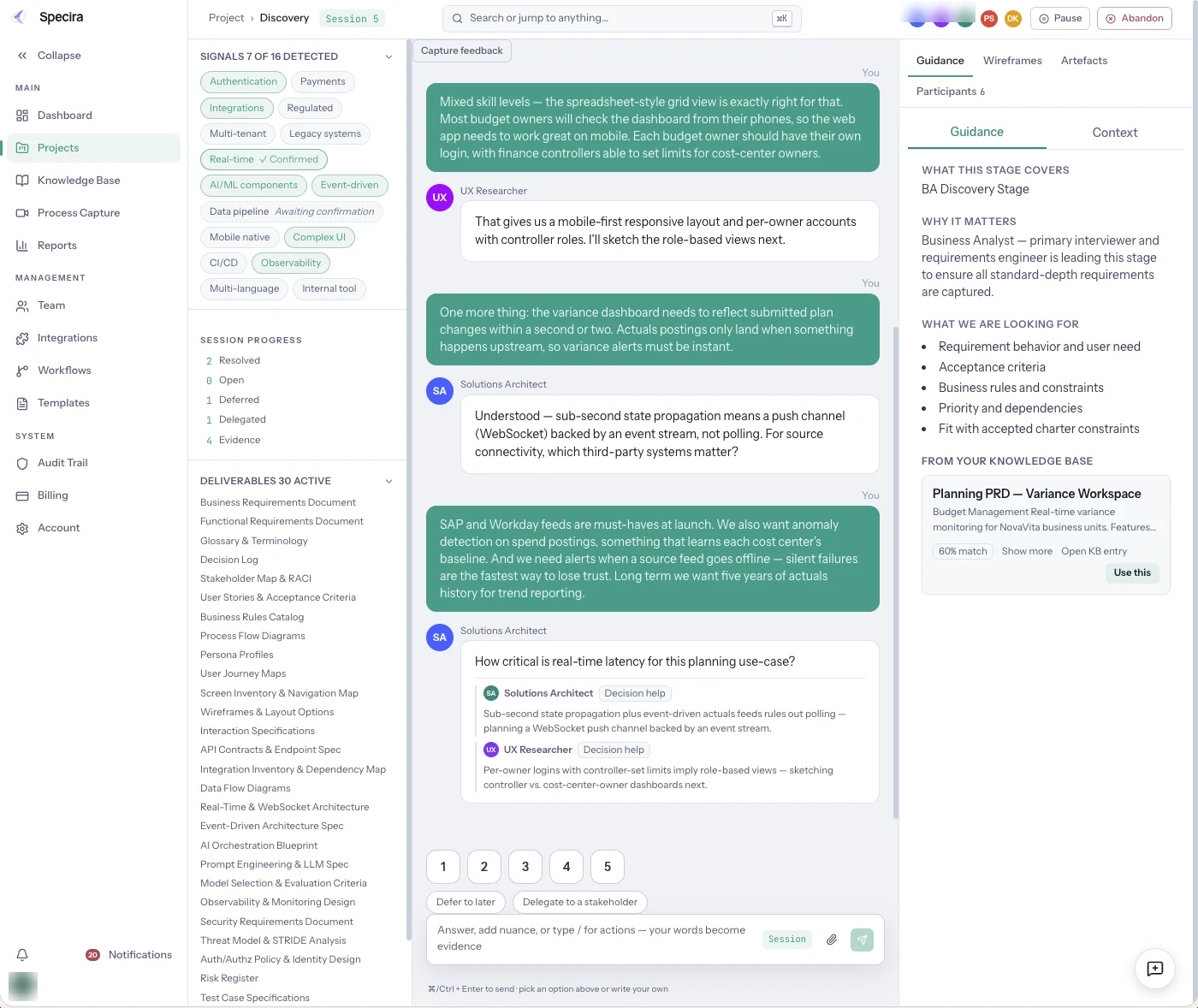
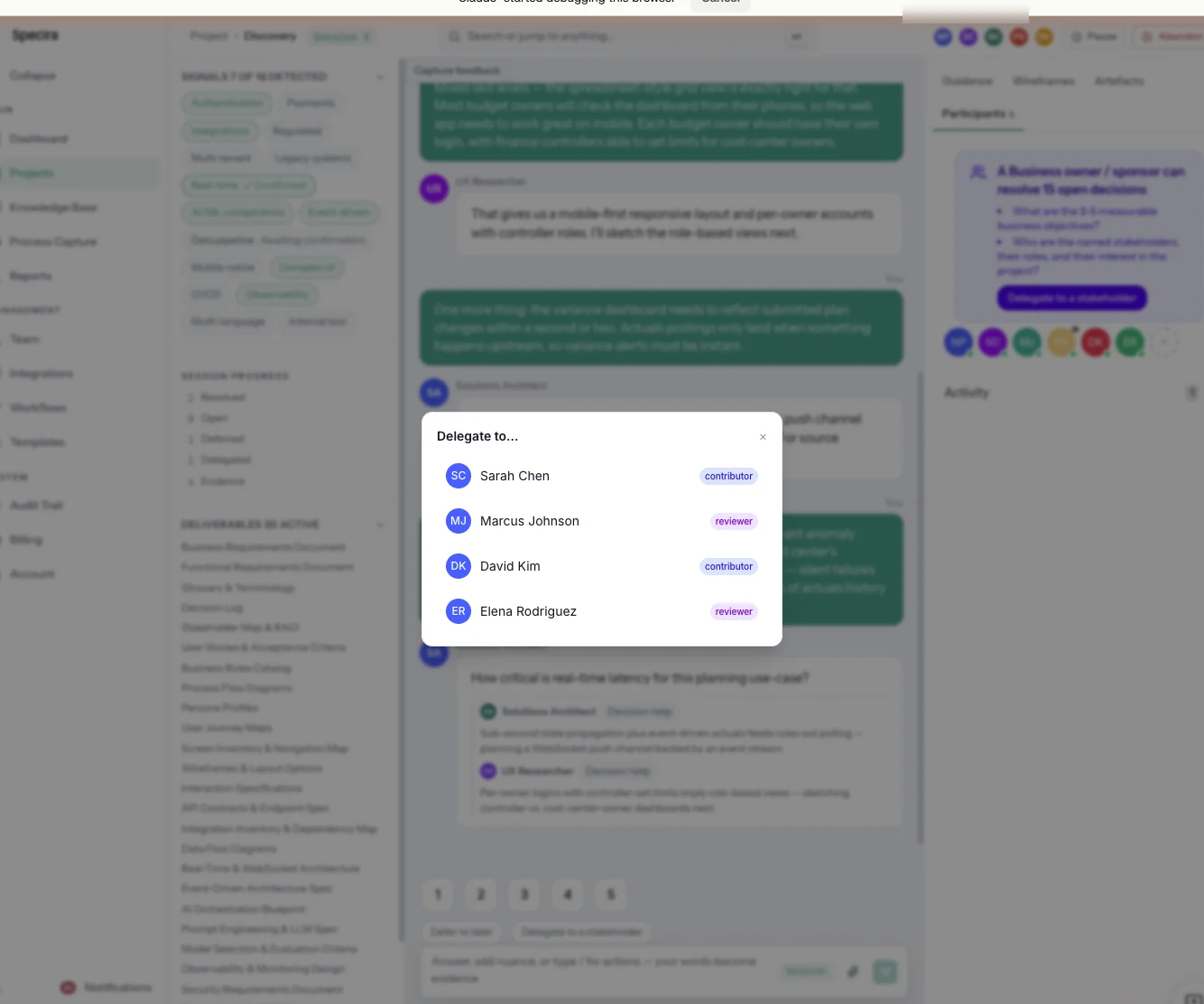
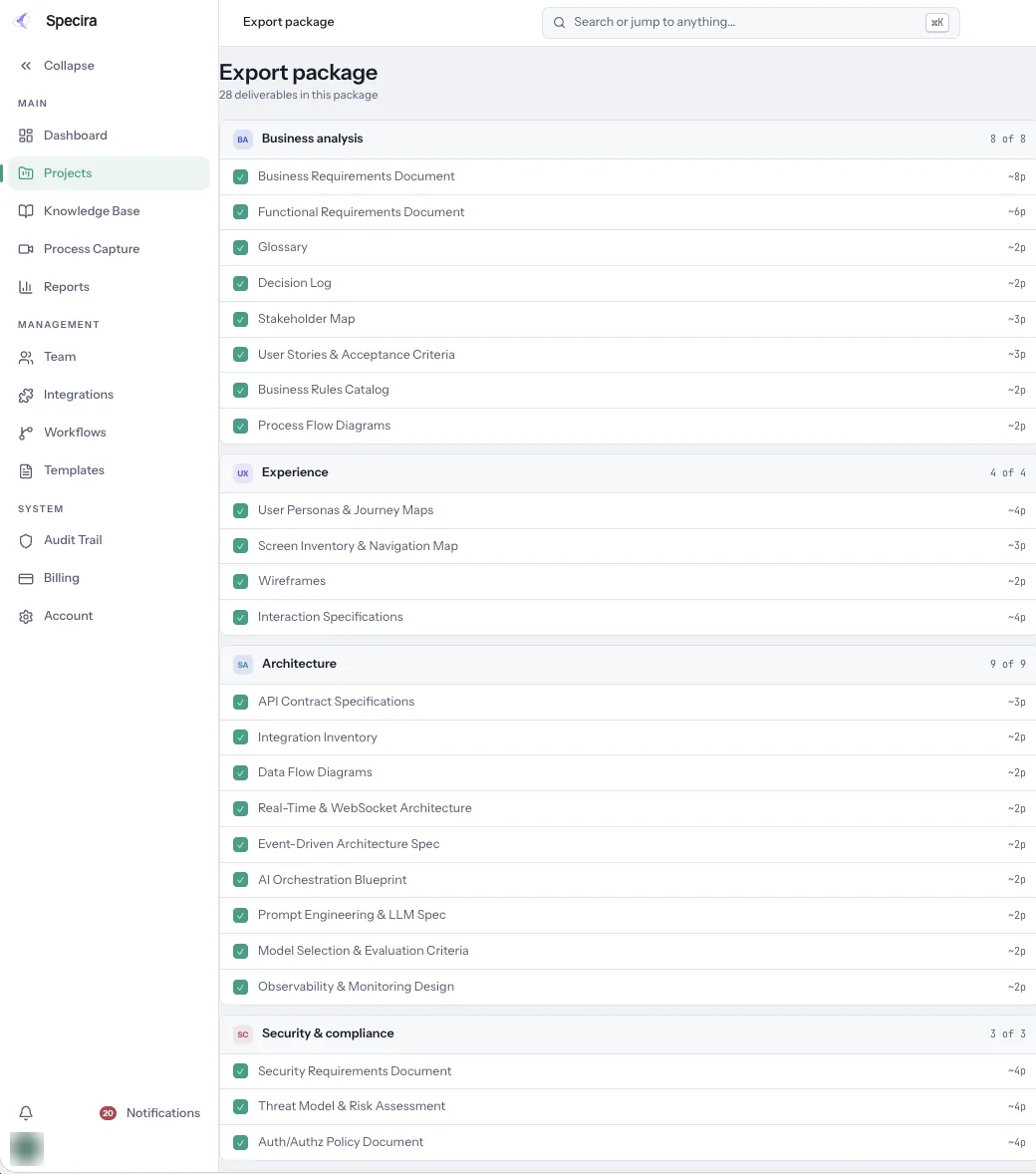
What you are looking at. The session is the discovery half that still needs a person, the delegate dialog is where the analyst decides who answers what, and the export package is the documentation half that no longer costs a week.
Bring your analyst to the call. We will show them the half of their job that gets shorter and the half that gets harder.
Book a DemoScreens are from a seeded Specira demo workspace; counts and scores are sample data.
What are the most common questions about AI replacing business analysts?