Why do telecom supply chain software projects fail to translate field requirements into working systems?
I once sat in a boardroom in Montreal where a supply chain VP pulled up a spreadsheet with 14 tabs. Each tab mapped a different logistics operation: semiconductor procurement, warehouse distribution, field technician dispatch, 5G tower provisioning. Fourteen tabs, and nobody in the room could tell me how they connected. That's telecom. A regional provider coordinates logistics across multiple countries, juggles consumer hardware alongside massive 5G capital expenditure, absorbs geopolitical shocks (remember the 2021 chip shortage?), and dispatches technicians to frozen cell sites in Northern Ontario. But honestly, the complexity itself isn't the killer. The real problem is simpler and more frustrating: what supply chain managers describe in their requirements is not what engineers end up building.
First week of field deployment, the calls start. A supply chain director asked for "optimized reverse-logistics workflow." Sounds clear enough, right? Except the architects who designed the mobile interface never actually worked a warehouse shift. They didn't know that half the remote sites have zero cellular coverage, so offline sync isn't optional. The database schema they designed doesn't match how technicians physically stack pallets and scan barcodes (because nobody asked them). The billing API integration assumes always-on connectivity, which is frankly laughable at distributed sites in rural Alberta. And CRTC data residency mandates? Buried in a compliance spreadsheet that the engineering team never saw. The result: field deployment failures, expensive rework, and missed 5G rollout windows that were supposed to hit Q3.
The usual process makes every one of these problems worse. Three groups (warehouse managers, field techs, network engineers) each write their own requirement documents. Nobody reads each other's. Then those documents pass through the classic telephone game: director to Business Analyst to developer. Intent degrades at every handoff, and I've watched it happen in real time. Regulatory compliance? Some other team maintains a separate spreadsheet. Nobody feels personally responsible for making sure the field software respects data residency rules. By the time a technician in Timmins discovers the inventory app crashes without Wi-Fi, it's already in production. And the rework bill? It's ugly.
How do telecom operators currently approach supply chain software modernization?
If you've been through one of these modernization projects, you already know the pattern. Document-heavy, sequential, and painfully slow. The coordination problems and late-stage field surprises? They're not bugs in the process. They are the process.
Approach 1: Siloed requirements gathering from separate stakeholders
Warehouse managers write their inventory workflow requirements in one Confluence space. Field technicians describe mobile app requirements in another (sometimes in Word docs emailed around). Network engineers provide integration requirements for billing and network management systems in a third project entirely. No shared structure. No cross-team validation. So when warehouse requirements demand real-time sync but field technicians need offline capability (because, again, rural sites), that conflict sits invisible until design review. By then? Fixing it means redesigning two systems instead of one.
Approach 2: Sequential handoffs with intent degradation
Director hands requirements to a Business Analyst. The BA rewrites them as technical specifications. The architect reads those specs and designs the system. Each handoff is a game of broken telephone, and I'm not exaggerating. "Optimized reverse-logistics" meant "minimize transportation cost" to the director. The architect interpreted it as "fastest turnaround time." The field technicians just wanted something easy to execute on a freezing loading dock at 6 AM. Three completely different systems in three people's heads. Nobody catches the mismatch until the field pilot falls apart.
Approach 3: Regulatory compliance in separate workstreams
Compliance teams maintain their own spreadsheets mapping data residency requirements (CRTC mandates for Canadian operators, similar rules in Europe, different ones in Latin America) to system components. These spreadsheets live in a completely separate SharePoint folder from the technical specification. Engineers designing the database schema? They don't even know those spreadsheets exist, let alone cross-reference them. So you end up with systems that must be rearchitected late in the project to meet regulatory constraints that someone had already documented. The information was there. It just never made it into the design.
None of these approaches give you what you actually need: a single view that combines the field technician perspective, the business process perspective, the technical architecture perspective, and the regulatory perspective. All at once. Without that, you get exactly what you'd expect: field deployments that need immediate patches, missed infrastructure rollout windows, and technicians filing angry tickets about tools that bear no resemblance to their actual work.
How does multi-perspective requirements intelligence transform telecom supply chain modernization?
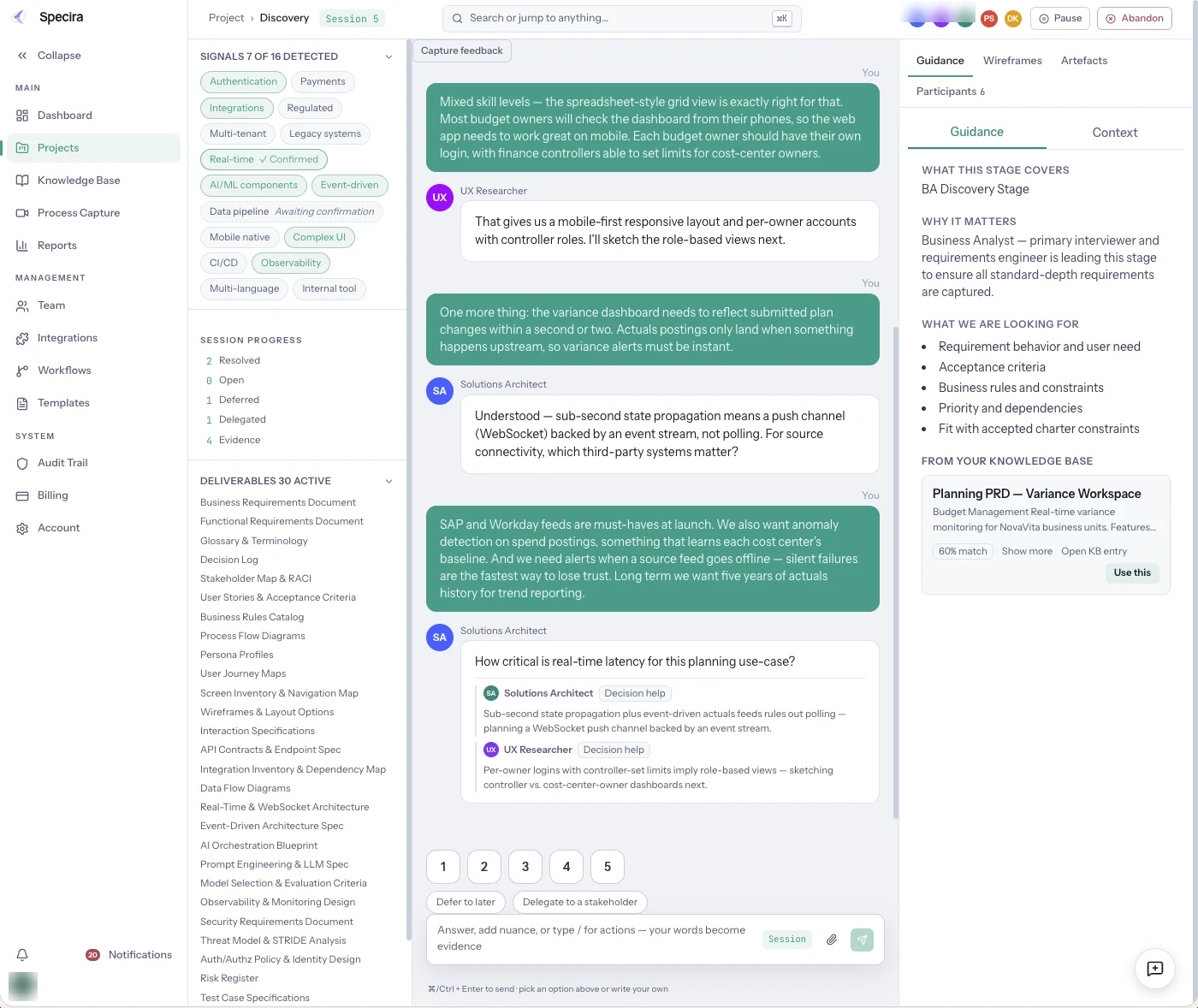
Specira's multi-agent system tackles the same supply chain requirement from four angles simultaneously. Think of it as putting four experienced specialists in a room together, except they actually read each other's notes (which, let's be honest, rarely happens in real life). Instead of passing requirements through a chain of interpreters where meaning leaks out at every step, all perspectives get validated at the same time.
Here's what that looks like in practice. When a supply chain director submits "optimize reverse-logistics workflow," four analysis agents evaluate that single requirement and flag conflicts and gaps for immediate resolution. No waiting until the code review six weeks later. The system evaluates the requirement through:
- BA Agent: Maps inventory lifecycle, stock replenishment, predictive maintenance, reverse-logistics workflows. Asks: what business process is actually being described here?
- UX Researcher Agent: Evaluates field technician mobile interfaces, barcode scanning for harsh weather conditions, warehouse dashboards. Asks: can a technician actually use this in the field?
- Solutions Architect Agent: Designs hybrid cloud data sync between logistics app, cloud BSS (business support system), and on-premises 5G infrastructure. Asks: how does this actually integrate with existing systems?
- Security and Governance Agent: Validates customer data privacy, telecom regulatory compliance (data residency, network access rules), identity verification for macro-network hardware access. Asks: what regulations must this satisfy?
Each agent flags gaps and conflicts in real-time. Here's a concrete example we keep seeing: the architect agent discovers that offline sync (absolutely required in remote regions) conflicts with real-time inventory visibility (required for billing integration). In a traditional process, this contradiction would hide for weeks. With multi-perspective analysis, it surfaces during the spec review meeting. The team discusses it, makes a decision, and captures the resolution in the living specification. Not in a panicked Slack thread during field deployment.
Then there's the Red Team Critic agent, which is basically a professional pessimist for your specification. It catches offline sync gaps for remote field operations, pokes holes in fallback protocols for network loss, and flags missing data residency considerations that regulators will absolutely ask about during the audit. Better to find those gaps in a document than in a regulatory inquiry.
What outcomes can telecom operators expect from multi-perspective requirements intelligence?
We've seen the same pattern with telecom operators who adopt end-to-end requirements intelligence. The improvements aren't theoretical; they show up in field deployment success rates and time-to-market for new logistics software:
What does zero intent loss actually feel like? The supply chain director's original request passes through BA analysis, UX design, architecture review, and compliance validation, then arrives in production exactly as intended. Field technicians open the app on day one and recognize it as the tool they described needing. That moment when a tech in Sudbury says "yeah, this is what I asked for" is worth the entire investment.
Eliminating ambiguous specifications cuts rework by 40-50%. That's not a small number when you consider what post-deployment patches actually cost: developer time, QA cycles, field re-training, missed rollout windows. When a sync issue or a missed data residency requirement does come up (and something always does), the fix is a minor clarification in the spec. Not a three-week architectural rework that pushes your 5G deployment to next quarter.
And then there's the audit trail. I've personally sat through telecom compliance audits, and the single most valuable thing you can have is traceability. When regulators ask how data sovereignty is maintained, your team can trace from the regulatory requirement (CRTC data residency mandate), to the business requirement (all customer data stays in Canada), to the architecture decision (on-premises database replication), to the actual code implementation (database sharding by region). That kind of traceability turns a stressful three-day audit into a two-hour review.
AT&T network modernization, $145+ billion investment 2019-2023: One of the largest infrastructure modernization efforts in telecommunications history illustrates the scale of telecom logistics challenges. AT&T invested over $145 billion in network infrastructure between 2019 and 2023, deploying 5G across thousands of locations while managing the logistics of decommissioning legacy 4G equipment. The complexity of coordinating field technicians, inventory tracking, and regulatory compliance across multiple states demanded flawless software specifications at every stage.
The scale of the operation required managing: thousands of cell site locations, hundreds of supplier relationships, real-time inventory tracking across multiple warehouses, field technician dispatch optimization, and real-time integration with billing and network management systems. Any gap in the software specification cascaded into delayed infrastructure deployment, missed regional rollout windows, or technician inefficiency at scale. The logistics software had to work flawlessly across geographically dispersed teams, diverse network conditions, and strict regulatory timelines.
What's the lesson for every telecom modernization? Specifications must be field-validated, architecture-sound, and compliance-ready from day one. Even small gaps compound across thousands of field deployments into material project delays and cost overruns.
Key takeaway
Telecom supply chain modernization is a high-complexity, multi-stakeholder challenge where field deployment must work flawlessly on day one. Traditional sequential requirements approaches fail because intent degrades at each handoff, field technician constraints get discovered late, and regulatory compliance is maintained separately from the technical specification.
- Multi-perspective requirements intelligence eliminates blind spots by evaluating requirements through business process, field usability, systems architecture, and regulatory compliance lenses simultaneously
- Conflicts are surfaced during specification review, not during field deployment, reducing post-launch rework by 40-50%
- Field technician workflows are validated for real-world conditions (offline operation, harsh environments, mobile interface design) before coding begins
- Regulatory compliance (data residency, telecom regulations, identity verification) is embedded in the specification from day one, creating audit-ready traceability
What do teams ask most about this use case?