
The vote took four minutes. Eighteen months of work, a dedicated squad, a budget line half of finance could recite from memory, and the steering committee killed the agentic AI pilot in roughly the time it takes to reheat a coffee. Not because it broke. The demos ran clean. The agent booked the meetings, drafted the summaries, even flagged a duplicate invoice once in a way that made the room go quiet for a second. What killed it was a question nobody on the build team could answer without hedging: what, exactly, was this thing allowed to decide, and who signed off on that? Nobody knew. The room moved to the next agenda item, and a year and a half of effort became a line in the postmortem.
That scene is about to play out across boardrooms everywhere, and there is now a number attached to it. In June 2025, Gartner predicted that more than 40% of agentic AI projects will be cancelled by the end of 2027, undone by escalating costs, unclear business value, or inadequate risk controls (Gartner, June 2025). Read those three causes one more time. Not one of them says the model was too weak, hallucinated too often, or could not reason. The agents mostly work. The programs around them do not, and they fail for reasons that were decided long before a single token was generated.
What is actually driving agentic AI project cancellations?
Hype, mostly, meeting reality at the production door. Gartner is blunt about the mechanism: most agentic projects today are early-stage experiments or proofs of concept, often driven by buzz and just as often misapplied, which blinds organizations to the real cost and complexity of running agents at scale. Then the bill arrives. The same report calls out "agent washing," the rebranding of old chatbots, assistants, and robotic process automation as agentic, and estimates that of the thousands of vendors claiming agentic capabilities, only around 130 are the real thing.
The money makes the stakes obvious. Worldwide AI spending is forecast to hit $2.59 trillion in 2026, a 47% jump year over year, according to Gartner (Gartner via CIO Dive, May 2026). When that much capital pours into a category, finance starts asking harder questions sooner. A January 2025 Gartner poll of 3,412 webinar attendees found only 19% had made significant investments in agentic AI, with 42% taking a conservative position and the rest waiting or unsure. Translation: most of the market is still cautious, still in pilot, still deciding whether the thing pays back. Those pilots are exactly the ones a CFO can cancel without much resistance, because nobody armed them with proof.
Here is the part I want to sit on, because it is the whole argument. Cost, unclear value, weak risk controls. Those are not three separate problems. They are three symptoms of one upstream failure: the agent was pointed at a goal nobody bothered to define, bound, or own. Cost runs away because there was no success criterion to stop it. Value stays unclear because "clear value" was never specified. Risk controls stay weak because the behavior they were supposed to constrain was never written down. The model is fine. The brief behind it never existed.
Why does "human-on-the-loop" still need governed requirements?
Because you cannot supervise a goal that was never written down. The governance world spent the last two years moving from "human-in-the-loop," where a person approves every agent action before it fires, to "human-on-the-loop," where the agent runs autonomously and a person watches, ready to intervene. That shift is necessary; you cannot scale agents if a human has to bless each step. But it quietly raises the stakes on the upstream work, because supervision only works against a defined target.
Think about what on-the-loop oversight actually requires. A supervisor has to notice when the agent drifts from its intended behavior. Drifts from what, though? If "intended behavior" lives only in someone's head, or worse, in three people's heads with three different versions, the supervisor has nothing to measure drift against. They are watching a process with no spec, which is just watching. Gartner made a related point in May 2026, warning that applying one uniform governance policy across very different agents will itself cause enterprise AI agent failure (Gartner, May 2026). Governance has to be specific to what each agent is for. And "what it is for" is a requirements question, decided before the build, not a policy you bolt on after.
An agent without governed requirements is not autonomous. It is unsupervised, which is a very different and far more expensive thing. Autonomy is freedom inside boundaries you defined. Without the boundaries, you do not have an agent. You have a liability that ships fast.
How do ambiguous goals become unprovable ROI?
Simple chain. You cannot prove value you never defined. When a pilot launches against "improve customer operations" or "make the team more productive," it has set itself up to fail the only review that matters, the one eighteen months later where someone asks for the number. There is no number, because nobody agreed on what to count. So the conversation defaults to vibes, and vibes lose to a hard budget line every single time.
I have watched this exact failure from the other side of the table, and it is rarely the technology that disappoints. The agent did real work. It just did work nobody had tied to a metric a CFO recognizes. "We summarized 40,000 tickets" is an activity, not a value. Did it cut handle time? By how much, against what baseline, measured how? If those questions were not answered during discovery, they will not get answered during the postmortem, and the project dies with a working demo still running on someone's laptop. Provable value is a requirements artifact. You define it up front or you forfeit it.
And the counterargument is fair, so I will give it its sentence: yes, some agentic value is genuinely hard to quantify early, and forcing a fake number can be worse than admitting uncertainty. True. But there is a wide gap between "we are honestly unsure and here is how we will find out" and "we never defined success at all," and almost every cancelled pilot I have seen lived in the second camp, not the first. This is the through-line of everything we have written on AI governance and the audit trail, and it starts upstream of the model.
What does an audit-ready requirements trail give an agentic program?
It gives you an answer to the question that killed the pilot in the opening. An audit-ready requirements trail records, for every decision the agent is allowed to make, what the objective was, what the boundaries are, what trade-off was chosen, and who signed off. When the steering committee asks "what was this allowed to decide, and who decided that," the answer is a document, not a shrug. That single difference is often what separates a program that graduates from one that gets voted down.
The market is already pricing this in. Gartner expects spending on AI governance platforms to reach $492 million in 2026 and pass $1 billion by 2030 (Gartner, February 2026). Money is moving toward governance because the cancellations taught a lesson the hard way. But here is the nuance I keep coming back to: a governance platform records and enforces decisions. It does not make the decisions correct or complete in the first place. If the requirements feeding it are ambiguous, you now have an audit trail of ambiguity, beautifully logged. The trail is only as good as the discovery behind it.
EY offers a useful counterexample to the cancellation trend, and it is worth crediting plainly. As the firm scaled agentic AI, it did not start by chasing autonomy. It started by building the governed foundation underneath it. Its EY.ai EYQ platform was deployed to more than 300,000 professionals, with what EY describes as governed prompt tooling, a centralized model catalog, guardrails, and a permissioned, lineage-rich, compliant data layer through the EY.ai Data Marketplace (EY, 2026).
The outcome is the tell. Within nine months the platform supported the development of more than 50,000 agents, and workforce adoption crossed 80%. That is not a pilot quietly dying on a laptop. That is agents scaling, because the objectives, the data lineage, and the controls were defined before the fleet was let loose, not bolted on after a committee got nervous.
The lesson is not "be EY," with EY's budget. The lesson is the order of operations. Govern the requirements first, then scale the agents. Do it backwards and you join the 40%.
How does this connect to the EU AI Act high-risk deadline?
It connects directly, and the timing is tighter than the calendar suggests. The EU AI Act's transparency duties and its enforcement machinery are already live, and the obligations that bite hardest on agentic systems are Article 12's automatic logging and record-keeping plus the law's human-oversight provisions. An agentic system that cannot show what it was permitted to decide, who approved it, and what it actually did is now exposed twice over: it fails the internal value review and the external compliance bar with the same missing artifact. We covered the mechanics in detail in the EU AI Act compliance guide, and the deadline is no longer theoretical.
So notice the convergence. The internal reason agentic pilots get cancelled (no defined objective, no provable value, no auditable trail) is the same shape as the external reason they fail compliance (no record of decisions, no human-oversight evidence, no logged behavior). One substrate satisfies both. A validated, traceable requirements set says what the agent is for, what it may decide, who owns that decision, and it does so in a form an auditor and a CFO can both read. Build that once and you answer two committees at the same time. Skip it and you are exposed on both fronts, which is a genuinely bad place to be with a dated regulatory deadline already on the calendar.
Did the confirmed EU AI Act delay change the agentic governance calculus?
No. Not in the way most steering committees hoped. The Digital Omnibus on AI is law now: Regulation (EU) 2026/1744 was published in the Official Journal on July 24, 2026 and entered into force on July 27, moving standalone high-risk obligations under Annex III from August 2, 2026 to December 2, 2027, with AI embedded in regulated products pushed out to August 2, 2028. The date moved. What did not move is the shape of the evidence those obligations ask for, and Article 12 logging, human oversight and technical documentation all describe artifacts you cannot retrofit onto an agent that already shipped without a written intent.
Here is the part worth sitting with. Five quarters. The official implementation timeline fixes the deadline at December 2, 2027, and because that date is confirmed instead of rumoured, every quarter a program spends treating the deferral as breathing room is a quarter subtracted from a runway that has no give left in it. The first read on the Omnibus was relief. Incomplete: what actually arrived was certainty, and certainty cuts in both directions.
Same failure pattern. This article has been describing it all along, and the confirmed date does not change its shape one bit, because the three cancellation causes Gartner named are not compliance problems and not one of them got easier on July 27. A program that cannot state what its agent is permitted to decide will lose its internal steering review long before December 2027 has any opinion about it. The deadline was never the forcing function. It was the audience. We walked the underlying obligations in the obligation-by-obligation compliance guide and argued the window case in why the reprieve is a window, not relief. Blunter now that the date is fixed: an excuse with a date on it has an expiry date too.
The model was never the risk
Agentic AI projects do not mostly die of weak models. They die of ambiguous goals, unprovable value, and ungoverned behavior, which are all requirements failures wearing a technical costume. Gartner's three cancellation causes share one root, and it sits upstream of the first prompt.
Govern the requirements before you scale the agents. Define the objective in numbers, bound what the agent may decide, name the owner of every trade-off, and record it in a trail an auditor and a CFO can both read. Do that and your pilot survives the steering review and the December 2, 2027 high-risk deadline at once. Skip it and you ship fast, prove nothing, and join the 40%. This is the same discipline we argue for in why your specs, not your agent, are the problem.
What would make an agentic program defensible at its next budget review?
A checkable goal. The planner forces that first, returning the charter sections with no objective, no success criterion and no constraint written in them yet, which is where an agentic program usually finds out what it never agreed on. Governance is the other half. Approval routing names who signs what and holds the export until they do, and the audit trail keeps the record of every transition, so the question of whether the agent stayed inside its brief has an answer that is not somebody's recollection.
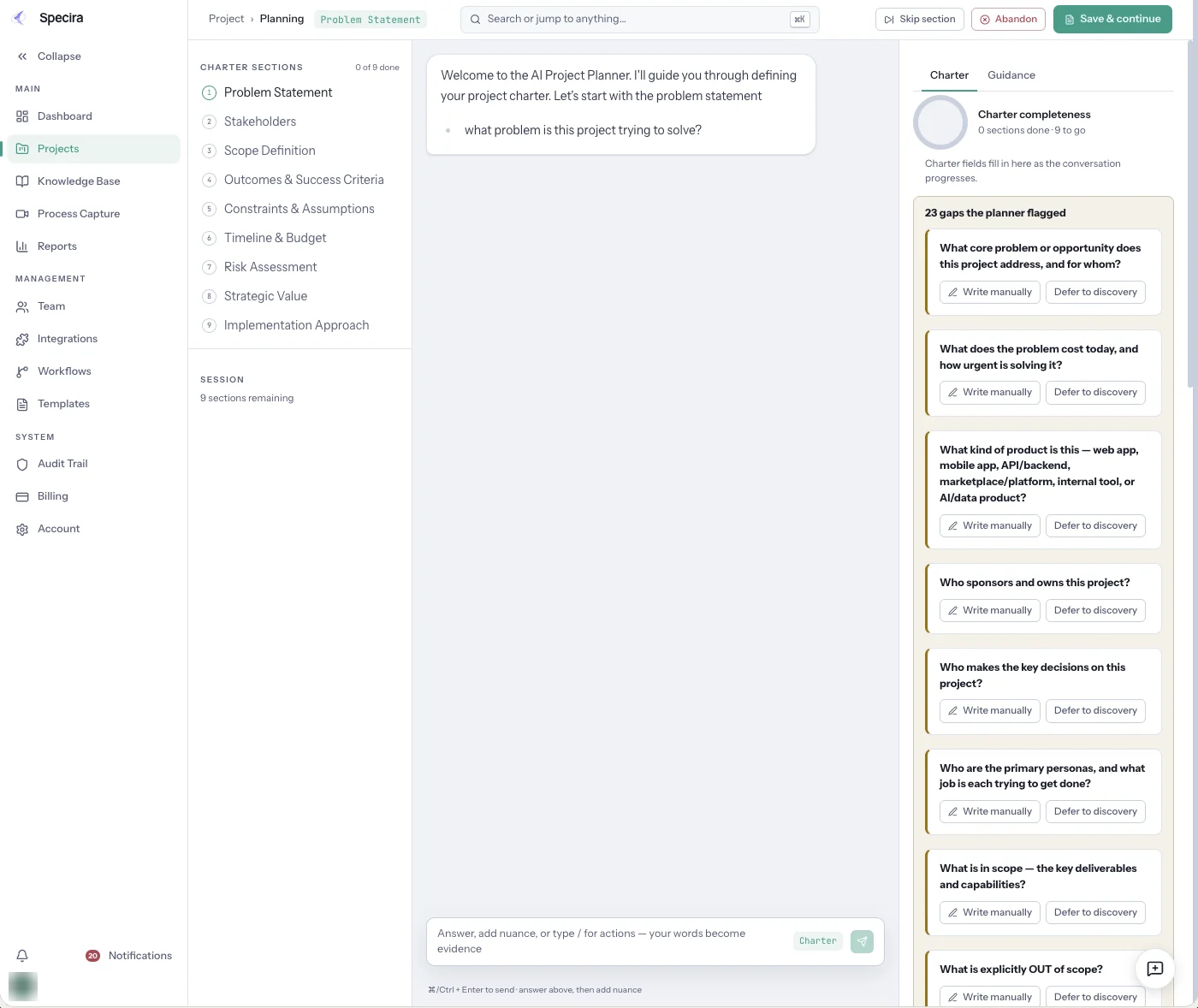
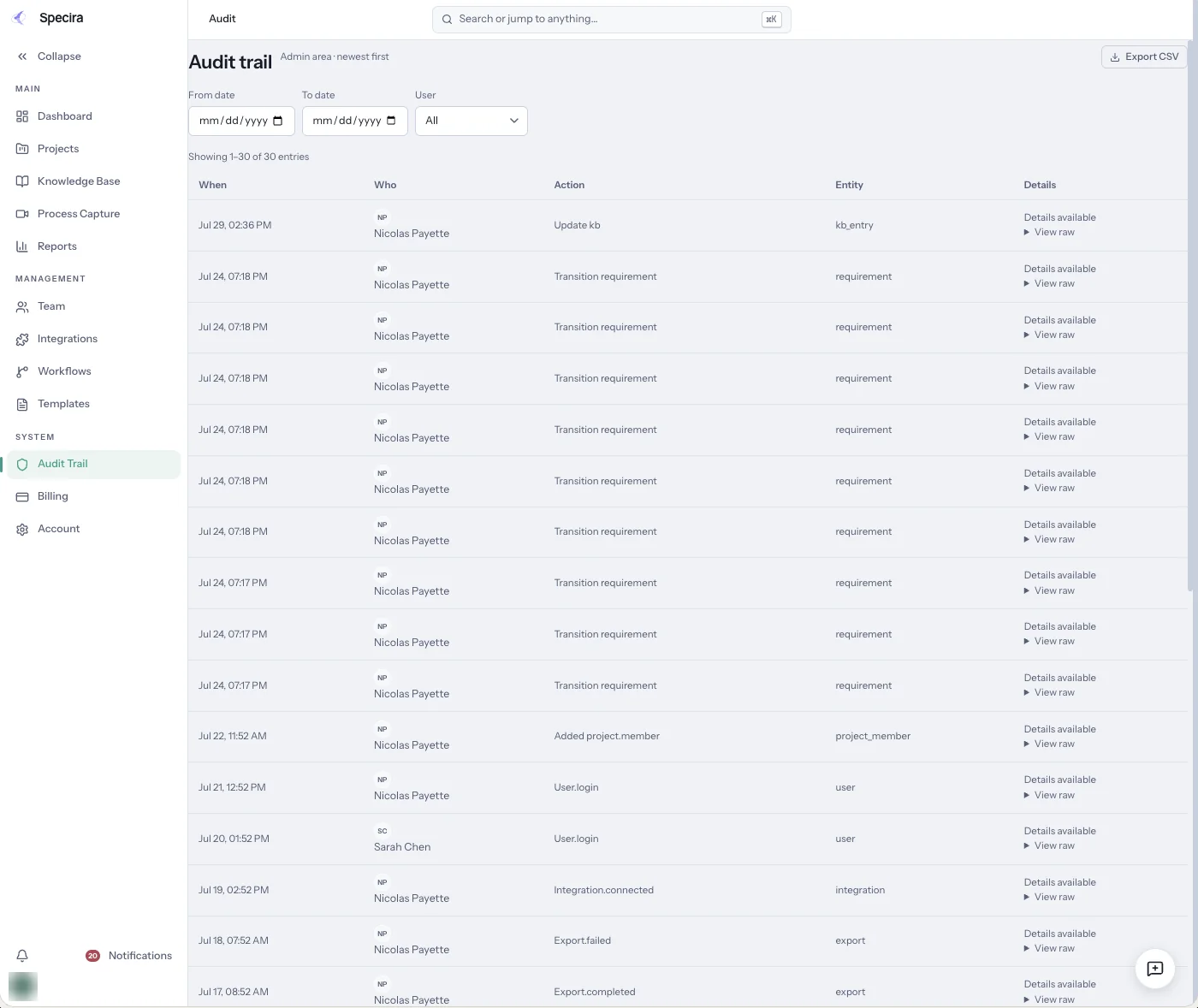
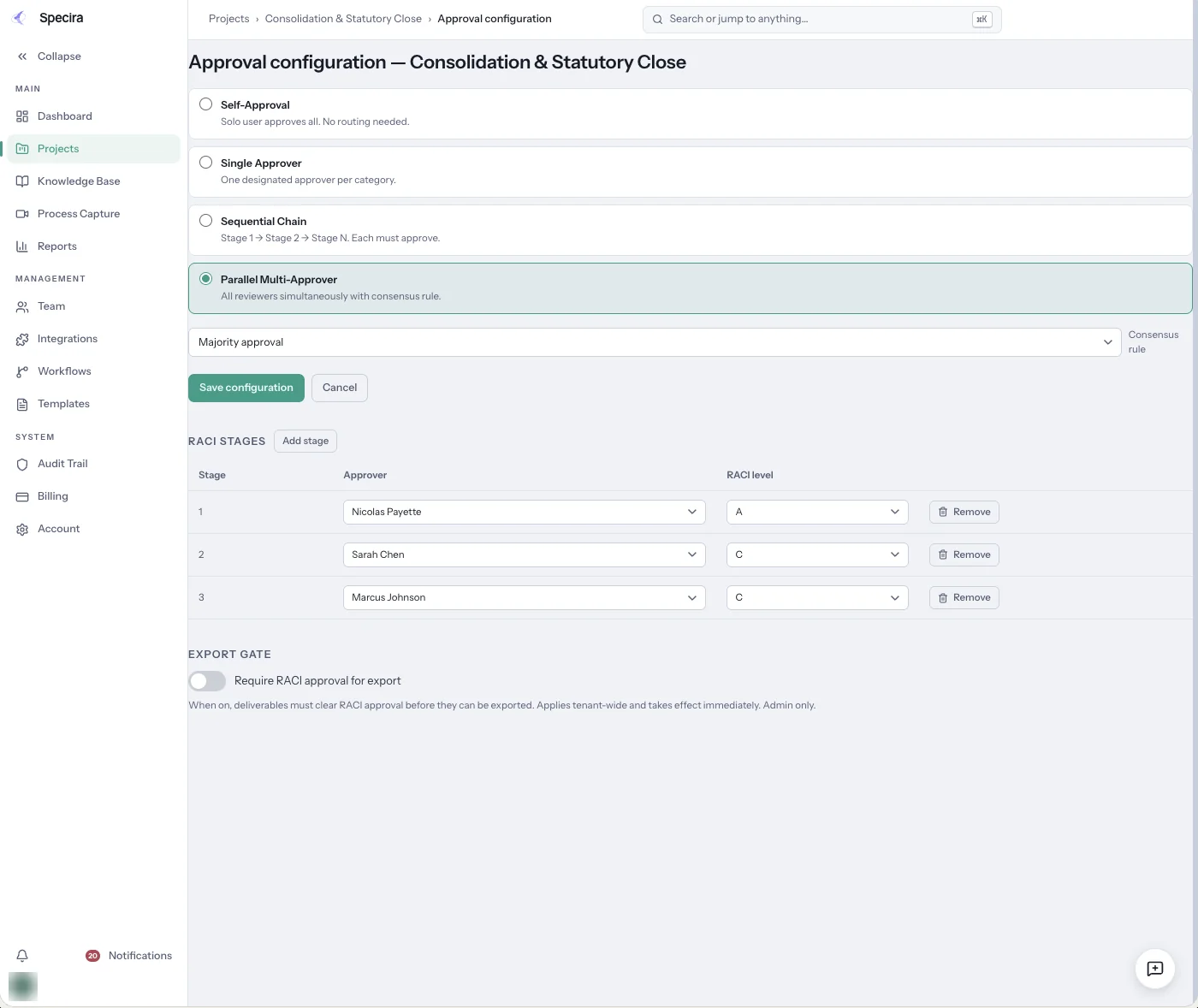
What you are looking at. The planner exposes the charter sections with no objective in them, the audit trail is the record of what the program actually did, and the approval configuration is the gate in between.
Name the agentic pilot your board will ask about first. We will show you what its charter is still missing.
Book a DemoScreens are from a seeded Specira demo workspace; counts and scores are sample data.
What are the most common questions about governing agentic AI projects?