
What happens when AI-generated requirements have no audit trail?
Last January, I got a call from a VP of Engineering at a logistics company in Toronto. Their billing module had been throwing errors for two weeks. The root cause? A business rule that contradicted an integration constraint with their payment processor. When the team tried to trace where the rule came from, they hit a dead end. Their business analyst had used ChatGPT to draft about forty requirements back in October. The conversation was long gone. No record of the prompt, no trace of the constraints the model weighed (or didn't weigh), no documentation of who reviewed the output. Forty requirements pasted into Confluence, zero provenance for any of them.
I wish that were unusual. It's not. I've watched the exact same pattern play out at three organizations in the past year, and honestly, the first time it happened I was surprised at how completely the trail vanished. Requirements generated by AI end up in specification documents, get handed to development teams, and nobody along the way has any visibility into the model's reasoning or its confidence level. Something breaks? No audit trail. A regulator asks how a decision was made? You've got documentation that documents nothing.
Look, the financial consequences are already real. In January 2025, Italy's Data Protection Authority (the Garante) fined OpenAI 15 million euros for GDPR violations. Not because the AI was "bad," exactly, but because the company processed personal data without adequate legal basis, skipped proper age verification, and couldn't show transparent documentation of how data was used. The regulators' point was blunt: if you can't document it, you can't defend it.
And this is only getting worse. (I initially thought the EU AI Act was mostly a concern for healthcare and finance. I was wrong.) The Act phases in through 2028 and mandates documented controls for high-risk AI systems across sectors. The NIST AI Risk Management Framework and ISO/IEC 42001 both require continuous monitoring, traceability, and documented governance. The FTC's "Operation AI Comply" is actively investigating deceptive AI practices and undocumented decision-making. If your team is generating requirements with AI but maintaining no governance layer, you're assembling a regulatory time bomb. One with a very short fuse.
Now that August 2 has passed, what actually changed for high-risk AI?
Less than promised. The high-risk obligations that teams spent eighteen months preparing for did not switch on this August 2, because the European Union published Regulation (EU) 2026/1744 in the Official Journal on July 24, 2026, and it entered into force on July 27, six days before the deadline it rewrote. Six days. Standalone high-risk systems listed in Annex III (hiring tools, credit scoring, education, access to essential services) now answer to December 2, 2027, and AI embedded in regulated products under Annex I moves to August 2, 2028.
Something did go live. The Article 50 transparency duties took effect on August 2, 2026 exactly as originally scheduled, which means that when a person is dealing with an AI system, or reading synthetic text, or looking at a generated image, they have to be told. One carve-out survived. Machine-readable marking of synthetic content under Article 50(2) applies from December 2, 2026 for generative systems that were already on the market before August 2; anything launched since then owes that marking now.
I read the first tracker headlines as a reprieve. Wrong word. A deferral moves the date and leaves the evidentiary standard untouched: Article 12 still demands lifecycle event logs traceable to the deployment environment and to whoever triggered each decision, and Article 99 still prices a violation at up to 35 million euros or 7% of global turnover. Sixteen months is not a pause. It is the window in which the audit trail either gets built into how requirements are written, or gets retrofitted under deadline pressure in late 2027. Our breakdown of the EU AI Act compliance requirements covers the conformity assessment, and the gap between automated requirements analysis and actual requirements intelligence is what separates a log you can hand a regulator from a folder of exports.
What does a governed AI requirements process look like?
When we started designing our own governance model, I kept asking: what's the minimum viable set of controls that actually holds up under audit? We landed on six layers. Not because six is a magic number, but because each one covers a distinct failure mode we'd seen in real projects.
First, source tracking. Every AI-generated requirement gets tagged: which model, which prompt, which version, which person initiated the request. Sounds basic, right? You'd be amazed how many teams skip this. Without it, you can't answer the simplest auditor question: "Who decided to use AI for this particular business rule?"
Second, confidence scoring. The AI reports its own uncertainty, and that number travels with the requirement. A 95% confidence score gets waved through faster than a 65%. I initially thought confidence scores were just noise (a number the model made up). Turns out they're genuinely useful for triaging review effort, especially when you're drowning in 200+ generated requirements.
Third, standards checking. Before any human even looks at a requirement, it runs through automated validation. Does it match existing architecture? Violate a compliance policy? Conflict with something already approved? This gate catches roughly a third of issues in our testing, which frees up reviewers for the harder judgment calls.
Fourth, review workflow. A human expert reviews the AI-generated requirement, checks the reasoning, verifies the confidence score, and explicitly approves or rejects. The approval record captures the reviewer's name, the timestamp, and a mandatory comment explaining why. Not "approved" with no context. An actual rationale.
Fifth, export gate. Nothing leaves the system until it clears every check. Incomplete validation, missing approvals, low confidence without escalation: none of it reaches the teams who'd build from it. One engineering lead at a logistics company told me this single gate prevented two near-misses in their first month.
Sixth, immutable audit log. Every action, every decision, every approval gets written to a trail that can't be altered after the fact. What the model generated, when it was scored, who reviewed it, why it was approved, when it shipped. Regulators come knocking? You hand them the log.
That's the whole pipeline. Six layers separating "we used AI and hoped for the best" from "we used AI and can prove every decision was governed." The difference between a liability and an asset is documentation.
Why is requirements traceability critical in the AI era?
I used to think traceability was mainly a headache for pharma companies and defense contractors. Heavily regulated industries, sure, they needed paper trails because the cost of an undocumented decision could be catastrophic. But here's what changed my mind: I watched a mid-market SaaS company (roughly 400 employees, no regulatory obligations whatsoever) lose an enterprise deal because the prospect's procurement team asked how AI-generated features had been validated. The answer was basically a shrug. Deal gone. Traceability isn't just a compliance thing anymore. It's a credibility thing.
Think about what happens when a human analyst writes a requirement. You can usually trace it back: there's a Jira ticket, a Slack thread where three people argued about scope, meeting notes from the Wednesday standup where Sarah from product said, "No, the integration needs to support both v2 and v3." The analyst's name is on the document. If something goes wrong six months later, you can reconstruct the reasoning.
Now compare that to an AI-generated requirement. No conversation trail. No stakeholder debate. No documented reasoning. The output materializes from a prompt that nobody saved, produced by a model version nobody recorded. A regulator (or honestly, just your own QA team) asks: "Who validated this? What controls existed? Who approved it?" And nobody can answer. That silence is the violation.
The EU AI Act makes this explicit for high-risk systems: documented controls, retrievable on demand. The NIST AI RMF goes further and requires continuous monitoring, not a one-time audit you run in Q4 and forget about. Organizations using AI for requirements need evidence that each requirement was evaluated, each model decision was reviewed, each output was validated. Not "we have a process." Actual, timestamped evidence.
Traceability isn't bureaucracy. (I know it feels like it, especially at 6 PM on a Friday when you just want to ship.) It's insurance. The gap between "we generated this with AI and hoped it worked out" and "we generated this with AI, validated it against our standards, had a named reviewer approve it, and documented every step" is the gap between liability and defensibility.
In January 2025, Italy's Data Protection Authority fined OpenAI 15 million euros for GDPR violations stemming from undocumented data processing and insufficient transparency controls around how ChatGPT was trained and how personal data was used. The authority's report cited the lack of documented consent mechanisms, age verification procedures, and transparent disclosure of how user data informed model outputs.
For organizations using ChatGPT or similar models to generate business requirements without documented governance, the lesson is stark: regulators are actively investigating undocumented AI decision-making. If you cannot show how each requirement was validated, approved, and monitored, you are exposed to the same compliance liability.
Source: Garante per la Protezione dei Dati Personali, January 2025 decision
How do you build governance into your AI-assisted requirements process?
Here's the good news, and I mean this genuinely: you don't need to hire a compliance team or buy a new platform. What you need is governance woven into the workflow itself so that the people doing the actual work barely notice it, but an auditor sees a complete, defensible record.
Start with source attribution. Every time an AI generates a requirement, capture the full context: model name, prompt text, who initiated the request, the raw output. Store that record right next to the requirement, not in some SharePoint graveyard nobody visits. I've seen teams try the "separate governance log" approach. Within two months, it's abandoned. Proximity is everything.
Implement confidence scoring. Simple, well-scoped requirements score high. Ambiguous ones with five stakeholders and competing priorities? Lower. That number follows the requirement everywhere, visible to every reviewer. If the model surfaces its own uncertainty metrics, use those. If not, estimate based on complexity and how much the prompt overlapped with the model's training domain. (We found that domain-specific prompts consistently scored 15 to 20 points higher than generic ones, which makes intuitive sense.)
Add standards validation. Before anyone reviews a requirement, run it through an automated checklist. Security violations, conflicts with existing approved requirements, architectural mismatches, vague or untestable language. One team we spoke with at a fintech company in Toronto caught 28% of their issues at this stage alone, before a human reviewer ever looked at the output.
Require explicit approval. No AI-generated requirement enters production planning without a named human signing off. And not just clicking "approve." The record must include who, when, and a mandatory comment explaining the rationale. "Looks good" doesn't count. "Validated against payment processing SLA and confirmed with ops team" does.
Implement release control. Requirements can't leave the system until they've cleared every gate. Low confidence without escalation, incomplete validation, missing approvals: none of it reaches the developers who'd build from it. This sounds obvious, but you'd be surprised how many teams skip this and let unreviewed outputs leak into sprint backlogs.
Maintain immutable audit logs. Every action gets recorded: when generated, what the model produced, when scored, which standards it failed, who reviewed it, when approved, when released. The log can't be altered or deleted after the fact. That's your compliance evidence. A regulator asks for it, and you hand it over in minutes, not weeks.
Here's the practical reality, and I learned this the hard way after watching a retrofit project drag on for four months: if you start with new AI-generated requirements today, the governance investment is minimal. Retrofitting thousands of existing requirements with source attribution and confidence scores? Expensive, error-prone, and frankly soul-crushing. Start with new projects. Embed governance from day one. The overhead shrinks to nearly zero because governance becomes part of how work happens, not a burden layered on top.
Why AI governance pays for itself before the first audit
Here's what the numbers actually show: AI generates requirements faster than any team can review them. That speed, without governance, doesn't create efficiency. It creates liability. Undocumented decisions, unmeasured confidence, unreviewed outputs. Every single one of those is a compliance violation waiting for the wrong moment to surface. The EU AI Act, NIST AI RMF, and ISO/IEC 42001 all require documented controls and continuous monitoring. This isn't aspirational. It's mandatory.
Six layers convert that risk into an asset: source tracking, confidence scoring, standards validation, approval workflows, release gates, and immutable audit logs. We've seen teams go from "we have no idea where this requirement came from" to a fully defensible process in under 90 days. Regulators ask questions? You hand them the log. Something fails in production? You've got the data to trace exactly what happened and why.
If you want a starting point: capture source attribution and confidence scores for every AI-generated requirement this week. Roll out automated standards validation within 30 days. Add explicit approval gates within 60. By day 90, you've gone from liability to auditable process. That's not a theoretical timeline; it's what we've seen work in practice.
What does the December 2027 high-risk deadline mean for your team?
You have runway. On December 2, 2027, the obligations for standalone high-risk AI systems under Regulation (EU) 2024/1689 become enforceable, and the European Commission's AI Office will begin holding providers and deployers accountable for the controls they were supposed to have built during a transition window that just got sixteen months longer. Longer, not softer.
Article 12 is the one that should keep your team up at night. It mandates automatic event logging across the entire lifecycle of every high-risk AI system, traceable to the deployment environment, the technical specification, and the persons or systems that triggered each decision. Not optional. The log itself becomes the evidence.
I almost wrote that every AI-using team needs to scramble. Still not right. Article 12 binds providers and deployers of high-risk systems specifically: hiring tools, credit scoring, critical infrastructure, biometric identification. If your requirements process feeds one of those, you're inside the perimeter, and the extra runway only helps if you spend it wiring attribution into the workflow instead of promising to reconstruct it later.
Source attribution, confidence scoring, immutable timestamps. That is the ask. Our companion piece on the EU AI Act compliance requirements walks through the conformity assessment in detail, including what providers and deployers each owe once a system lands inside the high-risk perimeter.
What does an audit trail for AI-assisted requirements have to record?
Who changed what. Specira logs the requirement transitions, the knowledge base updates, the integration connections and the exports into one filterable table, because an auditor asking how a control got into the spec does not want a Slack thread as the answer. Approval routing sits next to it: named approvers per stage, a consensus rule for when one signature is not enough, and an export gate that holds deliverables until the approvals clear. The requirement itself separates what a person wrote from what a model suggested.
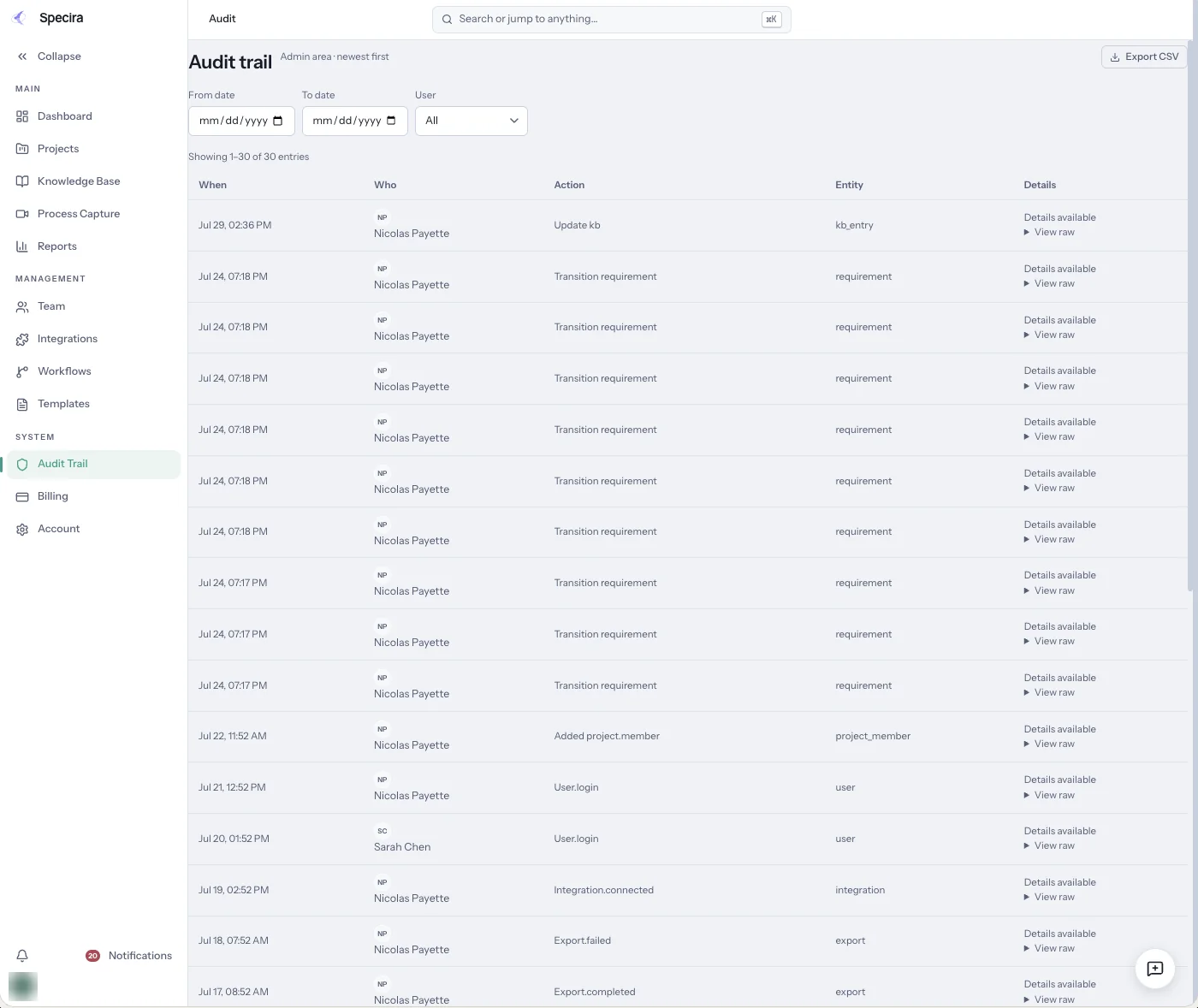
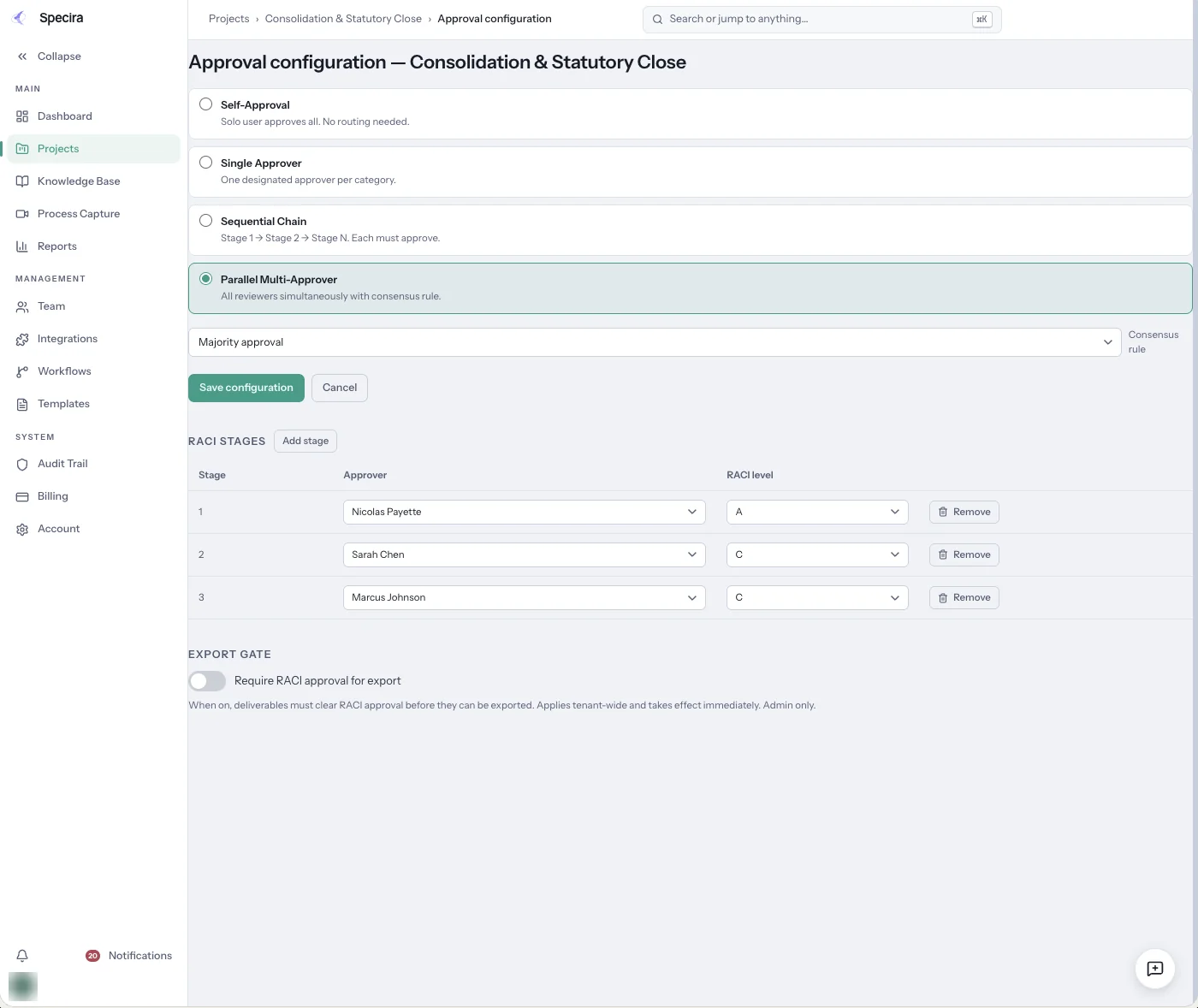
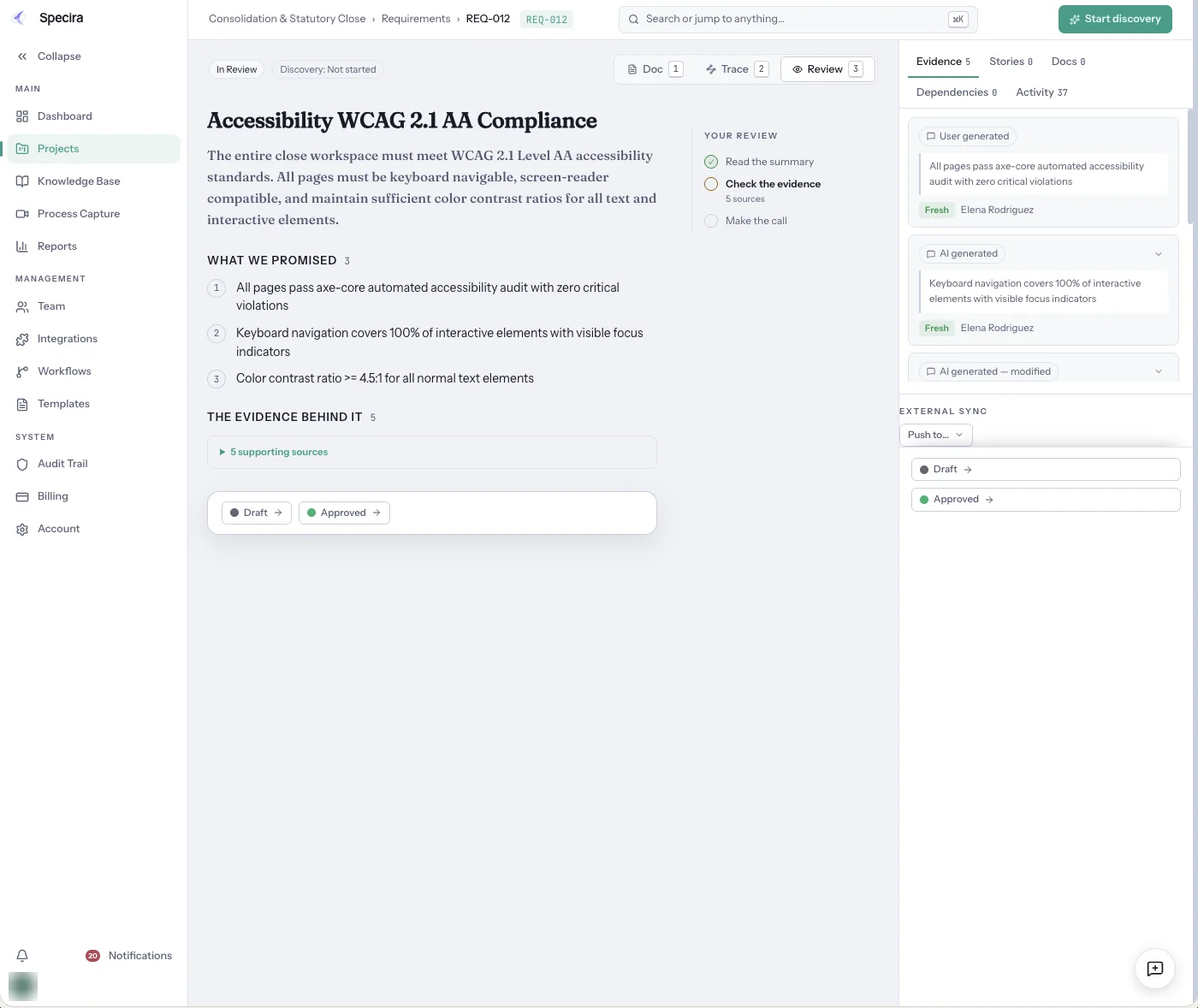
What you are looking at. The audit trail is the record an auditor reads, the approval configuration is the rule that produced it, and the requirement detail shows which evidence came from a person and which came from a model.
Tell us the question your next audit will open with. We will show you where the answer already lives in a Specira project.
Book a DemoScreens are from a seeded Specira demo workspace; counts and scores are sample data.
What are the most common questions about AI governance?