
What is the requirements error cost multiplier?
$14,500. That's the number a VP of Engineering wrote on a whiteboard during a postmortem I sat in last year, the fully loaded cost to fix a single requirements error that had sailed through code review, passed QA, shipped to production, and then blew up on a Tuesday afternoon for about 200 customers. Four lines of code. That was the fix. The original mistake was a single ambiguous sentence in a product brief that nobody questioned back in January. If someone had flagged it during planning, the cost would have been maybe $500. Instead, the team burned 29 times that amount.
Not a metaphor. That 29:1 ratio comes from NASA's error cost escalation study, published through the Johnson Space Center, which tracked defect costs across space mission software where the stakes are, you know, somewhat higher than your average SaaS product. Consistent pattern: roughly $6.50 during implementation, $15 during testing, and $29 or more in production. NIST's Planning Report 02-3 backed this up in 2002, calculating that inadequate software testing infrastructure alone costs the U.S. economy $59.5B annually. I thought that number was inflated. It wasn't.
It metastasizes. That's what most people miss about that multiplier. A requirements error doesn't sit politely in one place waiting to be found. Developers write code around the wrong assumption, confidently, because nobody told them otherwise. QA designs tests that validate the wrong behavior. The integration team wires to the wrong interface. Technical writers document a workflow that never should have existed. Three sprints. I've watched teams spend three full sprints unwinding a single misunderstood sentence from a requirements doc, and by the time somebody in production says "wait, this isn't what we asked for," you're not fixing one mistake but surgically removing a tumor that grew tendrils into every layer of the system.
| Phase | Cost Multiplier | Example (per defect) | Why It Escalates |
|---|---|---|---|
| Requirements | 1x | ~$500 | Change a sentence in a spec document |
| Design | 3x | ~$1,500 | Rework architecture diagrams and data models |
| Implementation | 6.5x | ~$3,250 | Rewrite code, update unit tests, re-review |
| Testing | 15x | ~$7,500 | Recode, re-test, regression test, re-deploy to staging |
| Production | 29x | ~$14,500 | Hotfix, re-test, emergency deploy, customer communication, data cleanup |
Which software defects are the most expensive to miss?
Brutal escalation. Understood. But the follow-up that matters is not where the most defects come from; it is which ones cost the most. I used to assume the priciest bugs were the gnarly coding ones, the race conditions and the memory leaks. Most engineering leaders assume the same thing. We were wrong.
Start with the counterintuitive part. Most defects are not born in requirements. NIST's contractors surveyed software teams and found only about 15 to 30 percent of defects originate there, depending on the industry. The rest show up later, in coding and testing. So why fixate on requirements? Because where a defect is born is not the same as what it costs. A requirements defect sits quiet through design, code, and integration. Each phase builds faithfully on the wrong assumption. Then it surfaces in production wearing a disguise. Few in number. Ruinous to fix late.
Now look at where most QA budgets go. Code reviews. Static analysis. Integration tests. End-to-end suites that take 45 minutes to run. Valuable? Yes. But every one sits downstream of where the costliest defects were set. It is like inspecting each floor for smoke while ignoring the blueprint that put the furnace against the gas line. You notice the smoke eventually. By then the structure is compromised.
On my own projects, when I finally measured it instead of guessing, rework ran to 43% of the effort. Most of it traced back to one root cause: features built correctly according to what someone wrote down, but incorrectly according to what the business actually needed. The spec was followed perfectly. The spec was just wrong.
The dominant reason for software project failure is not technical complexity. It is ambiguity in requirements that compounds silently through every downstream phase.
Adapted from Barry Boehm, "Software Engineering Economics," Prentice Hall
How much does your team spend on avoidable rework?
Blank stare. That's what you get when you ask a team lead how much they spend on rework. Nobody tracks it. A sprint that was supposed to deliver four features delivers two, plus patches for two things from the previous sprint that came back from stakeholder review with "that's not what I meant." Everyone shrugs. Normal velocity. I did this for years before I realized what I was looking at: the 29x rule operating invisibly inside every standup, every retro, every awkward conversation about why we missed the deadline again.
Want a quick gut check on your own exposure? Pull up your team's total annual cost (salaries, tools, cloud infrastructure, the works) and multiply by whatever percentage of effort you honestly think goes to rework. Be honest with yourself. That number is your rework cost, and I promise it's larger than you expect.
When Microsoft Research studied how developers spend their time, they found that only 32% of developer time goes to actual coding. The rest is consumed by understanding requirements, navigating ambiguity, attending alignment meetings, and fixing misunderstandings. This is not a productivity problem. It is a clarity problem.
Microsoft's internal study, led by researchers including Thomas Zimmermann, tracked over 2,000 developers and found that unclear requirements were the single largest source of wasted developer time. Teams that invested in structured requirements processes reported spending significantly less time on rework cycles.
Source: Microsoft Research: Exploding Software Engineering Myths
Real scenario. Ten engineers, $150K fully loaded per person, 40% rework rate. $600K a year, gone, rebuilding things that should've been right the first time. I've seen this exact profile at three different companies in the past eighteen months, and none of them believed the number until we actually calculated it together on a Thursday afternoon. Scale to 50 people and you're hemorrhaging $3 million. Not outlier teams. Industry baseline. Your team is probably in this range right now.
Disguises. That's why nobody notices. Rework shows up as "scope changes" in sprint planning, "tech debt" during backlog grooming, "bugs" in the QA tracker, "clarification needed" in a Slack thread at 4:47 PM on a Thursday. Each label sounds reasonable on its own. Trace them back and they converge on the same root: requirements that were incomplete, ambiguous, or (my personal favorite) never actually validated with the people who have to live with the result.
What does "shift left" really mean beyond testing?
Every DevOps pitch deck since 2018. You've heard "shift left" in all of them. The original idea was solid: move tests earlier in the pipeline, catch defects before they reach production. It worked. Organizations that adopted shift-left testing reported 50% to 80% reductions in defect costs. Genuine win. I'd never argue otherwise.
But the conversation stalled. Shift-left testing catches defects that already exist. Faster, sure. But it doesn't prevent them from being introduced in the first place, and I think the industry stopped there because testing felt like enough, because it was measurable, because nobody wanted to touch the messy human process upstream. The logical next step is to shift quality investment all the way left to requirements, where the costliest defects are set even when they are not the most numerous.
I can hear the objection already. "Great, so you want us to go back to waterfall and write 200-page requirements documents?" No. Absolutely not. Shift-left requirements means validating clarity, completeness, and consistency before coding starts, but doing it in hours, not months. Half a day. I've run these sessions in as little as half a day for a mid-sized feature, focused sessions where you surface the ambiguity, resolve the conflicts, and write down decisions in a format your engineers can actually build from without guessing. One team I worked with in Montreal called them "confusion killers." Perfect name.
Different economics. That's why the distinction between shift-left testing and shift-left requirements matters. Testing earlier reduces the average defect cost by catching problems at a cheaper phase, which is helpful but limited. Shift-left requirements eliminates the defect before it ever enters the system. One approach lowers the multiplier from 29x to maybe 6x. The other removes the defect entirely. If you had to pick one investment (and yes, ideally you do both), the math overwhelmingly favors prevention over early detection.
How do you calculate the ROI of structured requirements?
Fine. Requirements matter. But how do you put a dollar figure on improving them so your CFO doesn't laugh you out of the room? Fair question, and one I've had to answer in maybe fifteen executive presentations over the past three years, so here's the formula, which is simpler than you'd expect:
Annual ROI = (Current Rework Cost x Reduction Percentage) minus Requirements Investment Cost
Last fall. Real client. Twenty engineers, $150K fully loaded per person, rework rate sitting at roughly 40% (they were skeptical until they actually measured it, which took about a week of honest Jira archaeology). That's $1.2M in annual rework cost. Structured requirements, based on published research, typically cut rework by 40% on the conservative end. $480K in savings. Subtract maybe $50K to implement and maintain the process. Net: $430K in year one. The client's exact words: "Why didn't we do this three years ago?"
Scale changes everything. A 100-person engineering org? $2.4 million in annual savings, give or take. I worked with an enterprise client, north of 500 engineers across four continents, where requirements deficiencies were quietly burning through more than $10M a year. Nobody had ever added it up. The cost was spread across hundreds of Jira tickets labeled "bug" or "change request," and once we aggregated the total in a spreadsheet the room went silent for about ten seconds. That's a lot of money to spend on confusion.
Compounding. That's the part that doesn't show up in year-one ROI but matters enormously by year two and three. Teams that invest in structured requirements start building institutional knowledge about their domain, and the validated patterns from Project A accelerate Project B, and the edge cases you documented in Q1 prevent three misunderstandings in Q3. Requirements intelligence becomes a depreciating asset that actually appreciates. Opposite of how most software investments work, if you think about it.
Why the 29x multiplier changes how you budget for requirements quality
Every dollar you invest in requirements clarity saves $29 in production costs. That's not a motivational poster quote; it's a cost pattern documented by NASA, validated by NIST, and confirmed across decades of software projects. The ratio held in the 1980s. It holds now.
The opportunity here isn't incremental optimization. It's structural. If your team is like most (and I've yet to meet one that isn't), 30% to 50% of your engineering effort goes to rework that traces back to requirements ambiguity. You're not dealing with a testing problem or a coding problem. You're dealing with a clarity problem wearing a dozen different labels.
Start by measuring your rework rate. Actually measure it; don't guess. Then invest accordingly. The 29x multiplier is unforgiving in one direction and incredibly generous in the other: even modest improvements in requirements quality produce outsized returns.
Does the 29x rule still hold in the age of AI-generated code?
Yes. If anything, it holds harder. The multiplier was always about how far a bad requirement travels before anyone catches it, and AI-generated code lets it travel much, much farther. A coding agent will happily turn a one-line prompt into three hundred lines that quietly encode the wrong assumption, and it will do it before your coffee goes cold. The defect does not shrink. It gets buried: more code stacked on top of it, more tests written against the wrong behavior, more integrations wired to an interface that was never right to begin with. By the time the gap surfaces in production, you are not fixing a line. You are unpicking a week of confident output.
This is the exact failure mode I pulled apart in why software keeps failing the same way it did in 1995: the patterns that sink projects were never about typing speed, so generating code faster just reaches them sooner. It is the same blind spot behind the hidden cost your AI coding stack ignores. Faster generation. Same ambiguity. The multiplier compounds because every accelerated stage now rests on a requirement nobody validated. Speed moved. The 29x did not.
Where in a Specira project does a requirement defect actually get caught?
Upstream, or expensively. The AI Project Planner catches the first kind before a question has been asked, by reading the charter and naming the sections that have nothing in them yet. The second gets caught inside the requirement, where acceptance criteria and supporting sources sit beside the text. The export gate catches the third, holding the whole deliverable package shut while a single approval is still open, which is a cheaper argument to have than a production incident.
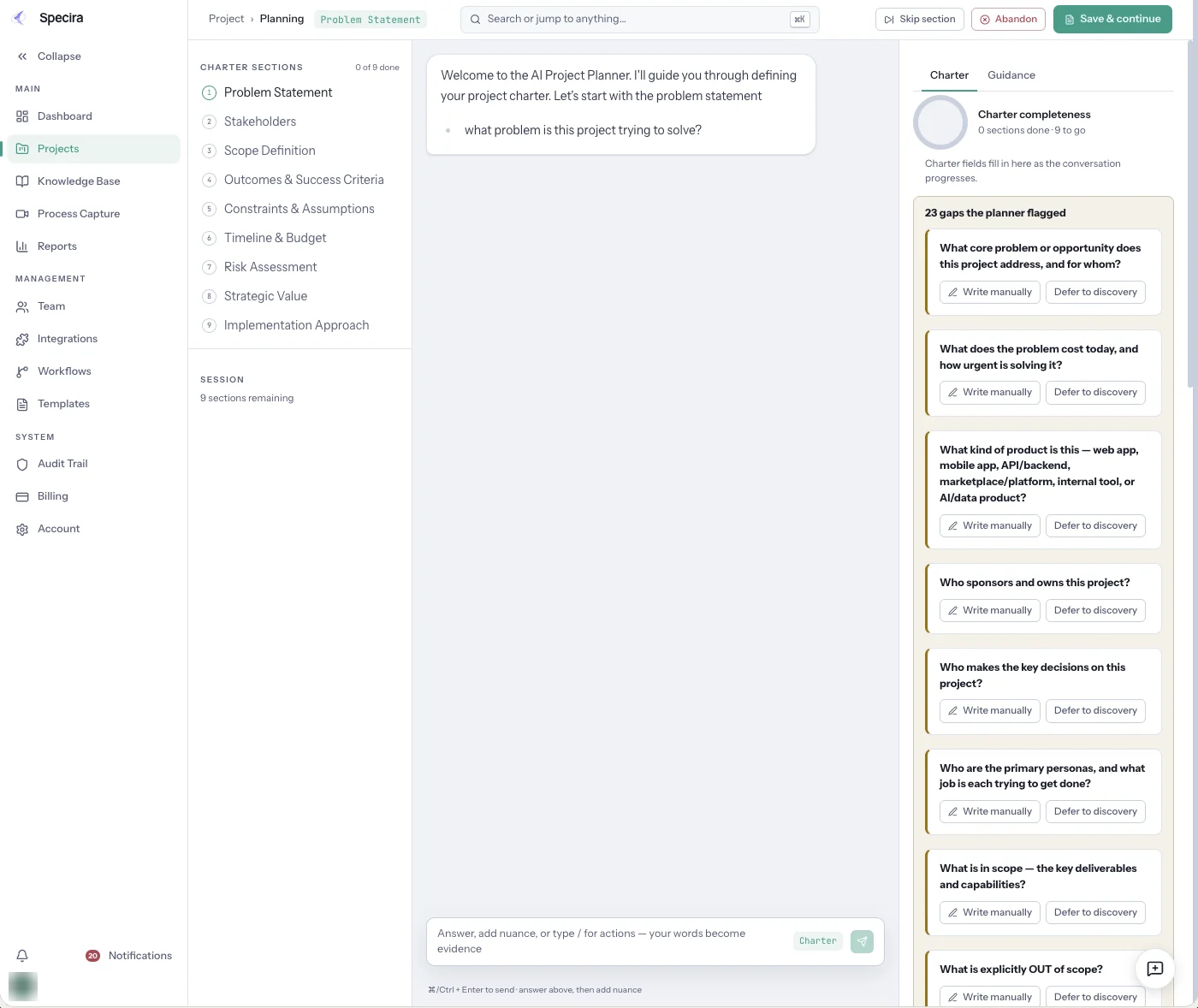
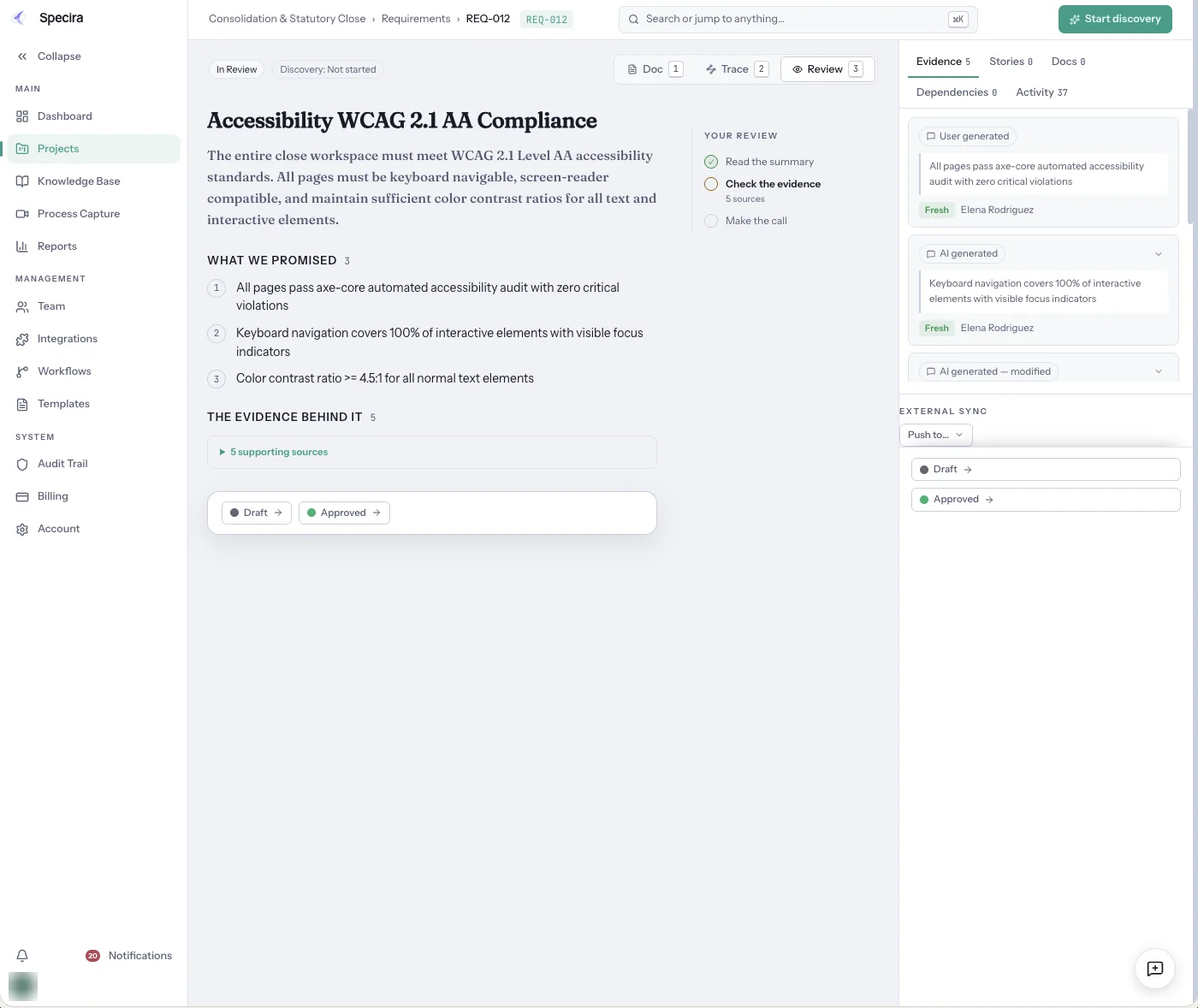
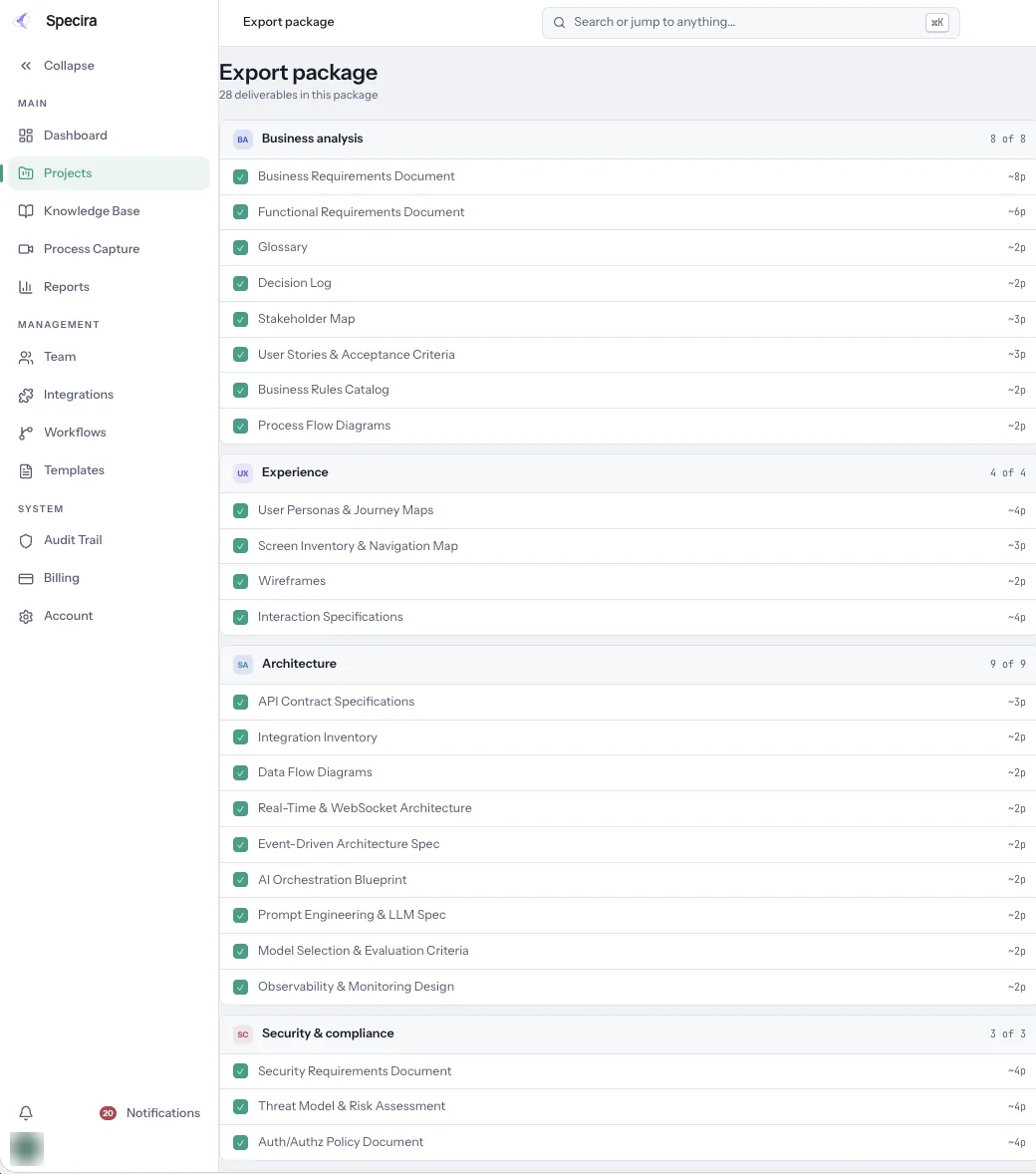
What you are looking at. The planner names the charter sections with nothing in them, the requirement detail carries the acceptance criteria and evidence that make a promise testable, and the export package is the gate that will not open early.
Send us the requirement behind your last hotfix. We will show you which of the three gates would have stopped it.
Book a DemoScreens are from a seeded Specira demo workspace; counts and scores are sample data.
Frequently Asked Questions