
Picture this: you're sitting in a sprint retrospective, and someone asks, "Why did that feature take twelve weeks?" The room goes quiet. People mumble about dependencies, shifting priorities, a vendor API that didn't behave. All true, probably. But here's what nobody says: the requirements were a mess before a single line of code got written. I've watched this scene play out dozens of times across different companies, different industries, different decades. The real culprit isn't planning or skill. It's waste so deeply embedded in how teams work that it feels normal. Teams accept 3-month timelines for 6-week work because they've literally never experienced anything else. That's why the biggest breakthrough in software won't come from code.
I call this the Invisible Problem. And honestly, I spent years contributing to it before I understood what I was looking at. You can't fix what you can't see.
What is the "Invisible Problem" in software delivery?
Look, every software estimate you've ever seen has waste hiding inside it. Not a little. A lot. The Invisible Problem is the gap between what your team could ship with clear, validated requirements and what they actually ship when working from the vague, assumption-heavy specs that pass for "ready" in most organizations. I thought this was just a process maturity issue when I first started noticing it. Turns out it's more structural than that.
Let me walk you through a Tuesday afternoon I've witnessed at least forty times. A product owner writes a requirement (usually in a hurry, between two meetings). The dev team reads it, fills in the blanks with their own assumptions, and builds something. Two weeks later, the stakeholder watches the demo, tilts their head, and says: "That's not quite what I meant." So the team rebuilds. Here's the part that kills me: nobody logs this as a requirements failure. It gets filed under "refinement" or "iteration" or just quietly absorbed into next sprint's velocity. The waste is real, sometimes enormous, but it has no name, no measurement, no accountability.
You can't optimize what you can't see. And most teams have never seen their requirements process clearly enough to know how much it costs them.
So why does the waste stay invisible? One word: baseline. There isn't one. I asked a VP of Engineering at a 400-person company last year what their rework rate was. He stared at me like I'd asked him the square root of his shoe size. Teams have always operated this way. They don't know what a healthy rework rate looks like because they've never tracked it. Nobody counts mid-sprint scope changes (I've asked; most teams can't even agree on what counts as one). The waste just gets normalized into velocity expectations, absorbed like background noise that nobody thinks to measure.
waiting, reworking, and clarifying requirements
How do you know if your team has a requirements problem?
Here's the thing about requirements problems: the teams that have them are usually the last to know. I was one of those people for years, blaming "technical debt" or "poor estimation" when the real issue was sitting upstream the whole time. The symptoms get misdiagnosed constantly. But I've found five diagnostic questions that cut through it. Be honest with yourself. If three or more of these land, you've got an invisible requirements problem on your hands.
- Is more than 20% of your sprint effort going to rework? Microsoft's 2024 "Time Warp" study found developers spend only 32% of their time writing new code. The rest goes to waiting, reworking, and clarifying. If your team can't answer this question with a specific number, that's the first problem.
- How often do stakeholders say "that's not what I meant" at sprint demos? If it happens more than once per sprint, you are building from misaligned assumptions. The code is correct; the specification is wrong.
- How many mid-sprint scope changes happen per sprint? Scope changes are not inherently bad, but untracked scope changes are invisible waste. If you don't count them, you can't manage them.
- Can any team member explain the business rationale behind the sprint's top three items? If developers are building features without understanding the "why," they are making hundreds of small design decisions without context. Each one is a potential misalignment.
- When was the last time a shipped feature was retired because nobody used it? If the answer is "never," you are not measuring feature adoption. And if you are not measuring it, you have no idea how much of your effort is producing value.
Spotify discovered that new engineers took over 60 days to merge their 10th pull request. The problem was not technical skill. It was invisible friction: unclear onboarding processes, fragmented documentation, and a lack of standardized tooling that forced developers to spend their time navigating the system instead of building.
After deploying Backstage, their internal developer portal that centralized documentation, service ownership, and project standards, that 60-day benchmark dropped to 20 days. A 67% reduction. Engineers using the platform were 2.3 times more active on GitHub than those who were not.
The takeaway: the waste was invisible because everyone accepted it as "how onboarding works here." Once Spotify made the friction visible and standardized the path, the speed gains followed immediately.
Sources: InfoQ, Backstage at Spotify, Spotify Engineering Blog
Why don't companies realize how much rework costs them?
I used to think companies just didn't care about rework costs. I was wrong. They genuinely don't see them. Most organizations track velocity, bugs, deployment frequency. They've got dashboards for everything that happens after code gets written. But where rework originates? That data point is missing from every single tool I've evaluated in 25 years. And the blind spot it creates is staggering.
primarily due to misaligned requirements
Three structural reasons keep this blind spot alive, and they're worth understanding because they're self-reinforcing. The first one tripped me up for years: waste gets categorized under the wrong labels. A misunderstood requirement becomes a "bug." A feature that needs complete rebuilding becomes "technical debt." A project that takes twice as long as estimated gets labeled "scope creep." I once sat in a postmortem where the team identified fourteen root causes for a missed deadline. Not one mentioned requirements. Every single label deflected accountability from the actual origin: the specs weren't clear, complete, or validated before anyone started coding.
Second (and this is the sneaky one), rework gets normalized into velocity expectations. When a team consistently delivers at, say, 42 story points per sprint, that number already includes rework overhead. It's baked in. Nobody asks whether velocity could be 40% higher without it, because nobody's ever seen delivery without it. You know what happens when teams layer AI coding tools on top of this broken foundation? They accelerate the rework, not the value. We explore that pattern in The Copilot Hangover.
And the third reason? It still frustrates me. There's no industry standard for requirements quality. Think about that. Teams measure code quality with static analysis tools. Test coverage with automated suites. Deployment frequency with platform metrics. But requirements quality, the thing that determines whether you're building the right product in the first place? No equivalent measurement ecosystem exists. None. Until one does, the problem stays invisible.
What does a requirements maturity assessment look like?
When I started doing requirements maturity assessments for clients about eight years ago, I expected most teams to land at Level 3 (Standardized). I thought the bare minimum, templates, reviews, clear ownership, would be table stakes. I was way off. The vast majority sit at Level 1 or Level 2. The assessment itself is a five-level scale, and the value isn't in the framework; it's in what it makes visible. Once a team sees where they actually sit, they stop guessing at improvements and start targeting them.
| Level | Description | What it looks like |
|---|---|---|
| Level 1 | Ad Hoc | Requirements live in people's heads, Slack threads, or scattered documents. No consistent format. No review process. Success depends on individual memory and tribal knowledge. |
| Level 2 | Documented | Requirements get written down, but quality varies wildly. Some are detailed, some are one-liners. No standardized template. Reviews happen inconsistently. |
| Level 3 | Standardized | Consistent templates, structured review processes, and clear ownership. Every requirement follows a defined format and passes through a validation step before development begins. |
| Level 4 | Measured | Quality metrics are tracked: completeness scores, change request rates, defect origin analysis. The team has data on where waste originates and uses it to improve continuously. |
| Level 5 | Optimized | Requirements quality is continuously improved using data-driven insights. AI-assisted validation catches gaps before they reach development. The team measures the cost of every requirement change and optimizes proactively. |
I mentioned most teams land at Level 1 or 2. They know requirements matter (everyone nods when you bring it up in a meeting), but they lack the structure and measurement to do anything about it systematically. Here's what surprised me, though, and it's genuinely good news: the jump from Level 2 to Level 3 alone typically cuts rework by somewhere around 25 to 35 percent. Not 5%. Not 10%. A quarter to a third of the wasted effort, gone. Why? Because Level 3 introduces the single most impactful change you can make: structured validation before anyone writes a line of code.
How can you start measuring requirements quality today?
You don't need to run a full maturity assessment to start making progress. Honestly, you can begin this sprint. Three metrics will give you the visibility you're missing, and none of them require buying new tools or hiring a consultant. They're observations you can make with Jira, Azure DevOps, or whatever you're already using. (For more on how Specira approaches this systematically, see our frequently asked questions.)
Metric 1: Completeness Score. Before each sprint, have your team rate every committed requirement on three dimensions. Clarity: can every team member interpret it the same way? (You'd be amazed how often the answer is no.) Testability: can you write acceptance criteria without sending a Slack message to the product owner? And stakeholder alignment: has the business sponsor explicitly confirmed this is what they want, not what someone assumed they want? Score each dimension 1 to 5. Anything below 3 on any of the three? That requirement is a rework risk, and your team probably already knows it in their gut.
Metric 2: Mid-Sprint Change Requests. This one's deceptively simple. Count every scope change that happens after sprint commitment. Requirement clarifications that shift implementation direction, stakeholder feedback that changes expected outcomes, dependencies nobody knew about until Wednesday afternoon: all of it counts. Track the volume per sprint and (this is the part people skip) the effort each change actually consumes. Do this for three sprints. Just three. You'll have a painfully clear picture of how much capacity gets swallowed by requirements that weren't ready when the sprint started.
Metric 3: Post-Launch Defect Origin. For every production defect, tag the root cause. Was it a coding error, a design flaw, or a requirements gap? Most teams I've worked with assume their defects are primarily code-level issues. Start tagging root causes, though, and a very different picture shows up. I remember the first time I did this with a financial services team in Montreal: 61% of their production defects traced back to requirements, not code. Per NASA lifecycle cost studies, requirements errors caught late cost 3x to 78x more to fix than those caught early. That's not a typo. Seventy-eight times. The sooner you trace defects to their actual origin, the sooner you stop paying that multiplier.
The shift that changes everything
The Invisible Problem persists for one reason: teams measure output (features shipped, story points completed) instead of alignment (did we build the right thing, for the right reason, the first time?). I spent years making this exact mistake. Introduce even basic requirements quality metrics, and the waste becomes visible. Visible waste is waste you can actually do something about.
You don't need a perfect process. Nobody does. You need a baseline and the discipline to look at it honestly. Start measuring this sprint, compare the numbers in three months, and let the data make the argument for you. If you want to see how teams are compressing six weeks of requirements work into hours, the path forward is closer than you think.
How do you make an invisible requirements problem visible on a Monday morning?
Invisible means unbudgeted. Specira's answer is not a quarterly report; it is a dashboard that opens on what is waiting for a decision, which projects have stopped moving, and which requirements still carry a low quality score. Momentum loss shows up as a row, not as a feeling in a retro. The project overview ties each number back to the discovery session that produced it, so a quality score is something you click into rather than something you argue about.
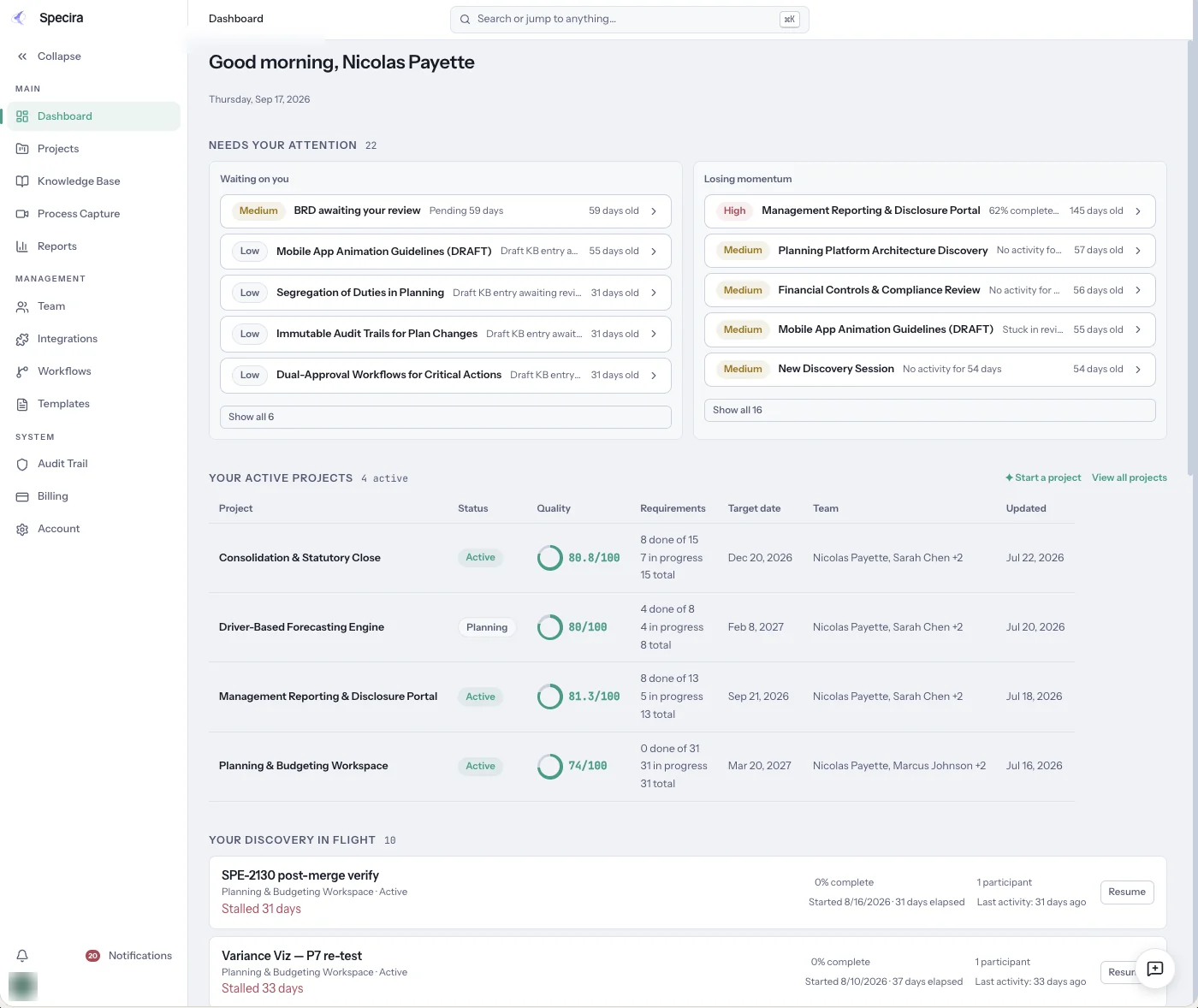
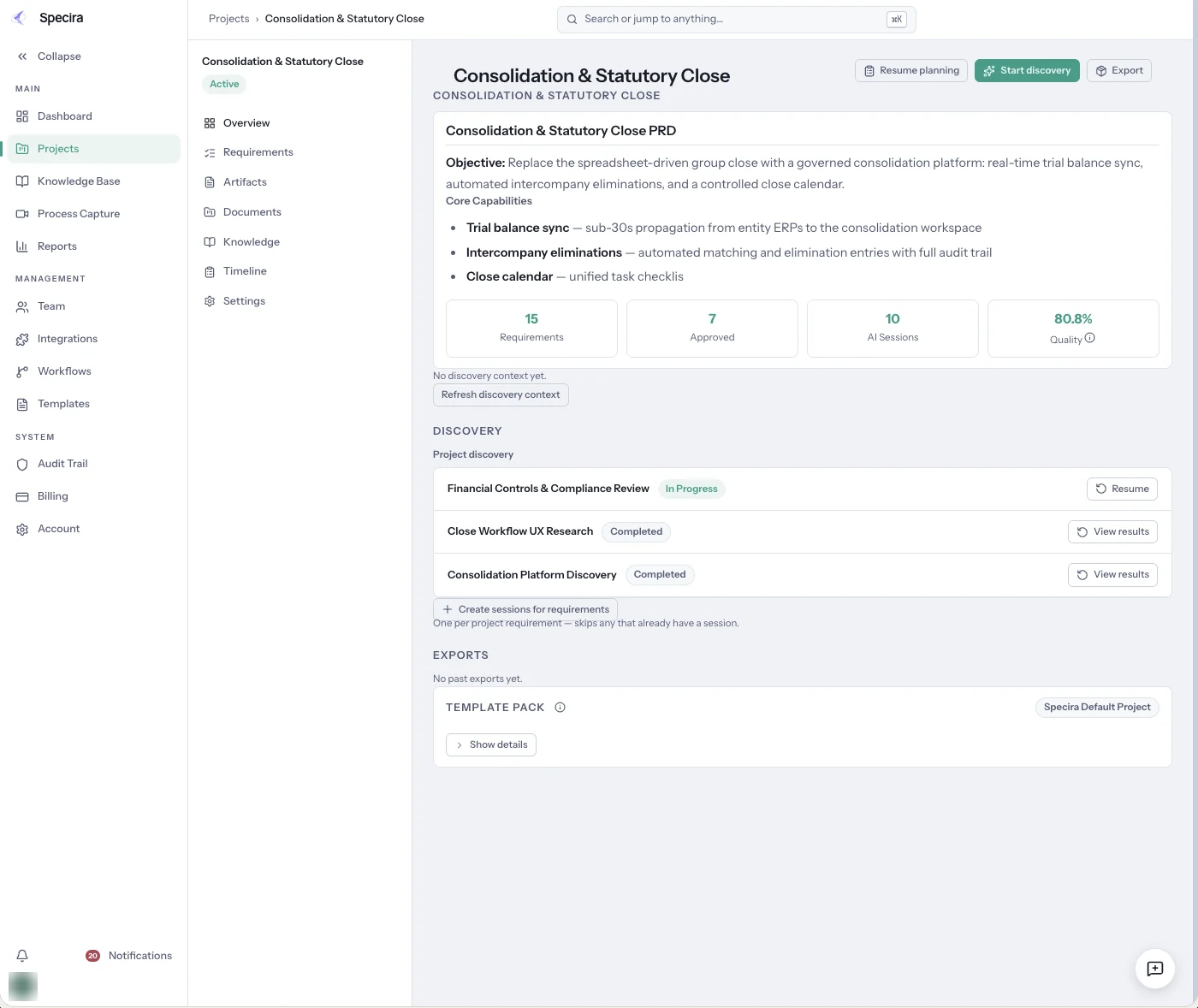
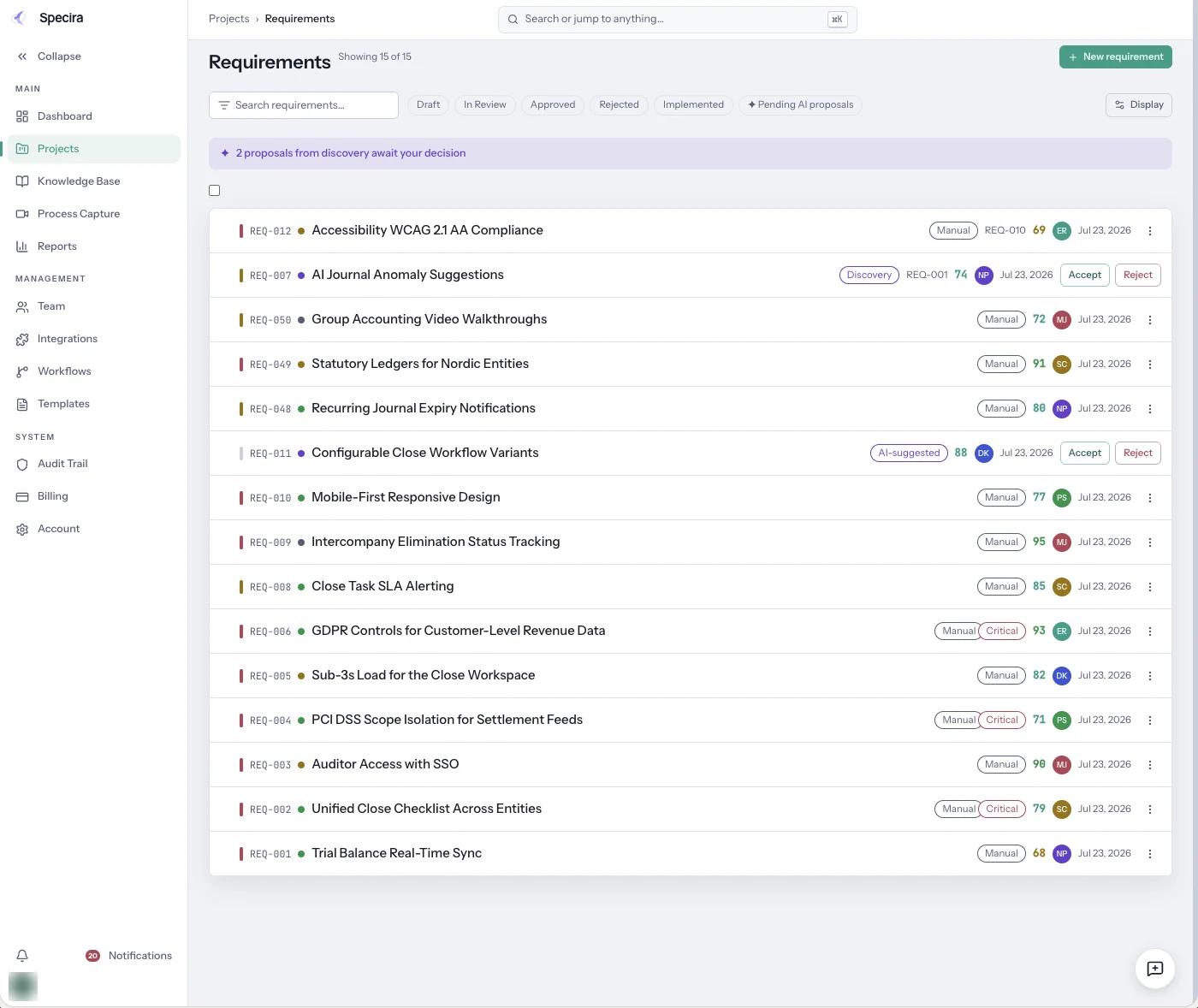
What you are looking at. The dashboard flags what is waiting on you and what is losing momentum, the project overview shows where those numbers came from, and the requirements list shows the scores behind them.
Pick the project your team quietly calls the slow one. We will show you what a requirements maturity read on it actually looks like.
Book a DemoScreens are from a seeded Specira demo workspace; counts and scores are sample data.
Frequently asked questions