
Six weeks. That was the block on the Gantt chart, labeled "Requirements," that a team lead pointed to during a project kickoff last year. Six weeks before a single line of code, before a single design mockup, before anyone even agreed on what the product was supposed to do. The room nodded along like this was gravity. I sat there thinking: 25 years of doing this and nobody questions whether it has to take this long?
It doesn't. An on-demand, AI-guided process produces the same deliverables (often better ones, honestly) in hours or days, depending on your team's availability. I was skeptical. Speed meant cutting corners, I figured. Wrong. The bottleneck was never the complexity of the work but the fragmented process we wrapped around it: the scheduling, the email chains, the waiting for a VP who's in Singapore until Thursday.
Same lesson. Twenty-five years of digital projects taught it to me over and over, from a disastrous CRM migration in 2009 to a payment modernization last winter. The teams that move fastest aren't skipping planning. They've replaced the calendar-dependent planning ritual with something always available, something that adapts to how they actually work.
Why does requirements gathering still take six weeks?
You've lived this. Week one: stakeholder interviews. Three of the five people you need are available (the VP of operations is in Singapore, naturally), so you run partial sessions and plan follow-ups. Week two: email chains multiply. The product owner answers a question on Tuesday that directly contradicts something the technical lead said in a separate meeting the previous Thursday. Nobody catches it. Nobody is reading both threads.
Week three: new constraints surface that invalidate two assumptions from week one. More meetings. By week four, you're stitching together a requirements document from conversations that happened at different times, with different people, under different assumptions, and hoping the result is coherent because you're running out of calendar space. Week six? Not the finish line. Week six is when everyone signs off because they're exhausted by the process, not because they actually agree on the content. Forty projects. That's roughly how many times I've watched this play out.
with 40-50% of downstream effort lost to rework from misalignment
Not the requirements. The process. Traditional gathering introduces drift between conversations because stakeholders genuinely change their minds between sessions (that's human, not malicious), context evaporates in email threads because nobody scrolls back 47 messages to check what Sarah said two weeks ago, and assumptions quietly harden into requirements without anyone challenging them. More time meant more thoroughness. That's what I got wrong for years. It doesn't. More time makes the drift worse.
The 6-week trap. A process that feels thorough but actually degrades quality the longer it runs. Every day between the first stakeholder interview and the final sign-off is a day where misalignment grows undetected. We explored this hidden waste in depth when looking at the invisible problem costing your projects millions.
How does on-demand requirements gathering adapt to your team's pace?
No more calendar Tetris. Instead of coordinating five people's schedules across six weeks (good luck getting the CTO and the compliance lead in the same room before Q3), each stakeholder gets access to an intelligent process they engage on their own schedule. Product manager answers the Business Analyst agent's questions during Tuesday morning coffee. Technical lead works through the Solutions Architect agent's dependency mapping Wednesday afternoon while waiting for a build to finish. Security reviewer tackles compliance questions Thursday between other meetings. Nobody waits.
The traditional process isn't thorough. It's fragmented. An on-demand process doesn't sacrifice quality. It eliminates the scheduling gaps where misalignment grows.
One person, all the answers, deep domain knowledge? Hours. I've seen a solo product manager who understood the business need, user workflows, and technical landscape work through all four analyst perspectives in a single sitting, between lunch and 5 PM on a Wednesday. Multiple stakeholders with different expertise? The process adapts. Each person contributes at their own pace, and the platform maintains context across every conversation. That part surprised me. I expected context loss. Didn't happen.
Missed this for years. The speed of requirements isn't determined by how fast any single conversation happens. Your team's capacity to gather information and answer questions sets the pace. An always-available process removes the artificial bottleneck of calendar coordination, letting the actual work happen as fast as your team can sustain. Different bottleneck. "When can we meet?" becomes "when can you think about this?" Those are very different constraints.
Conflicts still surface. Immediately, though, instead of three weeks later. The AI agents cross-reference answers across all four analyst perspectives, and when the product owner says "we need real-time sync" and the technical lead later tells the Solutions Architect agent "our infrastructure can't support that at current scale," the platform flags the contradiction right then. Not in an email chain nobody reads. Not at the next meeting someone forgot to schedule. Right then.
In 2008, the BBC launched the Digital Media Initiative (DMI) to modernize its production and archiving systems. The project was contracted to Siemens, but by 2009, after falling 18 months behind schedule, the BBC terminated the contract and brought the work in-house. The core problem was not technology. It was requirements. As then-CTO John Linwood later stated, "the biggest single challenge facing the project was the changes to requirements requested by the business." Stakeholders across divisions kept changing what they wanted, and no structured process existed to surface conflicts, reconcile them, or maintain a single source of truth.
The BBC spent £125.9 million over five years. When the UK Parliament's Public Accounts Committee reviewed the outcome, they declared it "a complete failure." The only delivered output was an archive catalogue with 163 users that was slower and more expensive than the 40-year-old system it replaced. The lesson is clear: when requirements drift unchecked across stakeholders and timelines, even hundreds of millions cannot save a project. An always-available, structured process that cross-references every answer and surfaces contradictions in real time is not a nice-to-have. It is the difference between aligned delivery and expensive failure.
What do AI-guided requirements actually deliver?
Thin documentation. That's what I assumed "AI-generated requirements" meant when I first heard the phrase, the kind of placeholder text you get from a template library that says nothing specific about your actual system. Wrong. The opposite is true. An AI-guided process produces more actionable deliverables than weeks of traditional gathering, because those deliverables get generated during the conversation itself, not assembled after the fact from someone's meeting notes and a 200-message email thread.
Specifics. Here's what you actually walk away with.
User stories with acceptance criteria. Real ones. Not the vague placeholders we've all seen ("As a user, I want to manage orders," which tells a developer precisely nothing). Specific, testable stories reflecting validated decisions: "As a warehouse manager, I want to see real-time inventory levels for items below reorder threshold, so I can trigger purchase orders before stockouts occur." Day one. A developer can build from that on day one.
A dependency map. Which upstream systems feed into this project? Which downstream services depend on it? What breaks if one of those dependencies changes? Uncountable. That's how many projects I've been on where we discovered these dependencies during integration testing, which is exactly when you don't want surprises. The Solutions Architect agent is specifically designed to probe for technical dependencies that humans forget to ask about, and it surfaces them during planning instead.
A decision log with rationale and confidence scores. Subtle. Powerful. Every major decision gets documented: who agreed, what alternatives were considered, how confident the team is. Low-confidence decisions get flagged for follow-up rather than buried in assumptions. I wish I'd had this on a healthcare project back in 2017 where a key architectural choice was made in a hallway conversation that nobody wrote down.
A risk register. Not the compliance checkbox collecting dust in SharePoint. A working document capturing unresolved assumptions, known unknowns, and explicit trade-offs. When a stakeholder says "we're accepting this limitation because of budget constraints," that gets recorded with attribution. The Red Team Critic agent then evaluates whether the trade-off is actually sound or just convenient.
Challenged. Every deliverable goes through Specira's adversarial Red Team Critic agent before it reaches you, which means contradictions, gaps, untested assumptions, and risks the specialist agents might've accepted too readily all get scrutinized. And critically (this matters more than people realize), every AI output requires human review before export. The AI drafts. You decide.
Why structured requirements deliverables drive project success
The difference between traditional requirements documents and AI-guided deliverables isn't just speed. It's accountability. Every decision has an author. Every assumption has a confidence score. Every trade-off has a rationale. When something goes wrong downstream, you can trace it back to a specific decision and understand why it was made.
There's a compounding effect, too. Specira's knowledge base remembers your architecture, policies, and past decisions, so every new project starts with accumulated intelligence from previous ones. The platform doesn't just capture requirements; it gets sharper with every engagement.
How does faster software planning compound into competitive advantage?
Bigger picture. Most teams miss it, and I missed it too until I started doing the math on a whiteboard one afternoon in November. The value of faster requirements isn't about any single project. It's what accelerated planning enables across a whole portfolio over twelve months.
Six-week requirements process. Three, maybe four substantial ideas evaluated per year. That's the math. Planning itself becomes the bottleneck, not building. Teams wait in queue for "requirements capacity," a phrase that shouldn't exist but does at every company I've worked with. Market windows close while stakeholder interviews get rescheduled for the third time. Sound familiar? Nearly two decades. That's how long I lived this cycle before questioning the underlying assumption.
Different equation. Picture that process running at the speed of your team's capacity instead of your team's calendar. Straightforward project where one person has all the answers? Hours. Complex multi-stakeholder project? Days instead of weeks. The result: roughly a 10x increase in projects your organization can evaluate per year, a number that stunned me when I first calculated it because ideas that would've been deprioritized ("we don't have time to scope that") suddenly become viable. Innovation velocity increases not because developers code faster, but because decision-making finally scales at the same pace as AI-accelerated development. Without this alignment, teams experience what we call the Copilot hangover: faster code, same bottlenecks.
vs. catching it during the planning phase
Compounding. That's the part that keeps me up at night (in a good way). Every project starting with clear, validated requirements finishes faster, costs less, and frees capacity for the next one, and over a year the gap between teams with an always-available requirements process and teams still relying on calendar-dependent meetings becomes enormous. Not a 10% efficiency gain you can bury in a quarterly report. Structural competitive advantage, and it's why better requirements may be the single biggest breakthrough in software delivery.
What is the fastest framework to speed up requirements gathering?
No magic here. No secret methodology I'm going to charge you a consulting fee to learn. Just structure. After watching dozens of teams struggle with the same calendar trap, I distilled the on-demand approach into six steps. These work whether you're running a product launch, a legacy modernization where half the team retired last year, or a client engagement with a deadline that was already unrealistic when the contract was signed.
Before engaging the AI agents, answer one foundational question: What business outcome does this project need to achieve in 90 days? This answer becomes the filter for every requirement. Every agent conversation, every decision point, every deliverable gets measured against it.
Specira provides five specialist AI agents: Business Analyst, UX Researcher, Solutions Architect, Security and Compliance, and a Red Team Critic. The first four engage your stakeholders in parallel. The Red Team Critic then challenges every deliverable before it reaches you. Engage them when you're ready, not when a meeting is scheduled. A solo product manager with clear answers can work through all four analyst perspectives in a single sitting. A distributed team can engage each agent independently and reconvene when everyone has contributed. Learn more about how Specira's AI agents work in practice.
Each agent guides you through specific decision points: Who are the users? What are their workflows? What are the technical constraints? What are we explicitly not building? The process is decision-first, not draft-first. You answer questions and make choices, and the agents capture the rationale behind each one.
Before any output is finalized, Specira's adversarial Red Team Critic agent reviews every decision for gaps, contradictions, and untested assumptions. This is the validation layer that traditional processes skip entirely because it would require scheduling yet another round of reviews.
Every AI output requires human review before export. You receive user stories with acceptance criteria, dependency maps, decision logs with confidence scores, and risk registers. Nothing leaves the platform without your explicit approval. The AI drafts, you decide.
Specira's knowledge base, powered by Neo4j, remembers your architecture, policies, past decisions, and organizational context. Each project makes the next one faster and more precise. The platform gets smarter as your team uses it, grounding every recommendation in your specific environment.
Can multi-agent AI compress the requirements phase without skipping discovery?
Yes, but not the way most teams try it. Speed usually gets bought by deletion: fewer interviews, one workshop instead of four, a discovery phase quietly renamed "alignment session" and squeezed into ninety minutes on a Friday afternoon because the sprint starts Monday. That works. Right up until integration week, when the data retention constraint nobody thought to ask about forces a change that has to unwind decisions already made in three other places, which is the expensive end of the escalation curve Stecklein's NASA team measured and cited earlier on this page. It also feeds the rework share Capers Jones spent a career quantifying, cited further up.
Parallelism is the difference. Cutting discovery removes questions from the process; running discovery in parallel removes waiting from it, and on a Gantt chart those two decisions look nearly identical while producing opposite outcomes eight months later. Four specialists interviewing the same stakeholder in sequence need four calendar slots. Specira's four analyst agents, working their four disciplines at once, need one afternoon. Same questions, different queue. The Business Analyst agent chases workflow gaps, the UX Researcher agent walks the user journey, the Solutions Architect agent traces dependencies, and the Security and Compliance agent asks the retention question everyone forgets until the audit. Then the fifth agent, the Red Team Critic, attacks whatever the other four agreed on.
I used to think this was a scheduling trick. It isn't. Parallel discovery surfaces more, not less, because four disciplines interrogating the same answer set inside one window catch the gaps that a single sequential pass never circles back to. Depth survives. The calendar shrinks. Those are separable things, and collapsing them into one idea is why "fast requirements" still sounds like a contradiction to anyone who has cleaned up after a rushed discovery phase.
Which disciplines actually decompose, and why one general-purpose agent covering all of them underperforms a team of narrow ones, is the subject of a separate deep dive: what multi-agent AI for business analysis really means. Read that next.
What has to already exist for six weeks of requirements work to fit in an afternoon?
Questions first. Specira's planner reads the project charter and produces the gap list before the calendar invite goes out, so the session opens on the open questions instead of on introductions. Discovery then runs against that list, with five agents covering business analysis, experience, architecture, security and adversarial review at once rather than in sequence. What comes out is an export package grouped by the agent that owns each deliverable, plus a project overview that ties every requirement back to the session where somebody actually decided it.
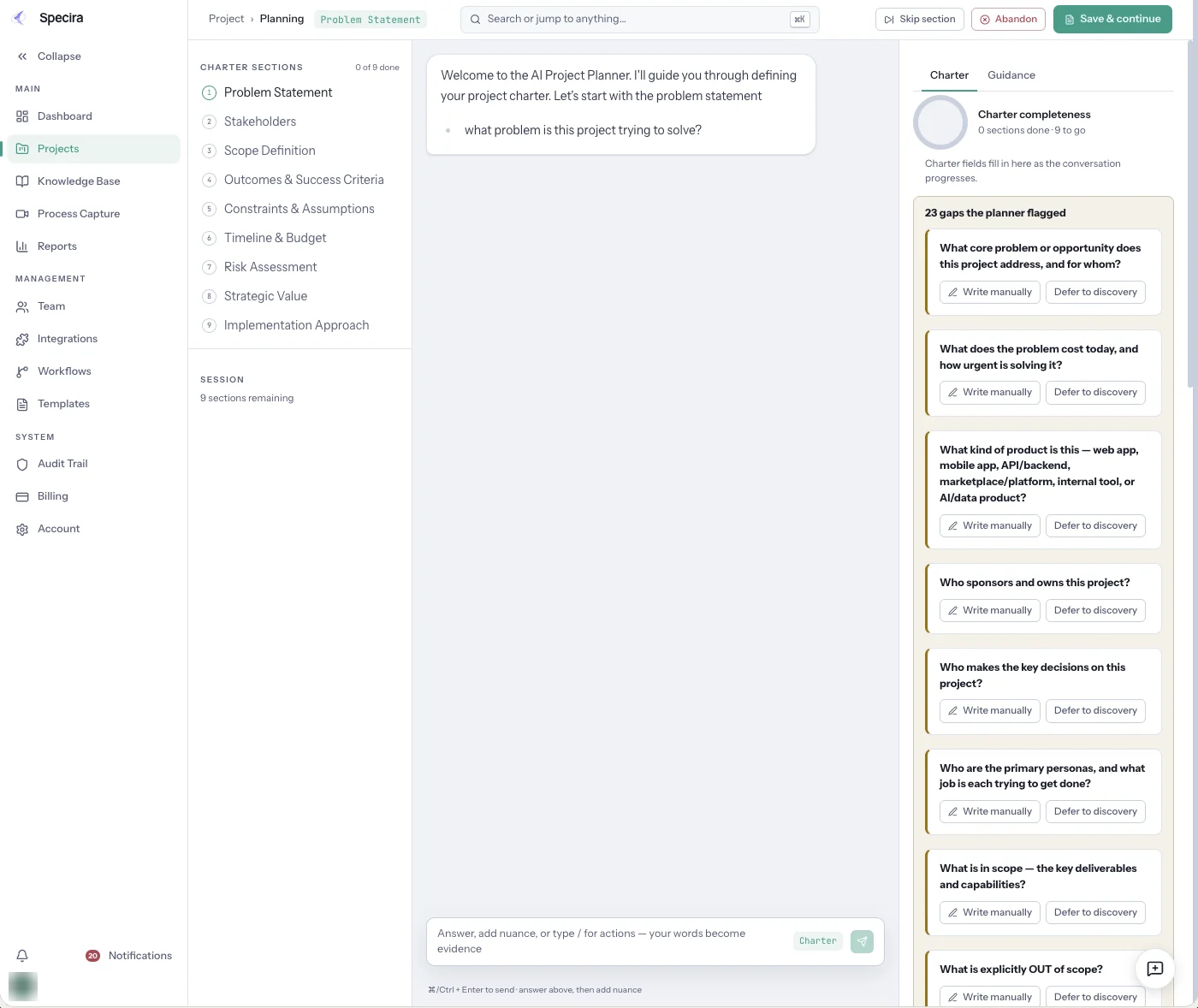
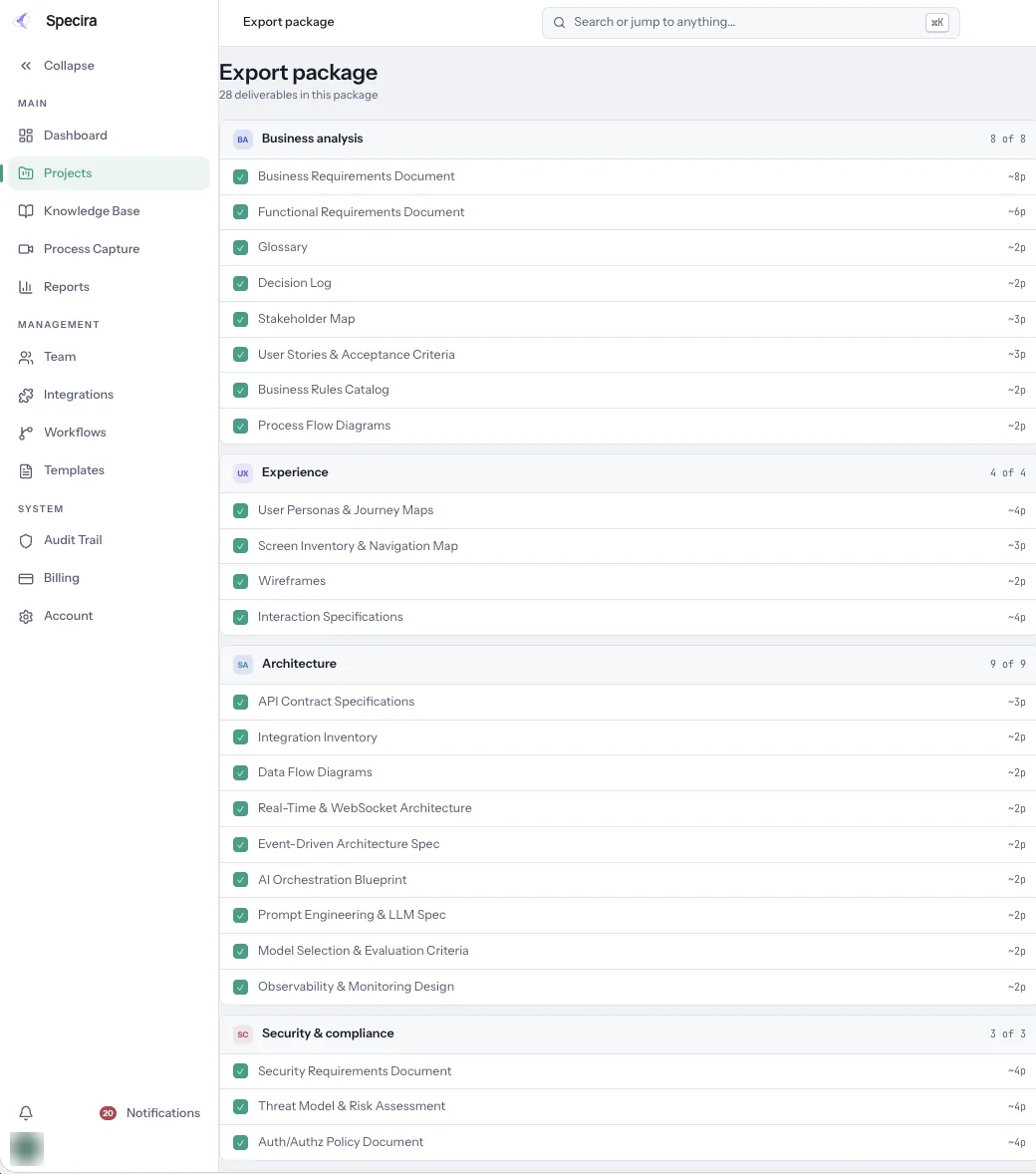
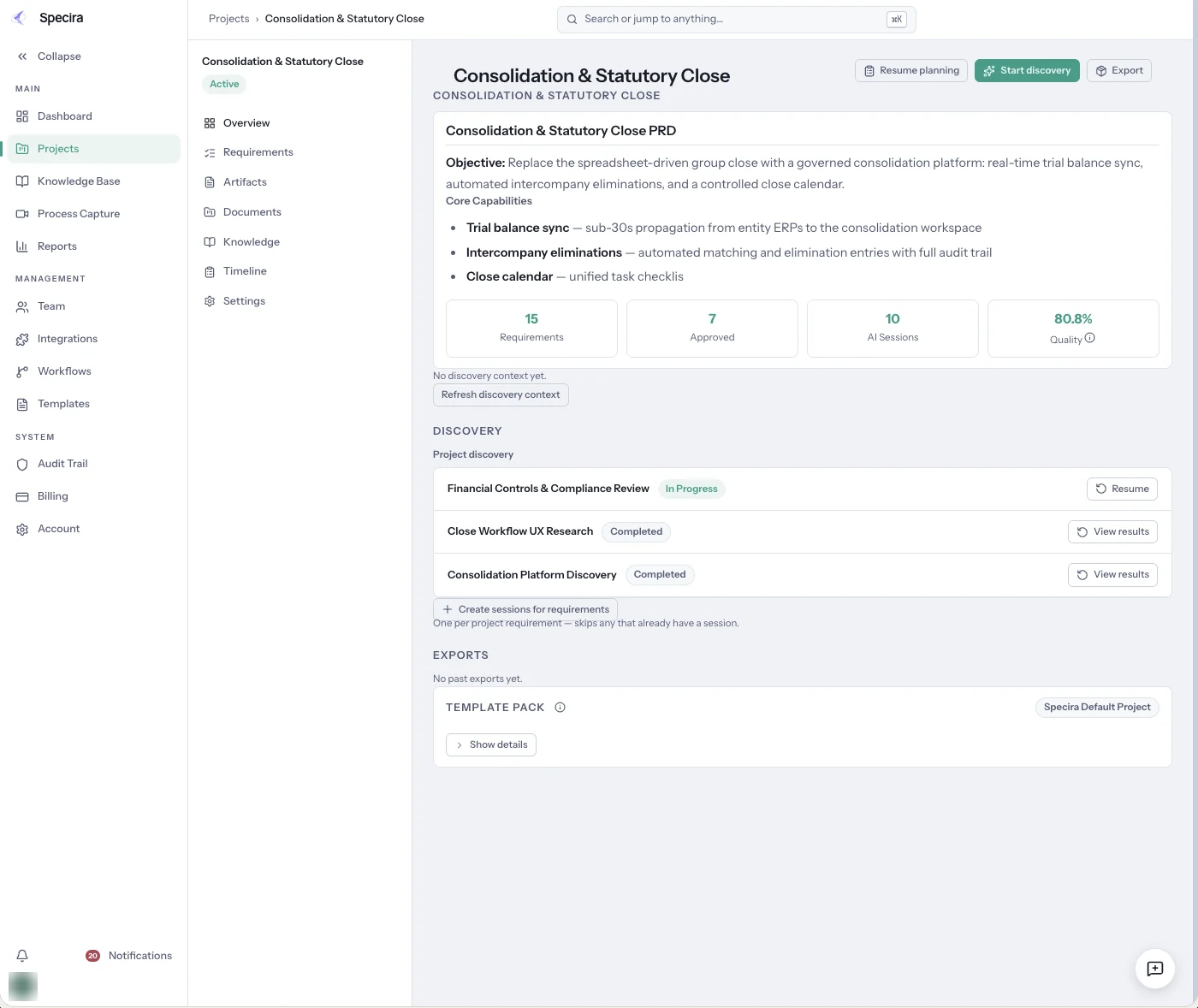
What you are looking at. The planner's gap list is what the session runs against, the export package is what the session produces, and the project overview is where the two are tied together.
Give us a charter you were about to spend six weeks on. We will show you what the first hour would surface.
Book a DemoScreens are from a seeded Specira demo workspace; counts and scores are sample data.
What are the most common questions about compressing requirements?