Why do insurance post-M&A integrations fail to deliver projected acquisition returns?
The P&C insurance industry has been on a consolidation tear for the past several years, and every major acquisition brings the same brutal integration challenge. Picture this: a large carrier just closed a multi-billion-dollar deal to acquire a regional specialty insurer. The champagne is barely flat and the integration team already has a problem. They need to merge disparate broker platforms (Guidewire on one side, Duck Creek on the other), multiple pricing engines with decades of patched actuarial logic, two completely separate claims systems, and policy administration tools that were customized differently over the past 15 years. The acquiring company's CTO is staring at a requirements problem of staggering scale: extracting undocumented pricing logic from veteran underwriters who've been hand-tuning rate tables since the 1990s, reconciling it with the acquired company's approach, and mapping everything to a modern cloud architecture.
The requirements-gathering process alone can consume six to eight months of painstaking cross-referencing. Subject matter experts from both organizations sit in conference rooms (or, more realistically, on endless Zoom calls) trying to reconcile competing business logic. "Our system applies an 8% flood surcharge." "Ours does 12% if there have been three claims in five years." Which is right? Both are, in their respective contexts. Meanwhile, regulatory teams work in parallel trying to ensure the merged platform complies with state insurance commissions in 30+ states, federal oversight requirements, and cybersecurity mandates that differ by jurisdiction.
And then come the late-stage defects during User Acceptance Testing. A rating engine fails on a specific regulatory mandate that nobody noticed buried in fine-print compliance rules for the state of Connecticut. A legacy product endorsement from the acquired company can't map to the new database schema because the data types are incompatible. Claims settlement logic from one system produces a $14,200 payment while the other calculates $13,800 for the same claim, and determining which number is correct requires two weeks of actuarial review. If you've been through one of these integrations, this probably sounds painfully familiar.
Every one of these integration failures traces back to the same root cause, and it took us years of watching these projects to see it clearly: requirements are fragmented across teams, documented in different formats by different people (Word documents here, Confluence pages there, actuarial spreadsheets in a shared drive nobody can find), and no mechanism exists to ensure all perspectives are captured before development begins. Acquisition value targets slip by years. Deal synergies evaporate. Integration budgets expand to 150% or more of what the board approved.
How do insurers currently approach post-M&A platform consolidation?
Most insurers follow a traditional, document-heavy approach that's been the default playbook since, well, forever. And predictably, it creates the same coordination problems and late-stage discoveries every single time.
Approach 1: Manual actuarial rule extraction and documentation
Veteran underwriters from both organizations sit across from Business Analysts and spend weeks dictating decades of patched business rules, pricing logic, and product endorsements. It's painstaking, sometimes awkward work. An underwriter named Dave explains a rule he's had memorized since 2003: "for commercial auto policies in flood-prone zip codes, apply an 8% surcharge if loss history shows water damage claims, or 12% if the customer has had more than 3 flood events in the past 5 years." A Business Analyst writes this down in plain English. Meanwhile, across town, a different team is documenting the equivalent rules from the acquired company's legacy system. Their underwriter, Maria, describes a similar but subtly different calculation. Do these two rules describe the same thing? Are the triggers identical or just close enough to be confusing? When you merge them into a unified platform, whose logic wins? Nobody knows until you schedule a three-hour meeting where Dave and Maria try to reconcile the differences. That meeting often raises more questions than it answers.
Approach 2: Separate IT workstreams for claims, policy admin, and broker portals that integrate late
To divide the work and speed delivery, many insurers create separate IT teams for claims modernization, policy administration, and broker portal redesign. Each team has its own requirements, architecture, and delivery timeline. The assumption? These workstreams will converge cleanly at the end. In practice, integration happens months into development, and teams discover incompatible data models, API contract mismatches, and conflicting assumptions about how data flows between systems. Rework spirals across all three workstreams.
Approach 3: Phased migration with complex Transition Service Agreements
Some insurers try to minimize risk by running both legacy systems in parallel for a defined period, with detailed Transition Service Agreements (TSAs) that specify which system handles which transactions and when the cutover will occur. This approach can take 18-24 months to fully migrate. During the parallel period, operational support costs skyrocket because both systems must be staffed, monitored, and maintained. And here's the trap: no clear incentive exists to force cutover to the new system. Teams continue to patch and extend the legacy system because it's familiar and lower-risk than forcing cutover to untested new infrastructure.
None of these approaches give real-time visibility into whether all actuarial rules, regulatory constraints, and integration touch-points have been captured in the specification. Integration risks get discovered late, during testing phases when rework is most expensive.
How does multi-perspective requirements intelligence de-risk insurance integration?
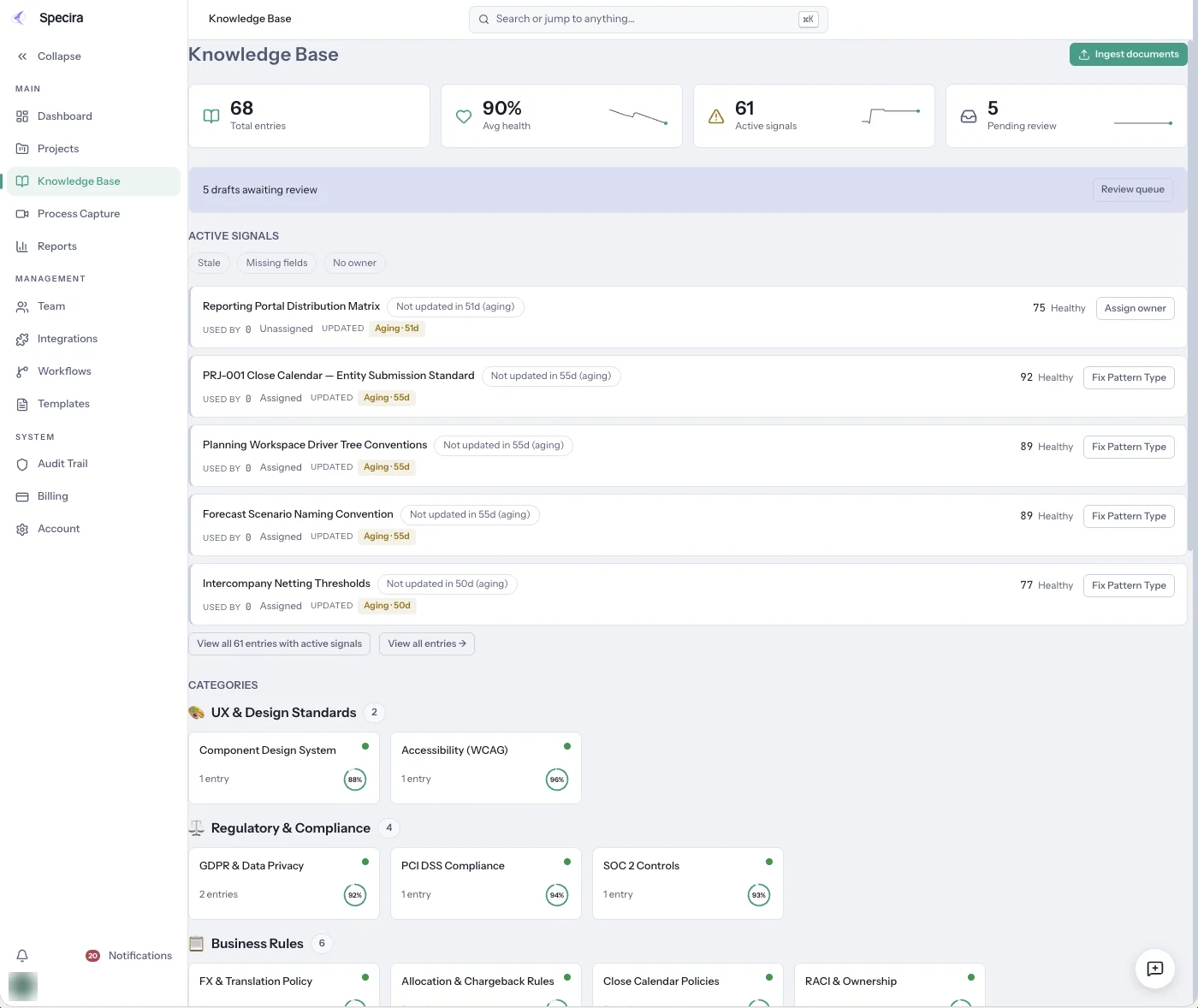
Specira's multi-agent system tackles M&A integration from four simultaneous perspectives, surfacing integration risks and requirements gaps before development begins.
BA Agent: Map legacy business logic to unified product definitions
The BA Agent analyzes legacy pricing engines, underwriting rules, and product endorsements from both organizations and maps them to unified business requirements. Rather than relying on subject matter expert interviews that miss edge cases, the BA Agent examines actual historical data: which rate factors are applied to which product categories, how different policy types interact, what exceptions and override logic exist in the legacy pricing systems. The output is a normalization mapping showing which legacy rules map to which unified rules, with contradictions flagged where the two organizations applied fundamentally different rating logic to the same risk. Underwriters make intentional decisions about how to merge the logic, rather than discovering the contradiction mid-development.
Solutions Architect Agent: Structure API payloads and microservices architecture
The Solutions Architect Agent evaluates the technical requirements and designs the data model, API contracts, and microservices architecture for the unified platform. Where must legacy mainframe data be extracted and transformed for modern cloud claims platforms? How does real-time policy administration feed into the rating engine? How do broker portals and mobile apps consume policy data? Critically, the Solutions Architect Agent identifies data structure mismatches between legacy systems early: one legacy system stores underwriter notes in a free-text field while the other structures them as discrete rule triggers. That mismatch gets flagged for early architectural decision-making, rather than surfacing during development.
Security Analyst Agent: Ensure cross-border policyholder data compliance
Insurance carries policyholders across multiple states and countries, each with different data protection rules. When integrating platforms, cross-border policyholder data must comply with GDPR (if EU data is involved), state insurance commission privacy mandates, and financial regulator rules like those from the UK's FCA. The Security Analyst Agent maps data flows through the new unified platform and identifies compliance gaps: inconsistent customer consent processes across the merged entity, data retention policies that don't conform to regulatory minimums, access controls that let underwriters see customer data outside their geographic license scope. All caught before development, not during audit.
UX Researcher Agent: Streamline broker portals and digital claims
Post-acquisition integration often means broker agents face a confusing portal merge: login workflows, quote processes, and claims submission interfaces that don't match. The UX Researcher Agent evaluates both legacy broker portal journeys and designs the user experience of the unified platform. Are first notification of loss (FNOL) flows intuitive? Is digital claims status tracking available? Do live chat integrations reduce underwriter overhead? Does the portal design accommodate the product mix of both legacy organizations? Answering these questions before launch means brokers can shift to the unified platform without disruption, reducing attrition risk to competitors.
Red Team Critic: Catch edge cases and integration risks
Specira's Red Team Critic Agent evaluates the specification from an adversarial perspective: "What can go wrong?" Duplicate claim records created from network timeouts when claims APIs get called twice. Idempotency key gaps in API gateways connecting disparate legacy platforms. Data consistency issues when policy admin and claims systems must stay synchronized. The Red Team reviews the specification and surfaces these risks before development, when they're cheapest to address.
Five key capabilities emerge from this multi-perspective analysis: complete actuarial rule mapping with explicit decision rationale, unified technical architecture that eliminates system integration friction, regulatory compliance validated across jurisdictions, improved broker and customer UX that reduces migration friction, and edge-case risk identification early in the integration lifecycle.
What outcomes can insurers expect from decision-attributed integration?
Insurance carriers implementing multi-agent requirements intelligence report consistent improvements in integration velocity and value delivery:
Complete actuarial rule traceability means no business logic is lost or misinterpreted during the merger. Every legacy pricing rule, endorsement, and claims settlement process has a documented equivalent in the unified platform, with explicit decision documentation showing why it was mapped that way. The result: confidence that the merged platform will produce equivalent or better underwriting results compared to running both legacy systems.
Think about those weeks-long compliance reviews that slow every integration timeline. When state insurance commissions review the merged platform, regulators can verify compliance through the decision-attributed traceability documentation rather than requiring weeks of manual testing. Especially valuable for acquisitions spanning multiple states, where each state regulator may have different requirements.
Integration confidence comes from knowing the full picture before cutover. When the C-suite sees that all legacy business logic has been captured, mapped, and validated, the acquiring organization can cut over to the unified platform without hesitation. Payback period shortens, and the $300M+ annual acquisition targets get met on schedule rather than slipping by quarters.
AXA's integration of XL Group following its $15.3 billion acquisition illustrates the complexity of post-M&A platform consolidation. AXA completed the acquisition of XL Group in September 2018, making it one of the largest P&C insurance acquisitions in history. The integration presented extraordinary technical and business challenges: AXA had to merge XL's specialty and reinsurance platforms with its own systems across 51 countries, harmonizing underwriting rules, claims processes, and regulatory reporting.
The integration required reconciling decades of accumulated business logic across different regulatory jurisdictions. XL's specialty underwriting teams in London operated under different rate-setting authority than AXA's commercial teams in Paris. Their claims settlement authorities differed. Their broker portal interfaces were built on incompatible technology platforms. Consolidating these required not just technical work but business decisions about which organization's approach would become the standard.
What does AXA's experience teach us about decision documentation? When you're integrating operations across 51 countries and two completely different underwriting cultures, every business decision during integration becomes a precedent. Document the rationale (why did we choose XL's rating approach over AXA's for commercial auto in Germany?) and future integration teams and auditors understand the logic. Skip that documentation, and decisions appear arbitrary; questions about whether the right choices were made resurface for years.
Key takeaway
Insurance post-M&A integrations are complex, multi-dimensional problems that fail when requirements are fragmented across Business Analyst, architecture, security, and UX teams. Without simultaneous analysis of all four perspectives, risks remain hidden until development, when they're expensive to fix.
- Decision-attributed traceability provides an audit trail for every legacy rule migration decision, protecting against future disputes about whether the right choices were made
- Multi-agent analysis from BA, SA, security, and UX perspectives simultaneously catches actuarial mapping gaps, architectural mismatches, compliance violations, and UX friction
- Edge case identification through Red Team analysis surfaces risks like duplicate claim records, idempotency gaps, and data consistency issues before they reach production
- Complete requirements specification enables confident cutover to the unified platform and accelerates value delivery to the acquisition timeline
What do teams ask most about this use case?