
Nathalie ran warehouse operations in Boucherville for twenty years. She knew one thing the system never did: that a particular supplier in the FIFO queue always shipped late around quarter-end, so her team quietly held those pallets and pulled the next lot forward. It was never written down. It lived in her head, in a habit, in the way she glanced at the loading dock on a Thursday afternoon and just knew. Then the team rebuilt the inventory module, and someone handed the requirements to an AI agent with a one-line prompt: replicate the current allocation logic. The agent produced a clean, well-structured spec in about four minutes, and it captured the FIFO rule perfectly. It never captured the exception, because nobody asked Nathalie, and Nathalie retired in March. The stockout hit in week three of production. It cost more than the whole module did to build.
Here is the uncomfortable part. AI was supposed to be the thing that finally captured what people know, the great documentation engine, and in one narrow sense it is delivering. Atlassian's 2025 State of Developer Experience report, a survey of 3,500 developers and managers, found that 99% of developers now save time with AI tools and 68% save more than ten hours a week (Atlassian, July 2025). Ten hours. A full workday handed back, every single week, to people who used to spend some of those hours talking to each other. So where does the captured knowledge go? Mostly nowhere. Speed and capture turn out to be very different acts.
The deeper finding is the one that should keep you up. Researchers at Microsoft and Carnegie Mellon surveyed 319 knowledge workers across 936 real tasks and found that the more people trusted the AI, the less critical thinking they brought to the work, especially on routine jobs (Microsoft Research, CHI 2025). A separate study of 666 people by Michael Gerlich at SBS Swiss Business School found a significant negative correlation between heavy AI use and critical-thinking scores, with cognitive offloading as the mechanism (Gerlich, Societies, 2025). Read those two together. The same tool that drafts the spec is quietly training us to stop asking the question that would have surfaced Nathalie's exception in the first place.
How can AI both capture and erase organizational knowledge?
Both at once, and that is exactly why the loss hides so well. AI is brilliant at explicit knowledge: the documented rule, the written process, the thing already sitting on a Confluence page. It can summarize a 200-page spec, restate a policy, transcribe a meeting. What it cannot do is reach the knowledge that was never expressed anywhere, the kind a philosopher named Michael Polanyi once described with a single line: we know more than we can tell. The reason behind Nathalie's workaround was tacit. It was real, it was load-bearing, and it had never been said out loud to anyone who wrote requirements.
So picture the two paths side by side. In the old world, discovery was a conversation. A business analyst sat with Nathalie for ninety minutes, asked clumsy questions, and somewhere around minute fifty-five stumbled into "oh, well, except for that one supplier." That accident was the whole point. The exception surfaced because a human was in the room being curious. In the new world, discovery is a text box. Someone types replicate the current logic, hits enter, and the exception is never invited. The rule survives. The reason dies. Nobody notices until production does.
I want to be careful here, because the easy version of this argument is wrong. AI is not the villain. I use it every day, and the ten hours are real. The problem is not the tool. It is what we decided to spend the saved time on, or rather what we decided to stop doing to save it. We cut the conversation. And the conversation was where the knowledge lived.
What happens when discovery gets skipped for speed?
You ship a spec that matches the prompt and misses what the operation actually needed. That gap is invisible at first, because the spec looks complete. It reads well. It passes review, because reviewers check the spec against the prompt, not against the reality nobody captured. The trouble shows up later, downstream, in production, where it is most expensive to fix and hardest to trace back to its origin.
This is the asymmetry that makes the whole thing dangerous. Skipping discovery saves you, what, a few days? Maybe a week of interviews. The cost of skipping it lands months later and arrives many times larger, as a stockout, a compliance miss, a feature that technically does what was asked and fails what was meant. Faster generation does not remove the requirements work. It defers it, hides it, and lets it compound. The bill always comes. It just comes later, with interest, addressed to someone who has no idea why the system behaves the way it does.
The danger was never that AI writes bad specs. It writes good ones, fast, faithful to the prompt. The danger is that a good spec of an incomplete understanding is far more convincing than a bad one, so it sails through review and detonates in production.
Why does tacit knowledge never make it into AI-drafted specs?
Because an AI can only draft from what it is handed. It cannot interview the supervisor who is not in the prompt. It interpolates from patterns it has seen, and that is precisely the problem, because an exception is by definition not the pattern. The model predicts the likely. Tribal knowledge is, almost always, the unlikely thing that one team learned the hard way and never generalized.
Think about what Nathalie's knowledge actually was. Not a rule. A story. "Three years ago that supplier burned us at quarter-end, so now we hold their pallets." It is causal, specific, tied to a particular incident on a particular Thursday. You cannot derive it from the data, because the data shows the workaround already in place, working, looking like normal operations. The why is not in the system. It is in the person. And a one-line prompt has no slot for a person.
When NASA wanted to revive the Saturn V's F-1 engine, the most powerful single-chamber liquid-fuel engine ever flown, the blueprints were not the problem. They had survived in the archives. The engine still could not simply be rebuilt, because the F-1s were essentially hand-crafted, and the critical manufacturing knowledge lived in the heads of the people who built them in the 1960s. Rocketdyne had actually tried to capture it, running tape-recorded interviews with the original engineers about hard-to-make parts and production tricks (The Space Review, 2019).
It was not enough. By 1992, a NASA knowledge-retention effort could find only 76 still-living retired F-1 engineers. When modern engineers finally took up the engine again, they had to disassemble surviving museum units and reverse-engineer them, adding instrumentation that was never recorded the first time around. The documents told them what the engine was. They could not tell them how it was actually made.
That is the cleanest proof I know that documents are not knowledge. The what was preserved. The why and the how walked out the door with the people, and no amount of speed could regenerate it. Now run that forward to a team that let an agent draft the spec instead of asking the person. Same loss. Faster.
What does structured discovery surface that a prompt cannot?
The reasoning. The edge cases. The places where two stakeholders hold flatly contradictory assumptions and have never once noticed, because they have never been in the same room answering the same question. Structured discovery is just the deliberate act of asking the senior person why the exception exists, and writing the answer down next to the rule, before they retire. That is the entire trick. It sounds almost too simple. It is also exactly what the one-line prompt skips.
Requirements intelligence is what we call doing that systematically rather than by luck. Instead of hoping a curious analyst stumbles into the exception at minute fifty-five, it runs a repeatable, multi-expert discovery that interrogates the why on purpose, captures the tacit reasoning as a first-class artifact, and feeds the AI a brief that already contains Nathalie's exception. The agent still drafts the spec in four minutes. The difference is what it is drafting from. This is the same gap we mapped in The Knowledge Drain, where the cost of scattered, undocumented knowledge was already adding up before AI sped everything up.
Does an MCP-connected AI agent solve the tribal knowledge problem?
Partly. The honest answer starts with credit rather than a shrug: through the first half of 2026 the requirements tooling vendors shipped real governance infrastructure. Jama Software walked through Jama Connect MCP on June 30, 2026, showing an agent pull approved requirements with permissions, versioning and audit logging all intact (Jama Software, June 2026), and Visure Solutions had announced the VISURE MCP Server on June 4 with comparable reach into risks and verification evidence (GLOBE NEWSWIRE, June 2026). Before that, the realistic options were a hand-pasted ticket, an ungoverned scrape, or a guess. All three leak.
But look at what the pipe actually carries. A context layer serves what a system already holds, which means every control inside it, every permission check and every audit line, gets applied to knowledge somebody once took the trouble to record. Nathalie recorded nothing. Her quarter-end exception was not in Jira, not in a Confluence page, not sitting in a requirements repository waiting for an agent with the right credentials to come and ask for it. Query that perfectly governed layer about the supplier rule and you get the FIFO logic back, clean, with a full audit trail. The exception is not there to retrieve. Absence returns nothing, and nothing reads a lot like fine.
I want to be careful here, because this could easily read as a knock on the vendors, and it is not one, since both companies are building the plumbing their customers genuinely needed and scope their own claims to access, traceability and audit readiness rather than to completeness. Neither promises that the requirement on the far end is correct. Their language is honest. It is the market's summary that gets sloppy, quietly turning access into validation. The whole argument is unpacked in why a governed context layer still misses tribal knowledge.
So the gap this article describes survives the upgrade. It just moved. It now sits on the far side of a permission-controlled, fully logged, well-built pipe, which is arguably a worse place for it to sit, because every visible signal in that pipeline now says trustworthy. Ask Nathalie first. Then connect the agent.
Capture the reason, not just the rule
AI deletes institutional knowledge not by malice but by omission. It faithfully records the documented rule and silently drops the tacit reason, because the person who holds the reason was never in the prompt. Faster spec generation does not capture more knowledge. It captures less, faster, by removing the conversation that surfaced the why.
The fix is not to slow down or abandon AI. It is to put structured discovery back in front of it, so the agent drafts from a brief that already holds the exceptions, the edge cases, and the reasoning your best people carry. Ask why before they leave. Write it down. Then let the AI move as fast as it likes, because now it is fast and right.
Nathalie is retired now. Somewhere a new analyst is staring at a stockout report, trying to reverse-engineer a decision she made on instinct in 2019. They will get there eventually, expensively, the way NASA got back to the F-1. Or someone could have asked her one question before March. That is the whole article. That is the whole problem.
How do you get the reason into the record, not just the rule?
Ask them now. A Specira session surfaces the matching knowledge base document mid-answer, with its confidence shown, and that partial match is what makes a senior person interrupt to say what the document left out. The agents' notes go in underneath, attributed. Every requirement then keeps the evidence rail, which tells you which sources are user-generated and which are AI-generated, how fresh each one is, and who put it there.
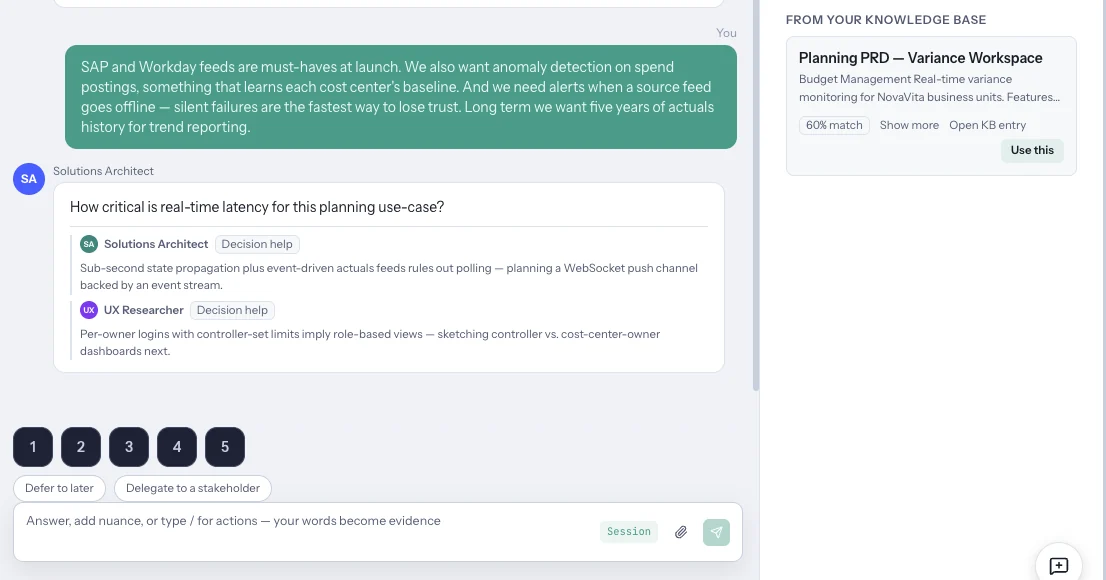
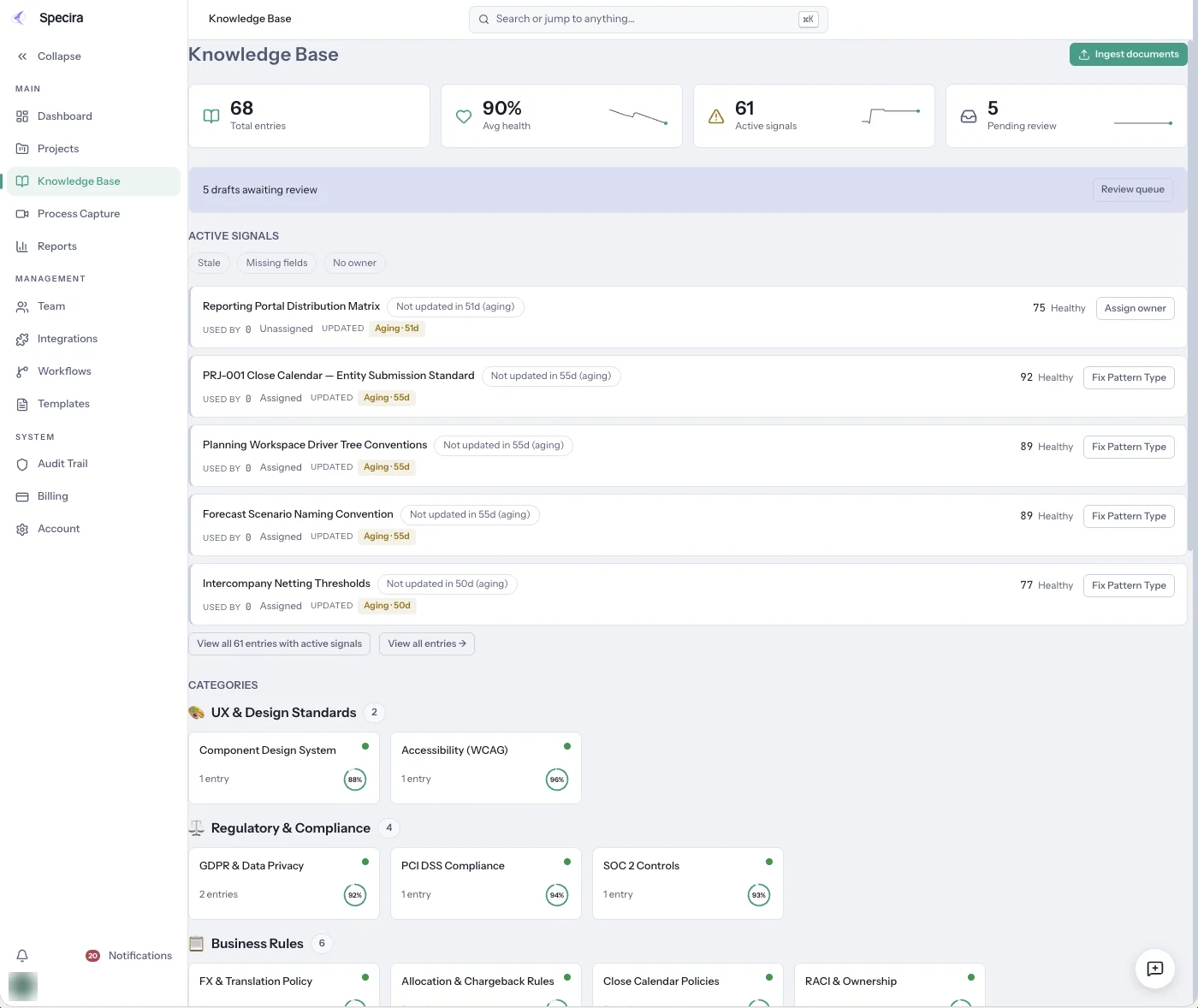
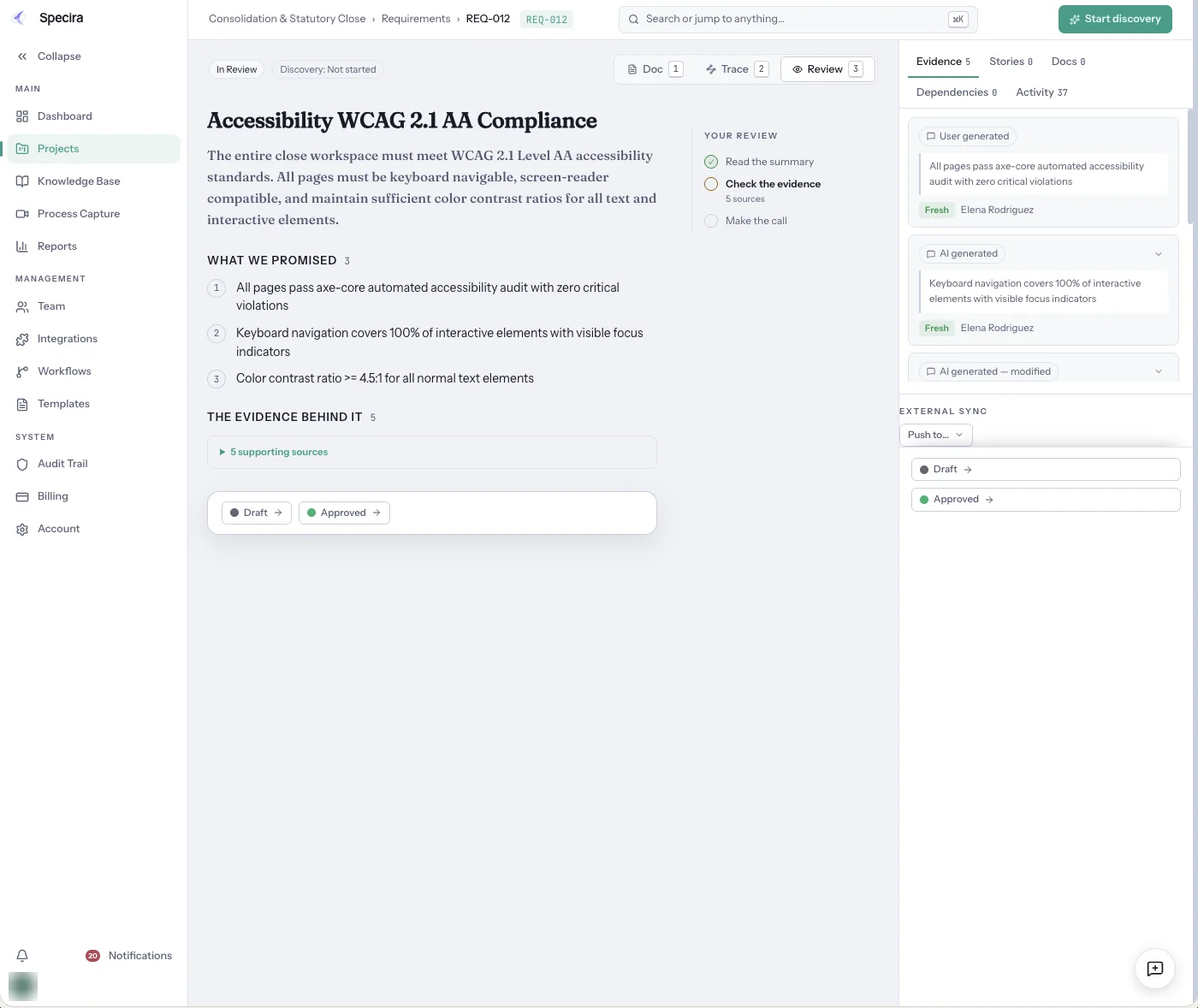
What you are looking at. The discovery notes show a knowledge base match arriving while the answer is still being given, the knowledge base flags what is aging, and the requirement detail keeps who contributed what.
Think of the rule everyone follows and nobody can explain. We will run the session that gets the reason written down.
Book a DemoScreens are from a seeded Specira demo workspace; counts and scores are sample data.
What are the most common questions about AI and knowledge retention?