
How much time do knowledge workers waste hunting for context?
Forty minutes. That's how long the lead Business Analyst spent at a project kickoff last year just finding the integration specs from a project that had ended nine months earlier. Confluence (three different spaces). Slack (half a conversation). A shared drive with about 200 folders named things like "Final_v3_REAL." The specs existed. Somewhere. In pieces. Nobody could assemble the full picture because the architect who wrote them had left for a fintech startup in October.
Not an outlier. I've seen that exact scavenger hunt at maybe a dozen organizations in the past three years, and when you finally put a dollar figure on it the number is staggering. $390K per year. That's what a 10-person Business Analyst team at $130K average salary burns just searching for information they already have, somewhere. The research confirms what I've observed: about 1.5 days per week, which works out to 78 days per year, or roughly 31% of total capacity. Nearly a third of every person's working life, spent not creating value but hunting for context that should already be at their fingertips.
Structural. That's the root cause, not laziness and not bad tooling exactly. A single decision ends up living in three places: a requirements document (outdated the week after it was written), a Slack thread (scrolled off everyone's screen months ago), and the architect's memory. That last one is portable. It walks out the door when they do. Someone new needs to understand why a system behaves the way it does? Fragments everywhere, complete answer nowhere.
What happens when your senior architect leaves?
Hiring cost. That's what everyone talks about when someone senior leaves. The recruiters, the three rounds of interviews, the 100-150% of salary you'll spend to backfill the role. Real number. Small part. The expensive part is everything that person knew that nobody else does, the five years (sometimes longer) your senior architect spent learning why the payment gateway integration breaks under holiday load, which vendors can actually handle your transaction volume, what contract terms matter when you're negotiating with Oracle versus Salesforce, and how the system really behaves when edge cases pile up at 2 AM on a Saturday.
When a senior specialist leaves, their coworkers cannot do 42% of that person's job. It was never written down. That comes from Panopto's Workplace Knowledge and Productivity Report. Not in a document. Not in a training manual. Not recoverable from old pull requests or code reviews. Pattern recognition, the kind that only forms after years of accumulated context. The junior architect sitting two desks away picks up some through osmosis, sure. Most of it? Gone. I thought you could reconstruct it from artifacts. You can't, at least not the judgment calls and the "why" behind decisions.
Not a fringe concern. 67% of IT leaders say they're worried about organizational knowledge loss from turnover. Two out of three. That's not "mildly concerned." That's technology leaders flagging it as a primary business continuity risk, while most of their organizations do essentially nothing to manage it.
Worse every year. Tech averages 13-21% annual turnover, depending on who you ask and which segment. The programming workforce is getting older, too: only about 20% of programmers are under 35 now, down from 53% back in 1984. Retirement wave building. You're losing your most experienced people to attrition, retirement, and acquisitions, and the institutional memory they carried for a decade or two can't be rehired. You can hire a new person with the same title. You can't hire their context.
Organizational knowledge is a depreciating asset. Every undocumented decision, every unshared pattern, every tribal knowledge holder who retires takes irreplaceable context with them.
Enterprise Knowledge Management principle
What is a living knowledge base versus a static wiki?
Wikis. That's the first instinct when leadership realizes knowledge is walking out the door. Confluence spaces get created. Architects are told to document everything. Six weeks. That's roughly how long the effort lasts before the next sprint starts, deadlines stack up, and maintenance stops cold. Eighteen months later, that wiki describes a system that no longer exists in that form, with half the links broken and architecture recommendations that contradict what the team actually implemented last quarter. Museum. Not a reference.
Discipline problem? That's what I used to think. Wrong. The problem is structural: static wikis separate documentation from the work that generates the knowledge. You finish a project on Friday, you're already on the next one Monday morning, and somehow you're supposed to carve out a week to write down what you learned? Doesn't happen. Even when it does (rare), the documentation starts decaying the moment the next architectural decision lands three months later.
Different principle entirely. A living knowledge base captures decisions during the work, not after. Every requirements session, every architectural choice, every integration pattern, every performance tuning decision gets recorded in context, along with the reasoning behind it. No separate "documentation phase." The capture happens as part of the project itself, so each engagement enriches the knowledge base automatically.
In practice? A connected graph where every decision links to the problem it solved, the constraints it addressed, and the outcomes it produced. A new team member joining in 2026 doesn't read a static document from 2022 and hope it's still accurate. They interact with a living system that reflects current architecture, current constraints, current best practices. Every project adds signal. Nothing rots.
How can teams start capturing institutional knowledge today?
Surprising part. You don't need to buy a new platform or reorganize your entire department. A structured conversation. That's what you need. Sit down with your senior architect (or Business Analyst, or whoever holds the critical context) and run what amounts to a guided interview where an AI-structured session asks the right questions, follows threads when answers get interesting, and captures everything in a connected knowledge model. Mechanically simple. The hard part was always knowing which questions to ask and in what order.
I assumed weeks. The real answer is 4 to 8 hours of focused sessions with subject matter experts. That's it. A single senior architect can walk through her mental model of an entire system in 4 to 6 hours if the questions are structured well, and the output captures not just facts ("we use RabbitMQ for event processing") but connections: why that decision was made, what constraints drove it, what tradeoffs the team accepted, and what they'd do differently today.
Then it compounds. Each subsequent project feeds the knowledge base on its own. New Stripe integration? Decisions, configuration choices, and lessons learned get captured in context. Production performance issue resolved at 3 AM? The solution gets recorded with its preconditions, the symptoms that triggered the investigation, and the outcome. Nobody has to remember to "update the docs." The capture is the workflow. Richer with every project cycle, every incident, every architectural review.
Boeing outsourced 65% of the Dreamliner's airframe design and manufacturing to 50+ international suppliers. In doing so, they lost critical institutional knowledge about manufacturing integration, tolerances, and coordination processes. When it came time to integrate the outsourced components, unexpected problems arose because the internal knowledge about how to coordinate such complex integration had eroded.
The result was 3 years of delays (2007-2011) and billions in cost overruns. The lesson: institutional knowledge is not just nice to have. It is foundational to executing at scale. When organizations offload expertise without capturing it, they lose both the people and the intellectual capital they carried.
Source: Simple Flying: Boeing's Problem After Outsourcing 787 and Seattle Times: Boeing 787 Outsourcing Issues
What prevents knowledge drain at scale?
A dozen organizations. That's roughly how many I've watched try to tackle this. Surprising thing: the ones who succeed and the ones who don't look almost identical at the start. Both buy tools. Both talk about "knowledge management" in all-hands meetings. The difference is simpler than you'd expect. Intentionality. Three things, done consistently.
First, capture expertise from high-risk people before they leave. Not after. Not during the two-week notice period when they're mentally checked out and already decorating their new office in their head. The moment someone announces retirement, or your VP hears through the grapevine that a senior architect is interviewing elsewhere, that's when you schedule the knowledge capture session. Four to eight hours. It preserves what would otherwise vanish on their last Friday.
Second, treat the knowledge base as a living asset, not a checkbox. Every project adds to it. Every decision gets recorded in context. Not "we updated the Confluence page." The actual system of record for how the organization works, maintained because people use it daily and the alternative is flying blind. I thought this would be the hard part. Wrong. Once the knowledge base is genuinely useful, people maintain it because they need it.
Third, connect the knowledge base to actual decision-making. Knowledge sitting in a database is just a nicer filing cabinet. It only matters if architects consult it before making choices, if new team members use it when onboarding instead of bothering the three people who've been here since 2018, and if product teams reference it when scoping features. Where decisions happen. That's where the knowledge base has to live, not somewhere you visit after the fact.
Why knowledge drain compounds into a measurable cost before anyone notices
Enterprise knowledge depreciates every single day if nobody actively manages it. Every senior departure, every undocumented decision, every tribal knowledge holder who retires takes irreplaceable context with them. You won't see the cost in a quarterly report. You'll see it in the rework, the repeated mistakes, the six-week delay while a new hire figures out what the previous architect already knew.
More wiki pages won't fix this. Better documentation templates won't fix this. What works is a living knowledge system that captures decisions in context, grows with every project, and makes institutional memory independent of any single person's employment status.
Where to start? Pick your highest-risk departure. Someone close to retirement, or someone your manager suspects is interviewing. Run a knowledge capture session: 4 to 8 hours. Convert that conversation into a knowledge asset that serves the organization for years. Each session compounds. Within 12 months, you'll have a knowledge base that is, quite honestly, more reliable than any individual's memory. That's your competitive moat.
What does tribal knowledge loss cost when a senior specialist leaves?
Nobody wrote it down. That is the real problem. When a senior specialist retires, industry estimates put the share of undocumented knowledge that walks out with them as high as 70%: the integration quirks, the vendor backstory, the "do not deploy that service on a Friday" instincts that never reached a wiki. Then comes the bill to rebuild the role. Gallup pegs replacement at up to 200% of salary for leaders and senior roles. The top of the range. Scarce talent, a long ramp-up, and the context you just lost, all stacked onto one hire.
I used to think the salary math was the scary part. It is not. The number you cannot put on a slide is worse: the reasoning behind a 2019 decision that everyone now depends on and nobody left can quite explain.
The timing is getting harder, too. Gartner predicts that by 2027, half of all enterprises without a people-centric AI strategy will lose their top AI talent to competitors who treat retention as a system, not a perk. Retirement already thinned the bench. Now poaching does too. Same loss, faster clock.
So what actually works? You cannot capture what you never surfaced. A living knowledge base helps, but only when the tacit knowledge gets drawn out while the expert is still in the building, still answering Slack pings, still in the room for the architecture review. That is what structured discovery does: it forces the unspoken assumptions onto the record before the last Friday. Our piece on AI, discovery, and the knowledge loss problem walks through the mechanism, and the intent gap in legacy modernization shows the price when the original "why" is already gone.
What keeps a departing architect's reasoning inside the building?
Catch it mid-sentence. Specira's knowledge base is not a wiki rotting quietly in a corner; entries carry a health signal, and an aging one gets flagged before an agent leans on it during a discovery session. The knowledge base proposes its matching document while the answer is still being given, which is the moment a senior person is most likely to correct it. Every requirement then keeps its provenance: who said it, which source backed it, and whether a human or a model wrote the line.
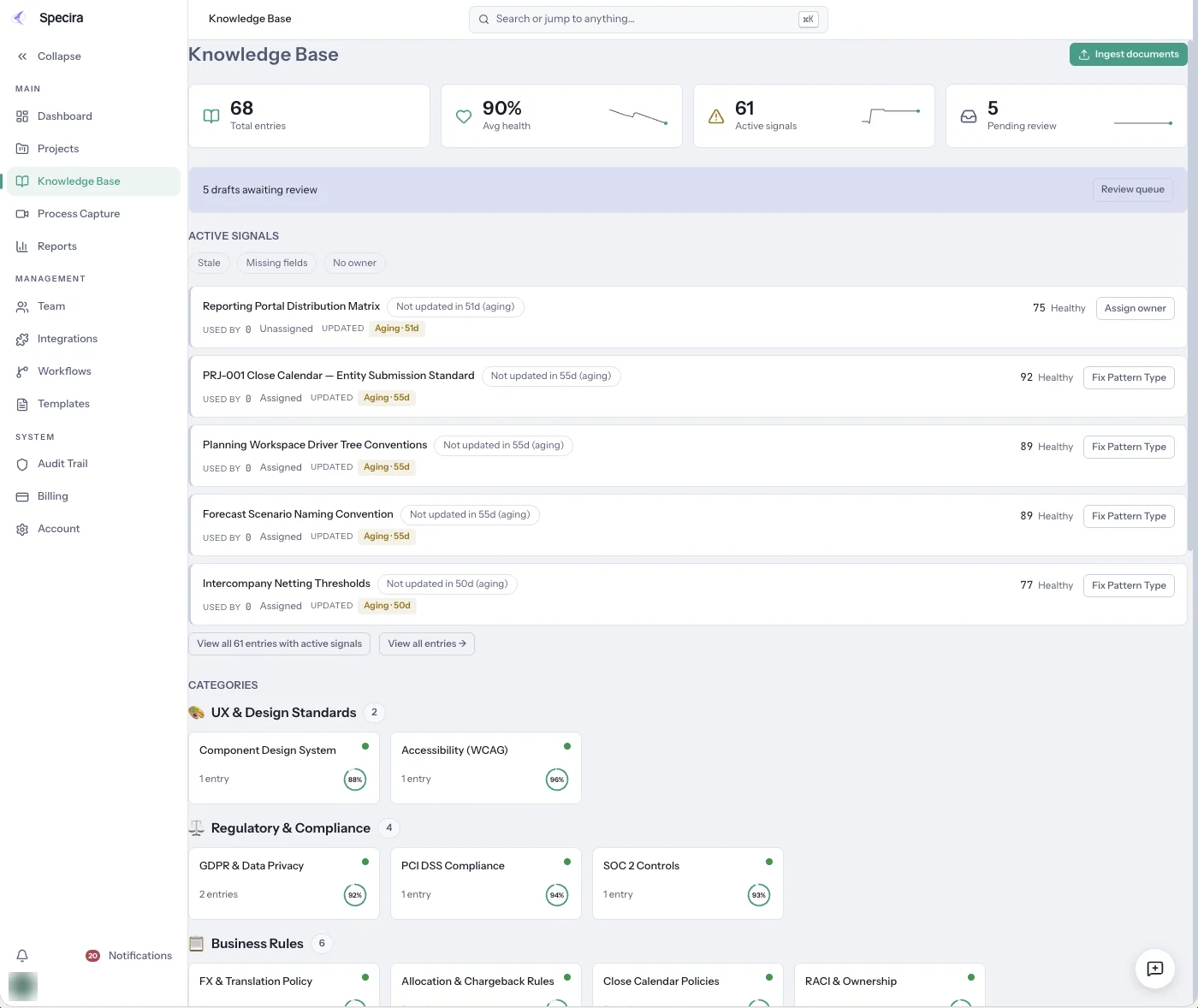
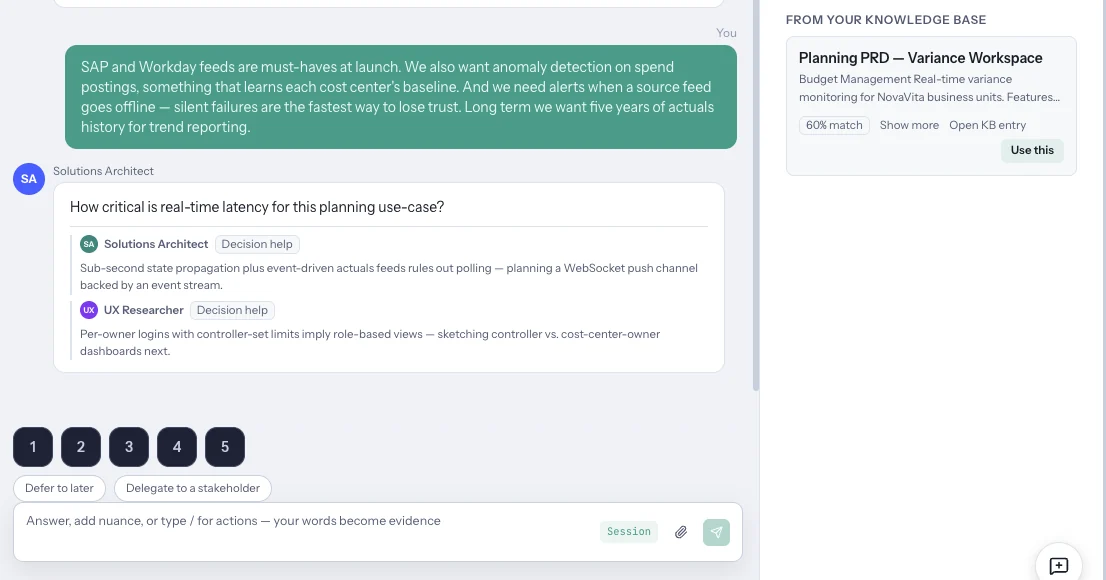
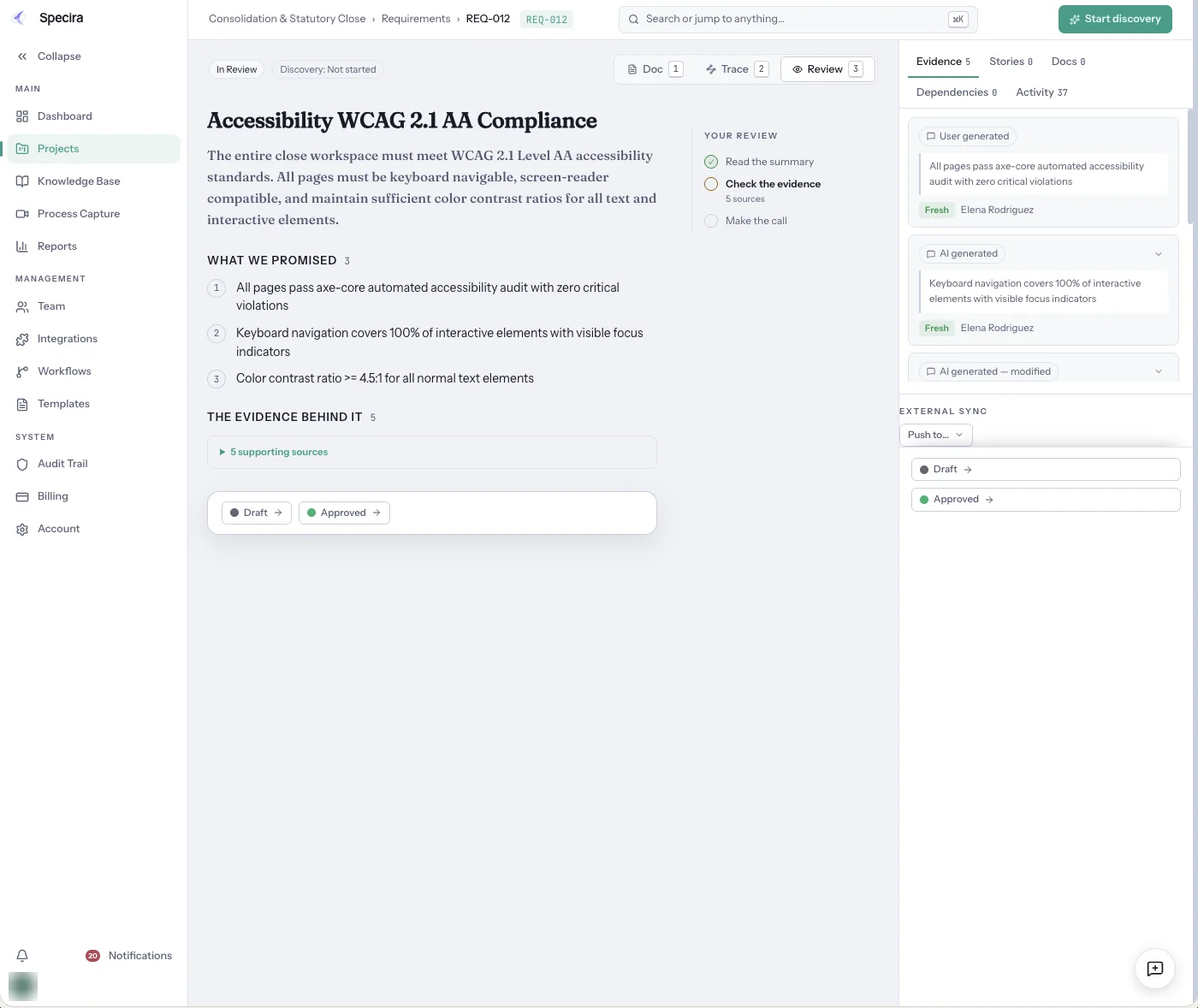
What you are looking at. The knowledge base flags entries that are going stale, the discovery notes show a matching document surfacing mid-answer, and the requirement detail keeps the author and freshness of every supporting source.
Name the person whose retirement worries you most. We will show you what a session built to get their reasoning on record looks like.
Book a DemoScreens are from a seeded Specira demo workspace; counts and scores are sample data.
Frequently Asked Questions