
Everyone said yes. The requirements document ran 60 pages, cross-referenced and internally consistent, signed off by every lead in the building on a Thursday afternoon in March. Not one section contradicted another. The spec was clean. Then, twelve weeks later, production hit the single condition the document never mentioned, a rule that had lived only in the head of an analyst who retired in 2021, and the release stalled cold. The document was right about everything it contained. That was never the problem. The problem was the thing it left out, and nobody in that room had any way to see the shape of what was not there.
I have sat in that meeting more times than I can count, on both sides of the table, across 25 years in enterprise software delivery. The pattern holds. A team pours its energy into getting the written requirements right, polishing every line that made it onto the page, and pours almost nothing into the harder question hiding underneath: what should be on this page that isn't? A checklist can confirm the first thing. It is useless for the second. This piece is about the category of tool built for that second question, what it genuinely does, and why the checklist template you got in onboarding is not one.
What is a requirements gap analysis tool?
A requirements gap analysis tool is software that surfaces what is missing, conflicting, or merely assumed in a set of requirements before the build begins, not after it breaks. It works upstream. At the discovery layer, its job is not to check that each written requirement is well formed, because plenty of tools already do that well. Its job is to find the requirements that were never written down at all: the assumption nobody stated, the edge case nobody raised, the rule that two teams each quietly believe the other one owns. A checklist confirms what you wrote. This finds what you didn't.
Sit with that jump. Twelve percent to thirty-one percent in two years is not noise; it is a direction, and it points at something a checklist was never built to catch. Most requirements failures are not errors of commission, where a person wrote the wrong thing down and someone could have caught it in review. They are errors of omission, where the thing that actually mattered was never captured, because everyone assumed it was obvious or assumed someone else had already handled it. Omission is invisible by default. You cannot proofread your way to a requirement that is not on the page, and no amount of review turns a clean document into one that admits what it forgot to mention. That is the exact cost we traced in the hidden cost of missed requirements: the most expensive requirement is almost always the one that was never written.
The broader delivery picture backs it up. Wellingtone's tenth annual State of Project Management report, published in March 2026 and drawn from project professionals worldwide, found that only 36% of organizations mostly or always deliver their projects on time. The gap is real. What sits underneath it is the harder question, and omission, the requirement nobody wrote down, keeps surfacing as the answer. The teams are not lazy and they are not unskilled. They are working hard on the visible half of the job, the requirements they can see, and running blind on the invisible half, the ones they cannot. A gap analysis tool exists to light up that second half.
How is it different from a requirements checklist?
A checklist verifies presence and format. A gap analysis tool hunts for absence. That is the whole difference, and it is not a difference of degree. A requirements checklist hands you a fixed set of things to confirm: does each requirement have an owner, a priority, an acceptance criterion, a testable phrasing? You tick every box. The document passes. But a checklist can only ever ask about items that someone already thought to put on the checklist, which means it is structurally incapable of surfacing the requirement that is specific to your system and appears on no generic template anywhere.
Think about what a template actually encodes. The last project's lessons. Every line on a requirements checklist is there because some earlier team got burned by its absence and added it, which is genuinely useful, and is also the exact trap: the checklist is a museum of the failures people already know about. Your project's failure is probably not in the museum yet. The requirement you are missing is the one that has not bitten anyone badly enough to earn a permanent line on the standard form, which is precisely why it is still missing and precisely why a checklist walks right past it.
What does a real gap analysis tool actually look for?
Four things, mostly. A real gap analysis capability is not a single trick; it is a set of distinct searches, each aimed at a different way a requirement goes missing. Name them and they stop being mysterious. It looks for unstated assumptions, for conflicts between requirements that each read fine alone, for gaps in coverage across the people who should have had a say, and for breaks in traceability where a requirement connects to nothing. Miss any one of the four and the gap slips straight through, so the tool has to run all four, not just the one that happens to be easy.
Assumptions first. They do the most damage. An assumption is a requirement that everyone believes is settled, so nobody writes it down, so it stays invisible to every checklist ever printed. Surfacing one means asking the questions that feel almost rude: what are we taking for granted about the data, the users, the volume, the timing, the one regulatory rule that changes by province? We wrote a whole piece on this failure mode, the graveyard of assumptions, because assumptions are where projects go to die quietly. A gap analysis tool treats every unstated assumption as a requirement waiting to be made explicit.
The other three are quieter but no less real. Conflict detection catches two requirements that each make sense on their own and quietly contradict each other in the one scenario where both fire at once, the kind of thing a human reviewer misses because they read the document in order and never held both rules in mind at the same second. Coverage asks a blunt question: whose perspective is missing? If security, or operations, or the person who actually runs the process every day never had input, there is a predictable, shaped hole where their requirements should be. Traceability closes the loop, flagging the requirement that links to no goal and the goal that produced no requirement. None are exotic. They are just tedious to do by hand, at scale, without missing one, which is exactly the kind of work that should never depend on somebody being thorough on a Friday afternoon.
Where do requirements management tools and review meetings fall short?
They manage the requirements they already have. They rarely find the ones they don't. A requirements management tool, the Jira or DOORS or Jama sitting in your stack, is excellent at storing, versioning, linking, and tracing requirements once those requirements exist. Real value. I am not knocking it. But storage is not discovery, and a requirements management tool is a beautifully organized filing cabinet that has never once told you about the file nobody created. The review meeting has the very same blind spot, just one row up.
A review meeting can only examine what got written on the agenda, and it inherits every assumption the room already shares, which is why the most dangerous gaps sail straight through a room full of smart, senior people nodding along in agreement. None of this means checklists and reviews are worthless. They catch real problems, they enforce a floor of discipline, and a good template is a perfectly fine place to start. Keep them. Just do not confuse a tool that confirms what you wrote with a tool that finds what you didn't, because that confusion is exactly how a clean, signed-off document ends up missing the one rule that mattered.
The most expensive missing requirement in engineering history was not missing from the code at all. It was missing from the assumptions wrapped around the code. On 4 June 1996, the maiden flight of the Ariane 5 rocket lifted off, veered off course, and tore itself apart in a fireball over French Guiana, taking its four Cluster research satellites with it. Thirty-seven seconds.
The Inquiry Board, chaired by Professor Jacques-Louis Lions, traced it to reused software. The inertial reference system from Ariane 4 had been carried straight over, sound and proven, and it did precisely what it was built to do. The catch: Ariane 5 built horizontal velocity roughly five times faster than Ariane 4, a value that overflowed a number conversion the older code had never once had to worry about, inside an alignment routine that did not even need to be running after liftoff. Every piece passed. The requirement that would have caught it, quantify the operating range for the new launcher and not the old one, was simply never written, because everyone assumed a proven module was safe to reuse as-is. A checklist confirming code reviewed and tests green would have ticked every box. Reuse is a good instinct, the architecture itself was later vindicated, and the Board's report is a model of transparency. The gap was not a bad line of code. It was a requirement nobody thought to ask for.
Can AI do requirements gap analysis?
Partly, and the part it can do is the part that matters most. AI is unusually good at the tedious, at-scale searches that a human doing a checklist skips under deadline: reading every requirement against every other one to flag the pair that conflicts, mapping which perspectives are represented and which are absent, tracing each requirement back to a goal and each goal forward to a requirement. It never tires. It reads requirement 340 as carefully as requirement 3, and it does not assume the boring section is fine because the interesting section was. What AI cannot do alone is sit across from the supervisor who has run the process for eleven years and coax out the rule that lives only in her head, and that is why gap analysis is never fully automatic. It is a machine surfacing candidates and a human confirming intent.
This is where the category earns a better name than gap analysis tool. What I have been describing, running the four searches continuously, before the build, with AI doing the scale and humans doing the judgment, is the practical shape of requirements intelligence: treating the intent behind a system as something to actively recover and make testable, not a happy byproduct of writing a good document. Do it early and you get to compress the requirements phase without cutting corners, because you are finding the gaps in days instead of discovering them in production. Do it at all and you spend far less of the project on rework, because the requirement you surface on day three costs a conversation, and the one you discover in month five costs a release. Same requirement. Wildly different price.
Checklist confirms. Gap analysis finds.
A requirements gap analysis tool is not a better checklist. It works at the discovery layer, before the build, and looks for four specific things a checklist cannot: unstated assumptions, hidden conflicts, missing perspectives, and broken traceability. A checklist confirms the requirements you already wrote. A gap analysis tool finds the one you didn't. That gap costs you.
Templates, reviews, and requirements management tools all have a place. Keep them. Just do not mistake storing and confirming requirements for discovering them, because the requirement that takes down a release is rarely the one on the page; it is the one nobody knew to write, caught only in discovery, before the build, while it still costs a conversation instead of an incident.
What does a gap analysis tool look for that a checklist never will?
The thing nobody wrote. The planner reads the charter and returns the sections with nothing in them, which is the unstated assumption made visible without anybody having to guess what to look for. Hidden conflicts and missing perspectives surface in the session, where five agents with different mandates write their disagreements under the same answer. Broken traceability is the fourth, and the requirement detail closes it by carrying the sources, the review checklist and the author of each line.
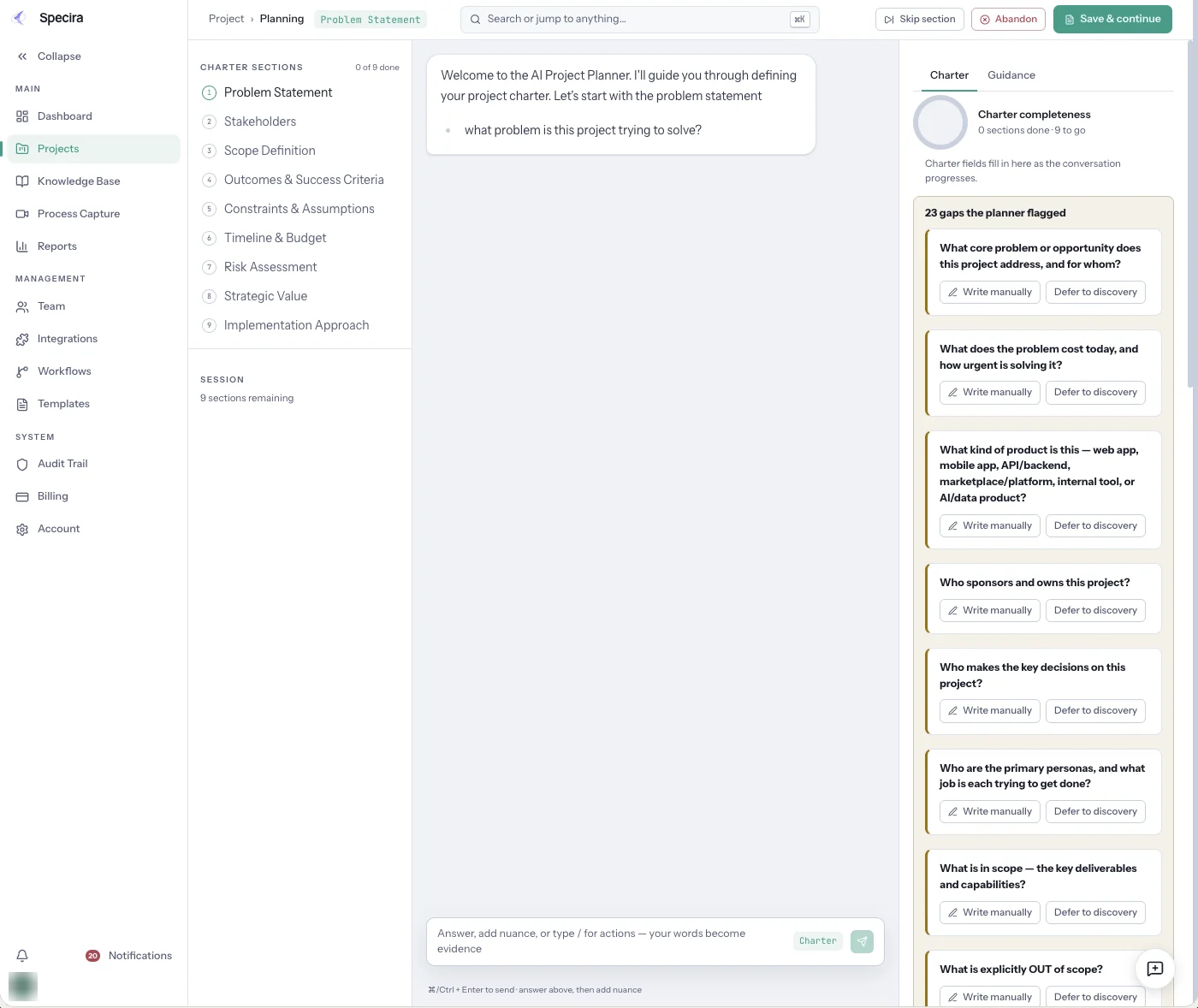
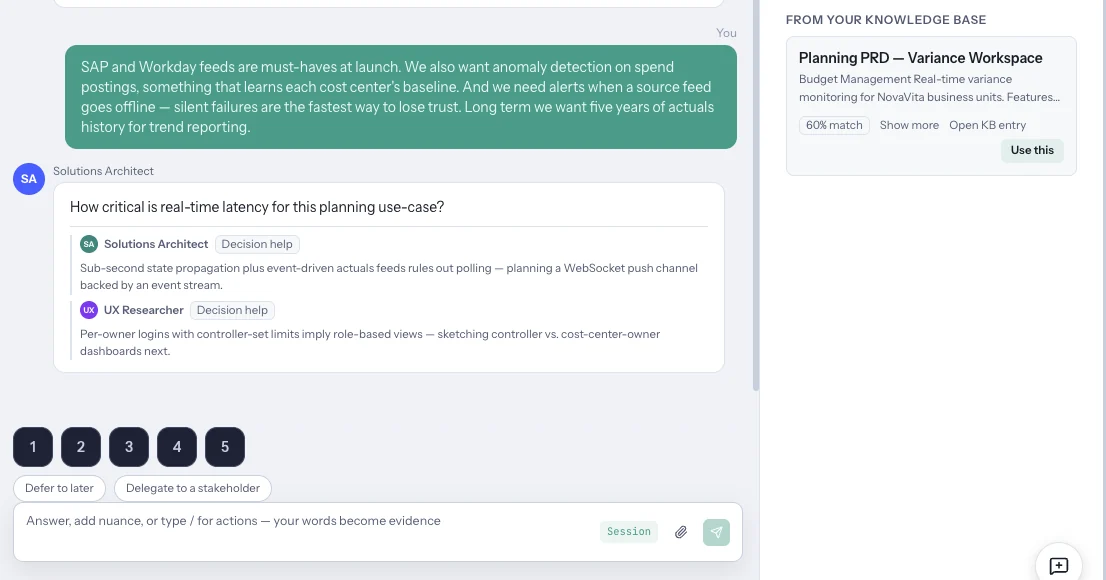
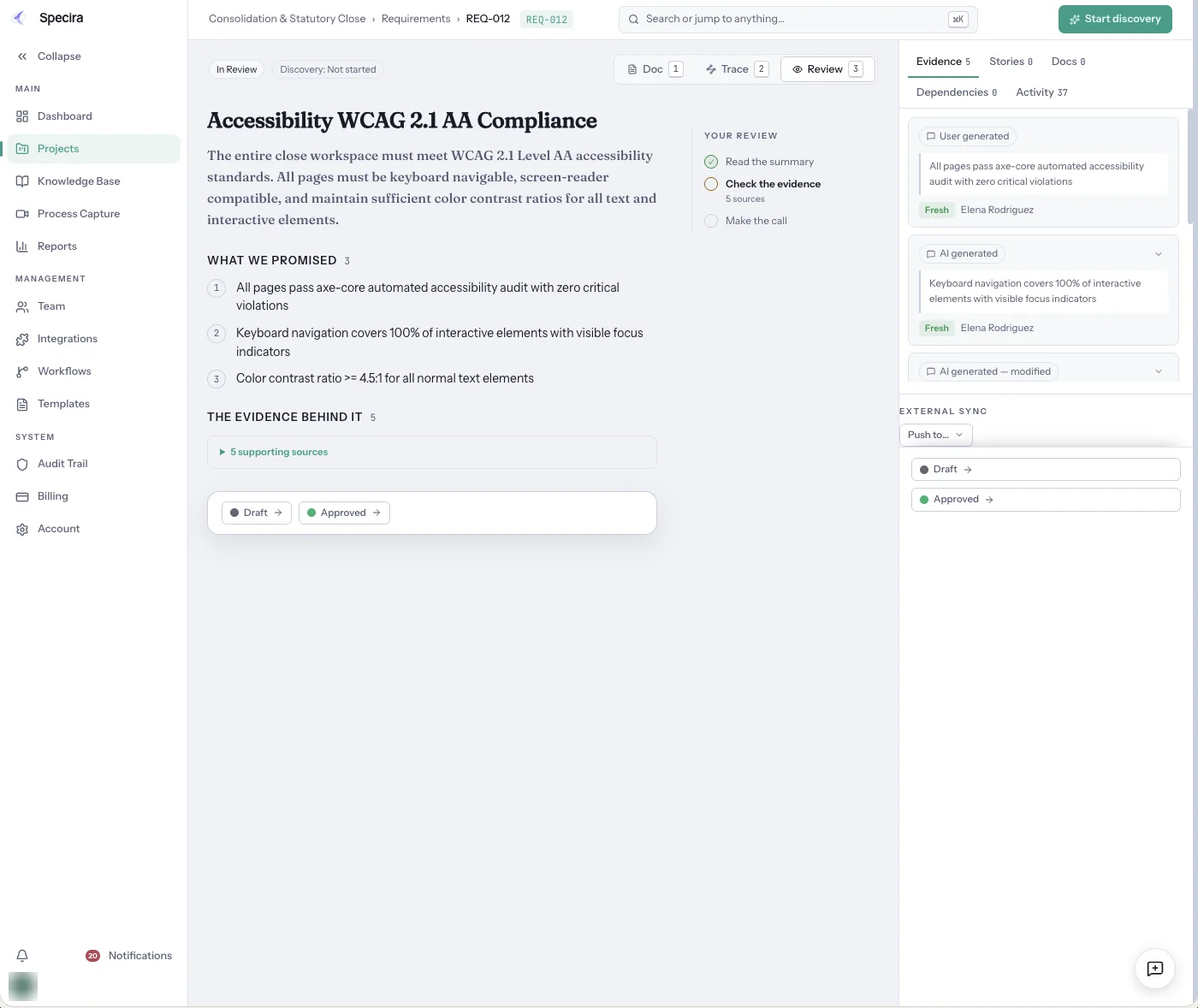
What you are looking at. The planner finds the charter sections with nothing in them, the discovery notes show conflicting perspectives written side by side, and the requirement detail is where traceability stops being a promise.
Send us a requirements document you consider complete. We will run the four checks a checklist cannot do.
Book a DemoScreens are from a seeded Specira demo workspace; counts and scores are sample data.
What are the most common questions about requirements gap analysis?