Why do e-commerce integrations fail at such high rates?
E-commerce platforms are integration nightmares disguised as simple storefronts. Behind that "Add to Cart" button sits a maze of interconnections: payment gateways that handle refunds and disputes, inventory management systems coordinating multi-warehouse fulfillment, shipping carriers each with their own APIs and rate tables, tax calculation engines that vary by jurisdiction (and sometimes by product category within a jurisdiction), and customer data pipelines feeding analytics and marketing systems. I've helped teams debug e-commerce integration issues at 2 AM on launch night, and trust me: every single integration point is a potential failure waiting for the worst possible moment.
The core problem is that these systems are routinely underspecified. Teams review Stripe documentation or Shopify API references, maybe copy some example code, but they don't map those technical contracts back to the business flows they're supposed to support. What about partial refunds when an order contains both digital and physical goods? Multi-warehouse fulfillment when inventory is split across three locations? International tax zones with different calculation rules for the same product? What happens when a payment dispute arrives three months after fulfillment and the customer has already received a replacement? These aren't theoretical scenarios. They're Tuesday.
What happens next is painfully predictable. Launch dates slip. Integrations fail in production with real customers watching. Refunds get stuck in queues. Inventory falls out of sync and you're selling products you don't actually have in stock. Teams spend weeks in post-launch firefighting, fixing payment flow bugs and inventory logic that should've been nailed down before anyone opened an IDE.
The traditional solution? Hire a larger technical team to "figure it out as we go" (which really means "discover problems in production"), or delay launch while a Business Analyst documents every edge case by hand in a 200-row spreadsheet. Both approaches are expensive and slow. What you actually need is a way to surface integration complexity upfront, map business flows to technical requirements, and catch edge cases during specification, not after you've shipped broken checkout flows to real customers.
How do e-commerce teams currently handle specifications?
Most e-commerce teams today fall into one of three camps when specifying marketplace and payment integrations. I've seen all three play out, and each one has real blind spots:
Approach 1: API documentation review
You read the Stripe or Shopify API docs over a weekend, create a spreadsheet of endpoints and parameters, and assume your developers will figure out the rest. Fast, sure. But it's technology-first thinking that misses business requirements entirely. You've documented the API but not the business flows it's supposed to support. So your developers end up making assumptions about edge cases and error handling, and those assumptions are wrong about 40% of the time. I've watched teams discover their refund flow was completely broken because nobody specified what happens when only part of a multi-item order gets returned.
Approach 2: Copy-paste spec templates
You find a generic e-commerce specification template on Google, fill in your product name and payment processor, and call it done. These templates are a starting point, sure, but they're designed for a generic storefront that doesn't exist in reality. They miss your domain-specific requirements completely. Building a B2B marketplace? You need net-60 payment terms and consignment inventory models. Subscription box service? You need recurring payment state machines and customer churn prediction logic. Generic templates can't capture the things that make your marketplace different from everyone else's, and those differences are exactly where the integration bugs hide.
Approach 3: Vendor-led discovery
You let your payment processor or shipping provider define the integration requirements for you. Predictably (and I mean this kindly), that output is biased toward their product. The vendor tells you "here's how you integrate with our API" but they're not telling you how your API integrates with your database, your customer communication system, or your returns workflow. They don't know your business. They know their endpoints.
None of these approaches produce specifications that are complete, domain-aware, and edge-case-resistant. What you actually need (and what nobody gives you out of the box) is a specification that surfaces payment scenarios, inventory scenarios, shipping scenarios, and tax scenarios all at once. Refunds, disputes, subscriptions, backorders, pre-orders, multi-warehouse splits, international zones, carrier rate selection, jurisdiction-specific exemptions, multi-currency conversion. All of it, together, before you write a line of code. That's how you make informed architectural decisions instead of discovering them during your launch weekend.
How does AI-powered specification change e-commerce development?
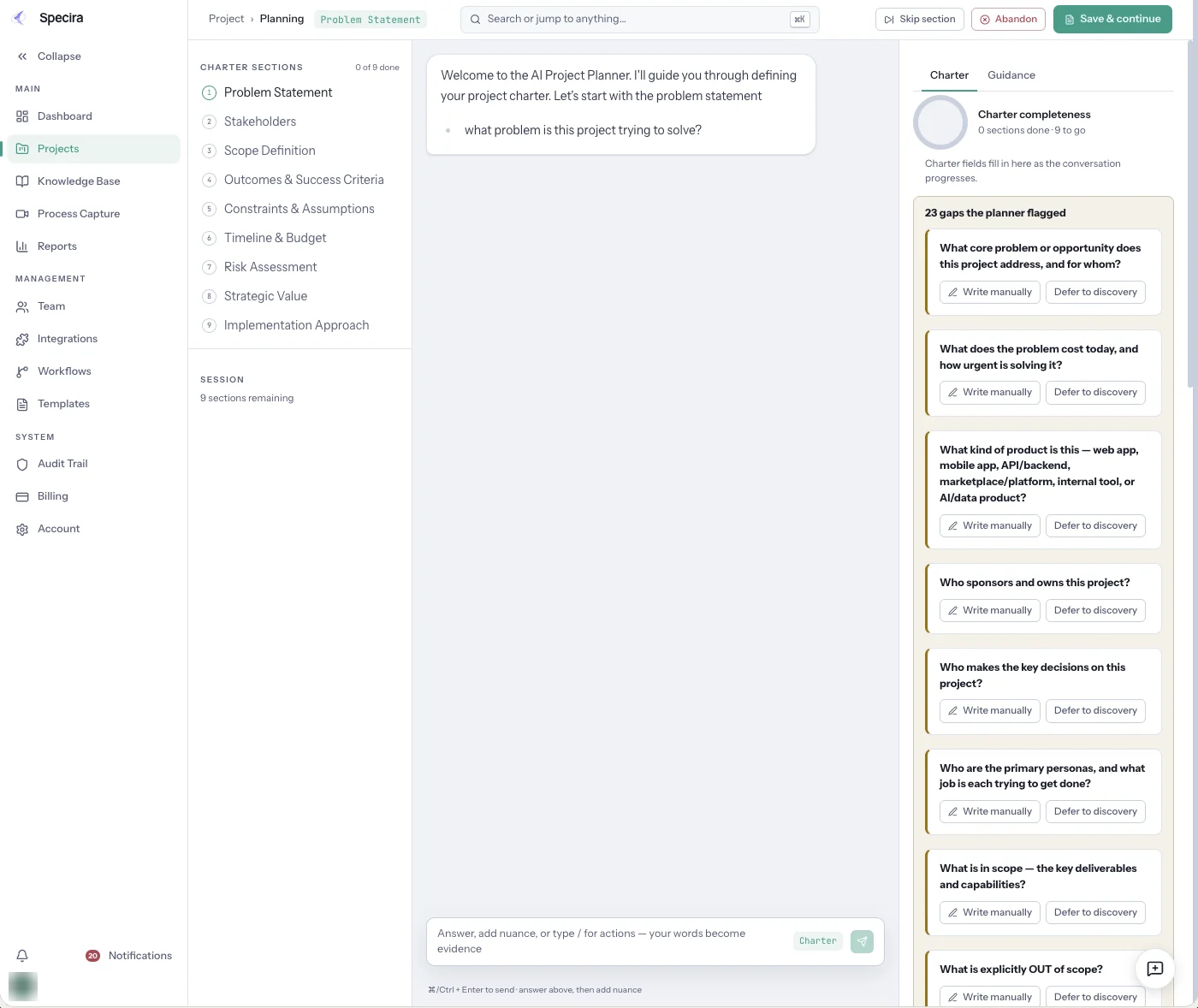
Specira applies the same conversational requirements approach that works for SaaS to the unique (and frankly terrifying) complexity of e-commerce. You describe your marketplace vision, and the AI asks the clarifying questions an experienced e-commerce architect would ask: "What happens when a customer disputes a charge for an order that's already been partially refunded?" "How does inventory sync when the same SKU sits in two different warehouses?" It automatically generates a complete specification covering every integration point and edge case.
This approach works because it mirrors how e-commerce teams actually think about launches: as a series of integration problems and business flow decisions, not as a single monolithic technical specification. The AI acts as a domain-aware technical sounding board, surfacing payment scenarios and inventory edge cases as you describe your product. You catch problems before they become production incidents that customers tweet about.
The three key outputs from this conversation are automatic:
- Domain-aware requirements: Your specification covers payments (refunds, disputes, subscriptions), inventory (multi-warehouse, backorders, pre-orders), shipping (carrier rules, zones, rates), and tax (jurisdiction calculation, exemptions). Not a generic template, but requirements specific to your marketplace model.
- Integration mapping: Every API endpoint (Stripe, Shopify, FedEx, TaxJar) is mapped to a business flow with documented error handling, retry logic, and what happens when integrations fail.
- Edge case coverage: The AI surfaces scenarios developers miss: partial shipments when inventory splits, currency conversion when selling to multiple countries, cart abandonment recovery workflows, seller payout scheduling, and chargeback handling.
Your development team starts coding with a complete specification of every integration point, every business flow, and every edge case. No surprises during integration testing (well, fewer surprises; software is still software). No firefighting in production at 3 AM. No post-launch discovery of payment flow bugs that should have been caught weeks ago when the cost of fixing them was a conversation, not a hotfix.
What results can e-commerce builders expect?
Teams that use Specira to clarify their marketplace architecture before coding see consistent improvements across three dimensions. These reflect what happens when you stop treating integration testing as your requirements discovery phase:
The speed gains come from having complete integration specifications upfront. Instead of building a payment flow, discovering during QA that you didn't specify partial refunds ("wait, what if they return only the sweater but keep the shoes?"), and then retrofitting it, you surface that requirement in the first conversation and build it correctly the first time. Your development team has a clear specification of every payment scenario, every inventory edge case, and every shipping workflow before they write a single API endpoint.
First-time-right integrations mean fewer production incidents. When your Stripe integration goes live, it works because your specification covered webhook handling, retry logic, and what happens when payment disputes arrive months later. When your inventory system syncs with your warehouse, it works because you specified multi-warehouse fulfillment rules and backorder workflows before anyone touched the code. That's a fundamentally different experience from the "deploy and pray" approach most teams default to.
Complete edge case coverage protects your reputation, and honestly, your sanity. E-commerce failures are immediately visible to customers: payments get stuck, orders don't ship, refunds vanish into the void. Surfacing partial refunds, chargeback handling, and multi-currency conversion logic before launch means you ship with genuine confidence that your platform handles the scenarios that actually happen, not just the happy path you demo'd to investors.
Faire: The B2B wholesale marketplace that scaled through clear specifications. Faire is a B2B wholesale marketplace that connects independent retailers with brands and wholesalers. Founded in 2018, Faire has grown to a $12.4 billion valuation by obsessively specifying their marketplace mechanics before building. (Source: TechCrunch)
Faire's initial success came from precisely defining their core marketplace model: "net 60 payment terms" where brands get paid 60 days after shipment, creating a financial incentive for quick fulfillment, and a consignment-like risk model where Faire absorbs returns, protecting retailers from inventory risk. These weren't afterthoughts; they were central to Faire's specification before their engineering team built the payment system. Every API integration, every inventory rule, and every financial workflow was specified to support that business model.
Clear specification of complex payment flows (delayed payments, returns handling, brand credit, dispute resolution) was critical to Faire's marketplace reliability and growth. When sellers trust that their returns will be handled fairly and that they'll get paid reliably, they build sustainable businesses on the platform. When payment and fulfillment workflows are right the first time, Faire's marketplace becomes a reliable supply chain layer for independent retail, not a source of integration chaos. Faire's valuation reflects the competitive advantage of a specification-first approach to complex marketplace mechanics.
Key takeaway
E-commerce specifications are uniquely complex because they involve real money, physical goods, and regulatory compliance across jurisdictions. What separates a successful marketplace launch from a delayed one isn't better code. It's better specification of payment flows, inventory states, and integration contracts before development begins.
- Payment flows must specify refunds, disputes, subscriptions, and escrow upfront
- Inventory logic must handle multi-warehouse fulfillment and backorders before launch
- Shipping and tax rules must be specified for every jurisdiction and currency you support
- Integration contracts must be mapped to business flows, not just API endpoints
What do teams ask most about this use case?