Why do solo developers spend 30% of their build time on rework?
Building a SaaS product solo means wearing every hat: product, architecture, frontend, backend, DevOps. I've been there, and so have dozens of founders I've talked to over the years. Without structured requirements up front, you'll inevitably build features that drift from your original vision, make architectural decisions you regret around month three, or miss critical data model considerations that force painful refactors while your runway shrinks. The worst part? There's nobody sitting next to you to catch those gaps.
The outcome's depressingly predictable. You spend the first 2 to 3 months "building the right thing," feeling great about your progress. Then you burn another 1 to 2 months rebuilding parts of it because of gaps in your original thinking. I remember one founder telling me she rebuilt her entire auth system three times before launch because she hadn't thought through role-based access upfront. Demoralizing doesn't begin to cover it, and it delays your time to first revenue.
The traditional fix? Spend weeks writing formal specification documents: use case diagrams, functional requirements tables, user stories, technical specs. For a solo builder, that overhead feels worse than the problem it solves. (Who wants to write a 40-page spec when you could be coding?) Either the docs go stale within a week and diverge from your actual code, or you skip them entirely and pay the rework tax later. Neither option is good.
How do solo developers currently handle requirements?
Most indie developers today fall into one of three camps. I've used all three myself, and honestly, each one has real limitations.
Approach 1: Sticky notes and mental models
Scribble features on a whiteboard or a Notion page, open your IDE, start coding immediately. Let the architecture "emerge organically." Fast? Absolutely, for the first two weeks. But you quickly lose sight of the full feature map, forget the edge case you thought about in the shower last Tuesday, and make conflicting architectural decisions that haunt you three months later when everything needs to talk to everything else.
Approach 2: User story templates (linear, asana, jira)
User stories in a backlog tool: "As a [user], I want [feature] so that [benefit]." It helps organize work, no question. But it's bottom-up thinking that doesn't surface architectural decisions or data model implications. You end up with 147 stories in Linear or Jira, and when you step back and ask "wait, does all this fit together?" the answer is usually a long silence.
Approach 3: Heavy documentation (technical specs)
You force yourself to write a proper technical spec: 20+ pages covering architecture, data models, API contracts, and business rules. Thorough, no question. But it eats 2 to 4 weeks of your limited runway, goes stale the moment you start coding (sometimes within days, honestly), and creates sunk-cost pressure to follow a plan that no longer matches reality. You feel obligated to stick with the monolith you specced even though microservices now make more sense.
None of these balance speed with structure. What you actually want is simple to describe and hard to achieve: capture your vision, validate that it holds together architecturally, and move into code confident that you've thought through the consequences of your design choices. Clarity without the overhead. That's the sweet spot.
How does AI-powered requirements capture change this?
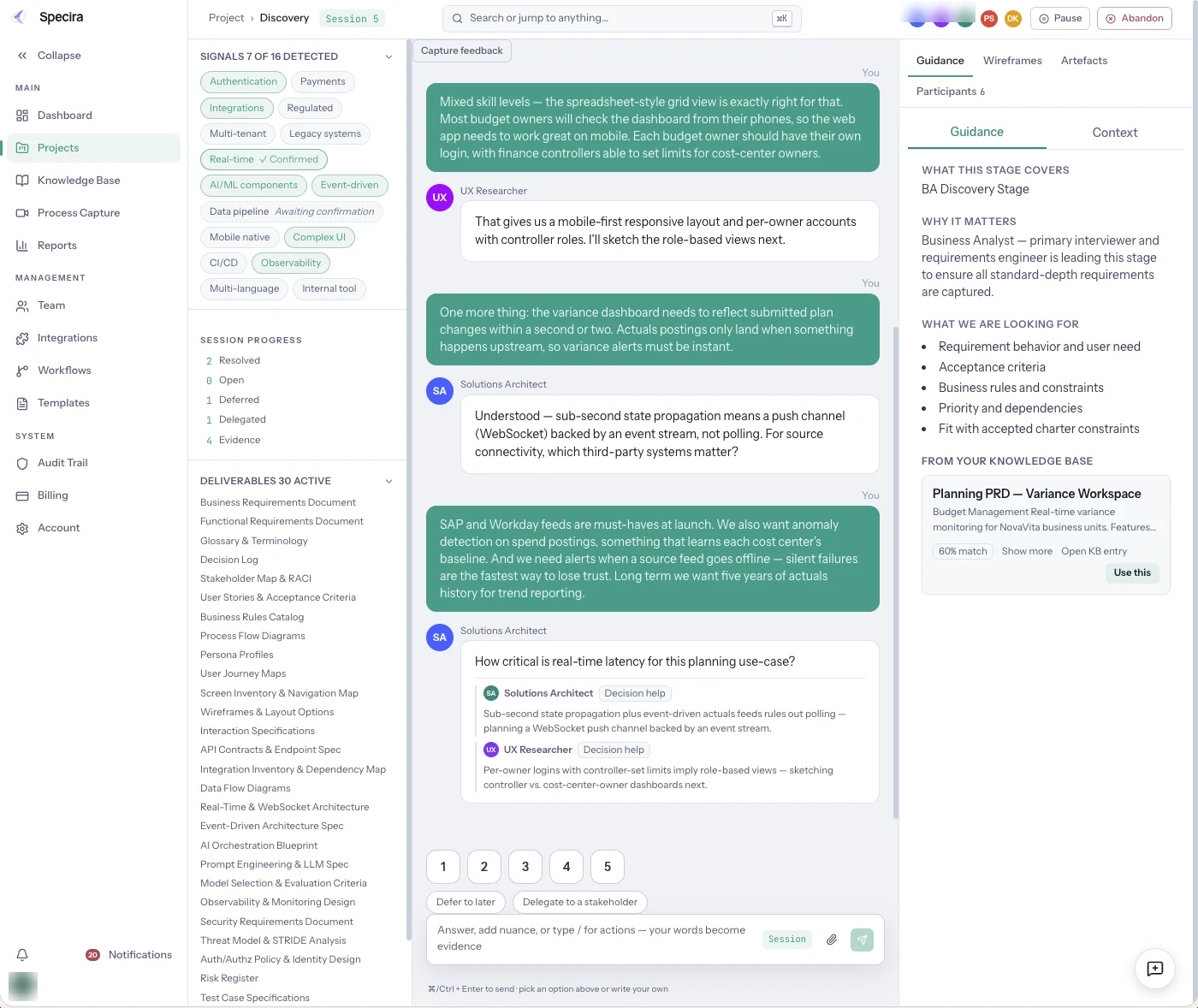
Specira flips the traditional approach on its head. Instead of sitting down with a blank Google Doc and staring at a cursor for an hour, you describe your product idea conversationally. Just talk about what you're building like you would to a cofounder over coffee. The AI captures requirements in real-time, asks the clarifying questions a senior architect would ask, and automatically generates a complete specification with architecture diagrams, data models, and API contracts.
Why does this actually work when other approaches don't? Because it mirrors how you think about products: as conversations and decisions, not formal documents. The AI acts as your technical sounding board, the cofounder you might not have, surfacing architectural implications as you describe features. "You mentioned user roles, but have you thought about whether admins need to impersonate other users?" Problems get caught before they become code, which is when they're cheapest to fix.
The three key outputs from this conversation are automatic:
- Living functional specification: A document that evolves with your product. It captures features, constraints, and business rules in a format that stays relevant as you code.
- Architecture diagram and data model: Not abstract, but concrete. Your database schema, API endpoints, and module boundaries are documented and validated before you write a line of code.
- Architectural decisions surfaced: The AI asks about multi-tenancy, authentication, scaling, and data privacy as you describe features, so you make intentional choices rather than defaulting to something that won't work at scale.
You start coding with a clear roadmap, fewer surprises, and dramatically less rework. And here's a bonus most solo founders don't think about until they need it: you also have documentation that investors, future team members, or acquisition buyers will actually value. I can't tell you how many founders I've met who got to the due diligence stage and had to spend three weeks reverse-engineering their own architecture to produce documentation they could have had from day one.
What results can solo builders expect?
Solo builders who use Specira to clarify their SaaS architecture before coding see consistent improvements across three dimensions. These aren't theoretical numbers; they reflect what happens when you stop guessing and start building from a real blueprint:
Where does the rework reduction come from? Making architectural decisions explicitly before coding. Instead of building a user authentication system, discovering your product needs role-based access control around week six, and retrofitting it (I've seen this exact scenario play out at least a dozen times), you surface that requirement in the first conversation and build it correctly the first time.
Speed gains come from clear scope and feature prioritization. You're not lying awake at 2 AM wondering what to build next; your specification tells you what MVP features are essential and what can wait for version 2. That clarity alone is worth the time investment.
And here's the part most solo founders overlook until they need it: when you eventually fundraise or sell, buyers want to understand your architecture and roadmap. A deck full of screenshots won't cut it. Specira gives you that material automatically, not as a frantic afterthought when the term sheet arrives.
Jon Yongfook, solo founder of Bannerbear: Bannerbear is an API that automatically generates images and videos from dynamic templates. Jon Yongfook built it entirely as a solo founder, bootstrapping it from zero to over $50,000 in monthly recurring revenue ($630K ARR) without outside funding. His approach: spend half his time coding and the other half marketing, with rigorous upfront product definition before writing any code. (Source: IndiePattern)
Jon's success hinged on clarity before code. He identified a specific market pain point (businesses needing hundreds of marketing visuals without hiring designers), defined the API contract and template system architecture precisely, then built it. One early blog post documenting his journey to $10K MRR went viral on Hacker News, bringing a wave of new users because the product was already solid enough to retain them. (Source: Starter Story)
Bannerbear demonstrates the solo founder advantage: when you invest time upfront in defining exactly what you're building, who it's for, and how the architecture will scale, you avoid the rework cycles that kill indie projects. Jon shipped free tools aligned to his core product that became top organic traffic pages, creating a sustainable growth engine that didn't require a marketing team. Clear specification turned a solo project into a business that competes with venture-backed alternatives.
Key takeaway
Solo developers succeed by being fast and efficient with their limited time and resources. Specira gives you the clarity and structure of enterprise requirements processes without the overhead. You get production-ready architecture, clear scope, and documented decisions, all from a single focused conversation before you start coding.
- AI-powered conversation beats sticky notes and mental models
- Structured requirements catch architectural problems before they become code
- Living documentation means you're not maintaining dead specs
- Investor-ready materials give you a fundraising advantage
What do teams ask most about this use case?