Why do features built by separate squads conflict at integration?
Multi-squad engineering is standard at growing B2B SaaS companies, and for good reason. One team owns billing, another owns core platform features, a third owns integrations. Distributed ownership, parallel development, domain specialization. Makes sense on paper and in the org chart. But here's what nobody plans for (and what I've watched happen at company after company): squads ship features that don't actually work together.
Picture this, because I guarantee you'll recognize it. Squad A finishes a new billing model with a redesigned invoice schema. They're proud of it; the code is clean. Squad B, three floors down or three time zones away, completes a pricing page referencing the old invoice structure. Both pieces of code? Perfect individually. Completely incompatible at merge. Months of work collide in a three-day integration sprint that nobody saw coming, and suddenly your release is delayed by three weeks while everyone points fingers.
Bad engineering isn't the root cause here. I want to be really clear about that, because the engineers always get blamed first. Siloed specifications are the real problem. Each squad writes their own product requirements document in isolation, completely unaware of what adjacent teams are building. Nobody surfaces that Squad A's data model change will break Squad B's API assumptions until code review or (worse) the CI pipeline. By then? Expensive, disruptive, and demoralizing.
Three structural failures drive this pattern, and after 25 years watching it happen, I can confirm they're entirely predictable. Domain boundaries are unclear (who actually owns the user profile schema? who controls the notification system? nobody knows, and nobody wants to ask because the answer might create more work). Interface contracts are verbal and unwritten, agreed upon in a Slack thread six months ago that nobody can find. Cross-squad visibility is zero until integration day. By then, both squads have committed to conflicting architectural decisions that each team considers "obviously correct."
And the cost compounds in ways that aren't immediately visible. A three-day integration crisis derails the sprint. A hotfix ships with less testing than anyone is comfortable with. Technical debt piles up as squads make locally rational optimization choices that conflict with adjacent teams' constraints. Eventually, the platform becomes harder to extend because every new feature must navigate a minefield of undocumented dependencies and implicit assumptions. I've seen a company reach the point where adding a simple field to the user profile required changes from four different squads. That's not architecture; that's archaeology.
How do SaaS companies currently manage cross-squad requirements?
Most multi-squad organizations default to one of three approaches. I've seen all three fail in their own unique and predictable ways:
Approach 1: Jira tickets without cross-squad visibility
Each squad maintains their own backlog in Jira. Epic owners write user stories per team, and each team adds their own technical notes and architectural decisions to their own tickets. The problem? There's no central place where Squad A can see that Squad B is quietly modifying a shared data model. Dependencies live in Slack conversations from three months ago or buried in Jira comments that everyone has already scrolled past.
Approach 2: Siloed product requirements documents
Product managers write PRDs (Product Requirements Documents) for their squad without consulting adjacent teams. A PRD captures features and user flows, but it rarely calls out interface contracts or domain model assumptions. When Squad A's PRD says "redesign the billing model" and Squad B's PRD is silent on how pricing integrates with billing, the conflict is invisible. Both teams build working implementations. Both are confident. Neither knows they're heading for a collision until the merge request shows up and the CI pipeline turns red.
Approach 3: Architecture review boards and monthly meetings
Teams sync monthly (or biweekly, if the VP of Engineering is really on top of things) to review roadmaps and surface conflicts proactively. Better than nothing, sure. But these meetings stay high-level, conflicts surface weeks after specifications are final, and fixing them requires re-planning that disrupts everyone's sprint. The cadence is too slow to catch everything, and the synchronous format makes it nearly impossible to dig into the technical details that actually matter.
None of these approaches surface integration conflicts at specification time, when they're cheap to fix. They all discover conflicts late, after both teams have committed to incompatible designs and written working code they're proud of. Asking either team to change at that point? You might as well tell them their baby is ugly. It's disruptive, expensive, and bad for morale.
How does AI-powered specification prevent cross-squad conflicts?
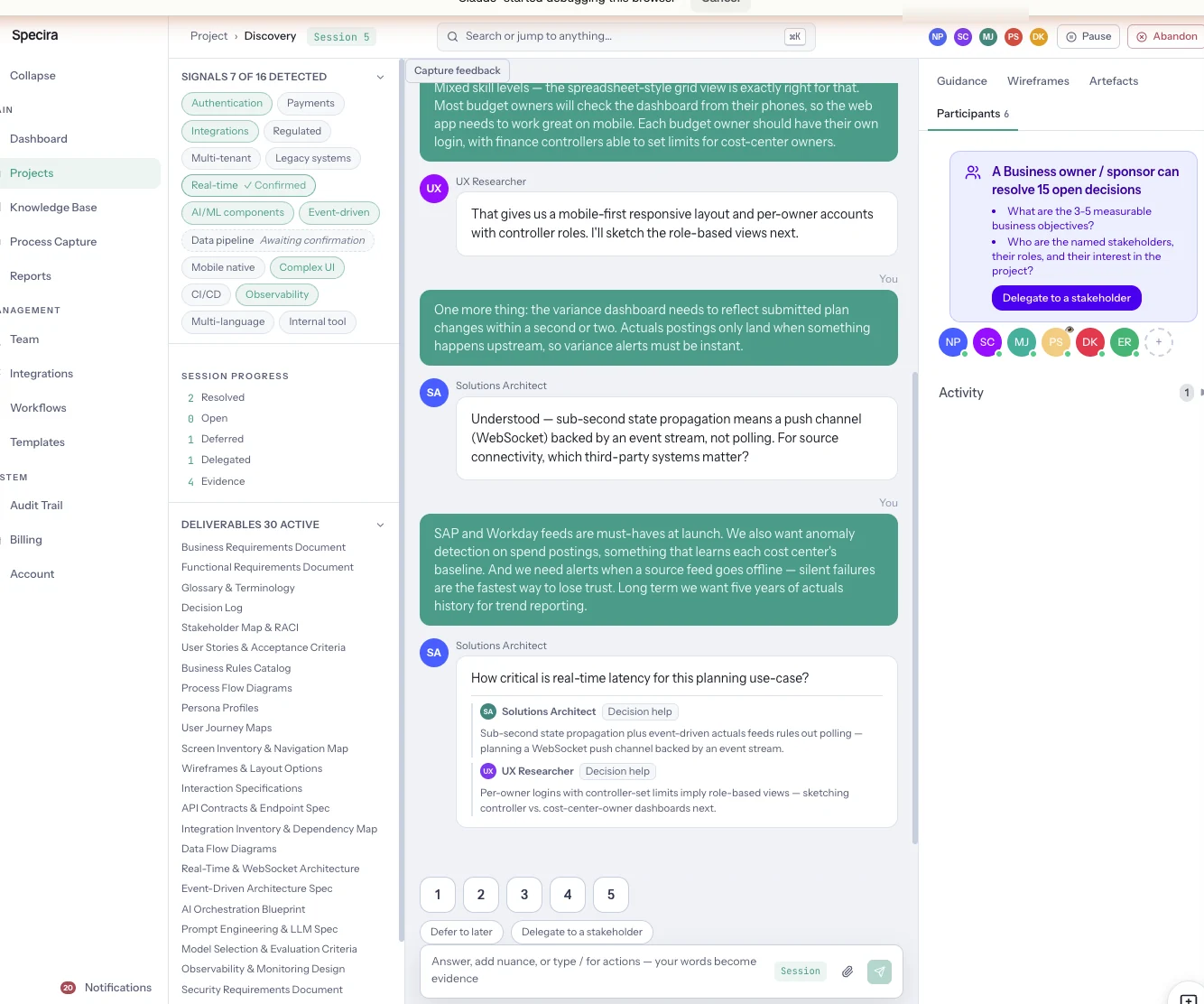
Specira transforms multi-squad coordination by making dependencies and conflicts visible at specification time, not integration time. Instead of five separate PRDs with five different assumptions about shared data models (each one internally consistent, collectively contradictory), all squads work from a unified specification layer that automatically surfaces conflicts the moment they appear.
Four key mechanisms make this work. I want to be specific here, because traditional tools like Jira, Confluence, and Notion don't have any of them.
Dependency-aware specifications
When Squad A writes their requirements, the system detects that they're modifying the user profile schema. When Squad B writes their requirements a week later, the system flags that Squad B's payment processor integration expects a different user profile structure. That conflict surfaces immediately, right in the specification tool, not at merge time when two developers are staring at a broken build wondering whose fault it is.
Interface contract generation
Instead of teams writing contracts in natural language or pasting ad-hoc JSON examples into Confluence pages nobody reads, the AI generates formal API contracts between squads based on their specifications. Squad A says "we're adding a subscription field to the user profile" and the system automatically generates an updated contract that Squad B's code can validate against during development. Not at integration. Not during the panicked Friday merge. During development, when changing a field name costs five minutes instead of five days.
Shared domain model
A single source of truth for entity definitions, relationships, and business rules prevents teams from developing conflicting assumptions about fundamental data structures. Domain model says a user has exactly one active subscription? Any squad trying to build multi-subscription support immediately gets flagged. That forces the conversation to happen at specification time over a calm 30-minute review, not in a panicked Slack thread at 11 PM when the release branch won't build.
Conflict detection before code
The system surfaces statements like "Squad A expects user.subscription to be an object with billing and renewal_date fields; Squad B expects it to be a string UUID." Before anyone writes a line of code. That shift alone moves integration risk from the end of the sprint (expensive, disruptive) to the beginning (when changing a spec takes minutes).
All squads reference a single specification layer with automatic conflict detection built in. When two teams' requirements collide, the system surfaces it immediately. Right time, right data, right conversation. No more "we should have talked about this three months ago" moments.
What results can multi-squad SaaS teams expect?
Teams using Specira to align multi-squad requirements see consistent improvements across three dimensions. These numbers come from the shift to catching conflicts at specification time instead of merge time:
Zero integration surprises comes from surfacing conflicts at specification time. When the unified spec detects that two squads have incompatible assumptions about a shared data model, the conversation happens before development, not at merge. Both teams adjust their design while changes are still just words in a document, not code someone spent three weeks writing.
That 35% reduction in escalations? It comes from fewer last-minute integration crises. Instead of a three-day "emergency integration sprint" (I've been in those rooms, and they are not fun) discovering conflicts and demanding urgent rework, escalations get resolved in a 30-minute specifications review. Product and engineering talk through the conflict with both squads present, make a decision, move forward. Calm, professional, resolved.
Shared documentation means every squad has a single source of truth for entity definitions, API contracts, and business rules. New engineer joins Squad B on a Monday? They don't need to spend their first week pinging Squad A about the user schema; it's already in the unified spec with full context. That alone cuts onboarding friction dramatically and prevents the knowledge silos that plague large engineering organizations. (I've seen companies where the only person who understood a critical API was on vacation in Portugal. That shouldn't be a business risk, but it was.)
Spotify's Squad Model and the integration challenge: Spotify's autonomous "Squad Model" became famous as a blueprint for scaling engineering teams. Each squad owns a vertical feature and operates with high autonomy over their technology choices and roadmap. But Spotify's own engineering leadership acknowledged the model had significant coordination challenges. Jeremiah Lee, a former Spotify engineer, documented how squads often built conflicting features because they lacked shared specification practices and visibility into adjacent teams' work. The company eventually moved toward stronger cross-squad alignment mechanisms, including shared technical standards and dependency mapping.
The lesson is clear: autonomous squads need a shared specification layer to ship coherently. Spotify's experience shows that organizational structure alone is insufficient. You need tools and practices that give every squad visibility into how their decisions affect adjacent teams, and that surface conflicts before they become expensive integration crises. Spotify's engineering blog now emphasizes "alignment without consensus," using shared specifications and interface contracts to let squads move fast while preventing costly conflicts.
Key takeaway
Multi-squad SaaS companies fail at integration not because of bad engineering or bad organization, but because of siloed specifications. When five squads write five separate PRDs with five different assumptions about shared data models and interfaces, conflicts are inevitable and discovered too late to fix cheaply.
- Unified specifications prevent siloed assumptions about shared data models
- Conflict detection at specification time is 10x cheaper than merge time resolution
- Interface contracts give squads autonomy while preventing incompatibilities
- Shared documentation reduces onboarding friction and knowledge silos
What do teams ask most about this use case?