There is a number your finance team sees every month. Call it $19 per seat, times however many developers you have, times however many tools are in the stack. Copilot. Cursor. Kiro. Maybe Tabnine still running on a few machines. The invoice is clean and concrete and completely comprehensible to anyone who has ever opened a spreadsheet. What does not appear on that invoice is the number that actually determines whether your AI coding investment is paying off, and that number does not live in any dashboard I have ever seen.
Rework. Specifically: the rework compounded by the fact that your team is now producing features twice as fast against requirements that are still just as ambiguous as they were before you bought a single seat of anything. That is the hidden cost. And after 25 years of watching enterprise software projects from the inside, I want to talk about the math behind it, because the math is not complicated, and the gap between "what teams believe they're getting" and "what is actually happening" has gotten significantly worse since AI coding tools went mainstream.
What is the hidden cost that AI coding ROI calculations miss?
Most ROI calculations for AI coding tools measure one half of the equation. The execution half. Time to write a function. Pull request throughput. Deployment frequency. These are real metrics, and the tools genuinely move them. I am not disputing that. What I am saying is that measuring only the execution half is like measuring how fast someone drives without asking whether they are going in the right direction.
The other half of the equation is requirements quality. Every project has a baseline failure rate at the requirements level: some percentage of stories that will need significant rework because the spec was wrong, the edge cases were missed, the stakeholder said one thing and meant another. Nobody tracks this number explicitly, but it is there, embedded in your sprint retros and your "that's not what I asked for" moments and your post-release change requests. Before AI tools, this failure rate generated rework at a certain pace. After AI tools, it generates rework at a much faster pace. Same failure rate. Higher velocity. More code committed before the problem surfaces.
That number is worth sitting with. Developers felt faster. The aggregate data showed they were slower. The perception gap, where engineers estimated they were 20% more productive while measured results showed them 19% behind, is not a coincidence. It is a structural feature of what happens when you optimize one part of a system that depends on the whole pipeline working. The bottleneck did not disappear. It moved.
How does AI velocity become a requirements debt multiplier?
Let me give you the simplest version of the math. Say your team ships one feature per week. Of those features, 20% (one in five) eventually require significant rework because the requirements were misaligned or incomplete. So once every five weeks, you eat a rework sprint. That is your baseline. Now you adopt Copilot and your throughput doubles. You ship two features per week. Your rework rate is unchanged, because Copilot has no opinion about whether your requirements are any good. So you now have a rework sprint every two and a half weeks instead of every five. Twice as much rework in the same calendar quarter.
Actually, it is worse than that. When throughput doubles, the amount of code committed before someone catches a requirements failure also doubles. More code to unwind. More tests to redo. More integration touchpoints to revisit. The rework itself gets more expensive even before you factor in the frequency increase.
This is what I mean by the velocity multiplier. AI tools do not change the probability of hitting a requirements failure. They change how fast you get there and how much you have built when you arrive. The hidden cost is not the subscription fee. It is the subscription fee times whatever multiple your AI-amplified velocity applies to your existing requirements debt.
"AI-assisted PRs have 1.7 times more issues than human-authored PRs, with incidents per pull request jumping 23.5% and review times growing 91% year-over-year."
LinearB 2026 Software Engineering Benchmarks Report
That 91% figure on review time is telling. When the code is generated faster but its quality needs more scrutiny, you have transferred effort from writing to reviewing. The total effort does not shrink. It shifts, and it shifts toward a part of the process that does not show up in the "AI makes us faster" narrative that gets used to justify the spend.
What does the data actually say about AI tools and delivery outcomes?
GitClear. Real data, not survey data. In their 2025 analysis of 211 million changed lines across repositories at Google, Microsoft, Meta, and enterprise companies, they found that code churn (new code revised within two weeks of its initial commit) nearly doubled, growing from 3.1% in 2020 to 5.7% in 2024. Copy-pasted code increased 8x during that same period. And the share of "moved" lines, which is refactoring, the thing that keeps a codebase coherent over time, dropped from 24.1% to 9.5%. Less refactoring. More duplication. More churn. These are not the signatures of a system that is getting better at requirements alignment. These are the signatures of a system that is getting better at generating code fast and worse at generating the right code.
Separately, Sonar's 2026 State of Code Developer Survey, which covered thousands of developers across organizations of all sizes, found that 38% of developers report reviewing AI-generated code requires more effort than reviewing human-written code. Twenty to forty percent of sprint capacity was being consumed by rework in affected teams. And here is the part that should trouble every engineering leader: the amount of time spent on toil was almost exactly the same (23 to 25%) for developers who use AI tools frequently and those who use them less often. The tools did not reduce the toil. They moved it around.
From the Field: what happens when the velocity promise collides with reality?
When Augment Code analyzed patterns across engineering teams adopting AI coding tools heavily in 2024 and 2025, they documented what they called "compounding specification debt": teams that adopted AI coding tools without governance frameworks saw a 4x increase in code duplication within 18 months, and test coverage in AI-assisted projects averaged 12%, compared to 68% in traditionally developed codebases. The maintenance cost of that code ballooned 300% within the same window.
The pattern they identified was consistent across industries: initial velocity gains in quarter one, followed by an inflection point around the 25,000-line mark where the cost of adding new features began to exceed the cost of manual development. Not because the AI tools stopped working. Because the requirements they were executing against were never validated, and the velocity had prevented anyone from noticing until enough code existed to make the problem genuinely expensive. Source: Augment Code: AI Technical Debt Compounds
This is the pattern I have been watching across enterprise teams for the past two years. The tools work exactly as advertised. The problem is that the advertisement only covers half of the system.
The Core Economic Argument
AI coding tools measure their value at the execution layer: faster code, more PRs, higher deployment frequency. These metrics are real. But they are incomplete.
The requirements layer sits upstream. It determines what gets built. When that layer has gaps, ambiguities, or unvalidated assumptions, those problems propagate downstream through every sprint. AI velocity does not filter out those problems. It accelerates them.
The true cost of your AI coding stack is: subscription cost, plus (requirements failure rate x velocity multiplier x cost per rework sprint). Most teams track only the first number. The second number is almost always larger.
How do you measure both sides of the AI coding equation?
Here is a thing I have said to engineering leaders in probably forty conversations over the past year: your AI tools are not the problem. The problem is that you are measuring one side of a two-sided equation and calling it an ROI calculation. Incomplete math. It feels like accounting. It is not.
The visible side of the equation is what most teams already track: subscription cost per seat per month, pull request volume, deployment frequency, maybe cycle time from commit to production. Fine. Track all of that. Now add the other side, which most teams do not track at all. How many stories return from Quality Assurance or staging for requirements reasons, not code quality reasons? What percentage of post-release change requests trace back to specs that were unclear at the start? How many sprint reviews end with someone saying "that's not quite what I meant" and generating follow-on work? These numbers exist in your project management tool right now, as reopened tickets and "rejected" story states and comments threads nobody has looked at in months.
Pull them. The ratio of those numbers to your total sprint output is your requirements failure rate. Multiply it by the velocity multiple your AI tools have created. That product is your compounded rework exposure, and it is the number that determines whether your AI coding investment is actually ahead or just moving fast toward the same wall you were always heading toward.
There is a version of this story where AI tools are neutral on the requirements problem, maybe even slightly helpful, because faster feedback loops give you more chances to catch misalignments before they compound too far. I have seen that version work for teams with genuinely strong requirements practices already in place. For those teams, AI velocity is additive. For everyone else (and from what I have seen, "everyone else" is roughly eighty or ninety percent of software teams) the tools accelerate arrival at the problem without doing anything to prevent it.
The fix is not to stop using the tools. The fix is to treat requirements quality as a first-class input to the ROI calculation, the same way you treat seat count and deployment frequency. Measure your requirements failure rate. Track what fraction of rework traces back to upstream ambiguity. If that number goes up after AI adoption, you know exactly what is happening: the velocity multiplier is working against you.
The invoice is visible. The compounded cost is not. That asymmetry is what makes this problem persistent. Finance sees one number. Engineering leadership sees a different number. The real number is the product of both, and nobody is running that calculation.
What would measuring the other half of the AI coding equation look like?
A second scoreboard. Your coding stack already reports commits, pull requests and deployment frequency; Specira reports what happened upstream, where the project overview shows how many requirements exist, how many cleared approval, and which discovery sessions produced them. The requirements list adds a quality score per line, with the source and the owner beside it. The dashboard is the part that stings, because it names the projects that stopped moving while everyone was busy shipping.
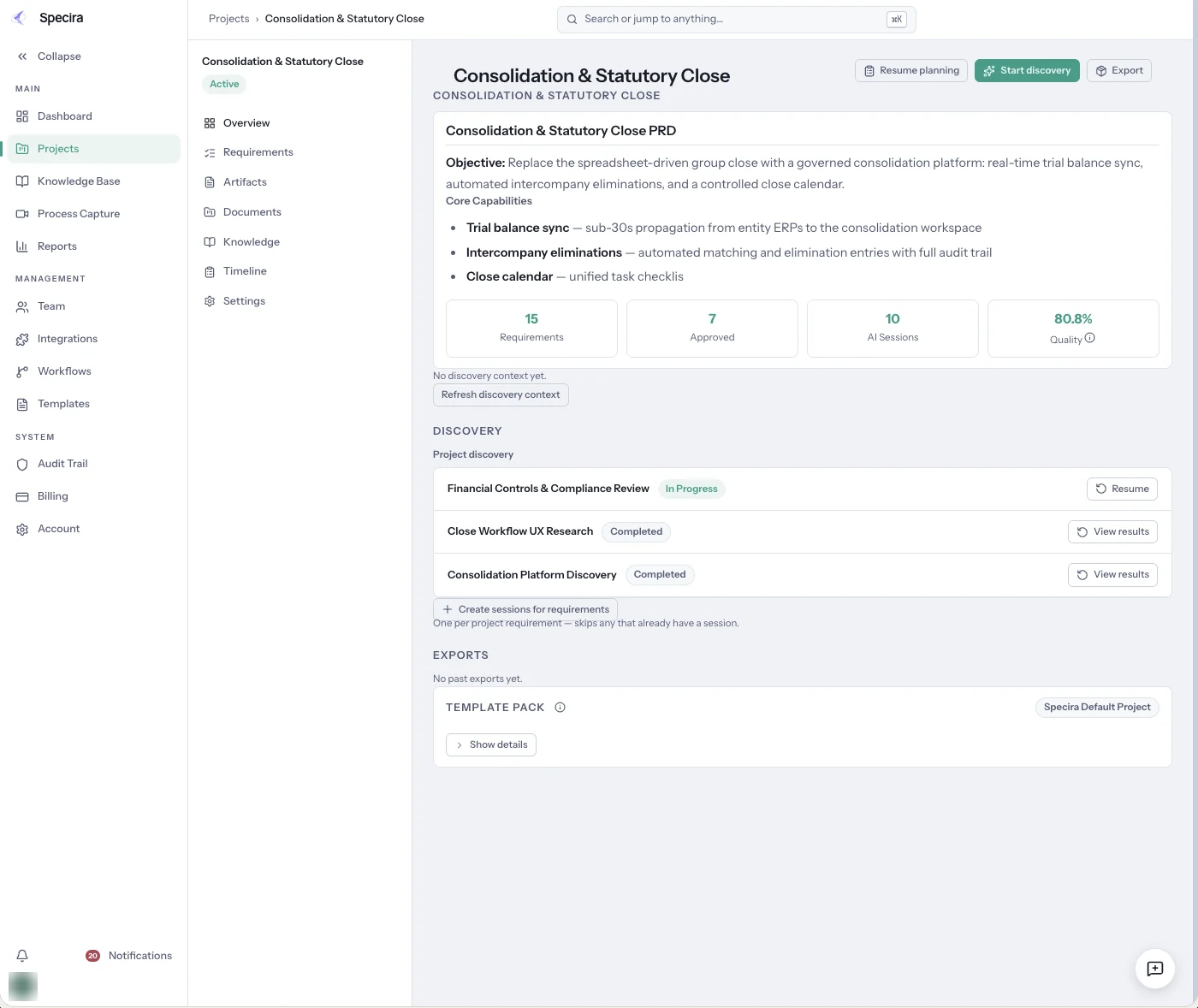
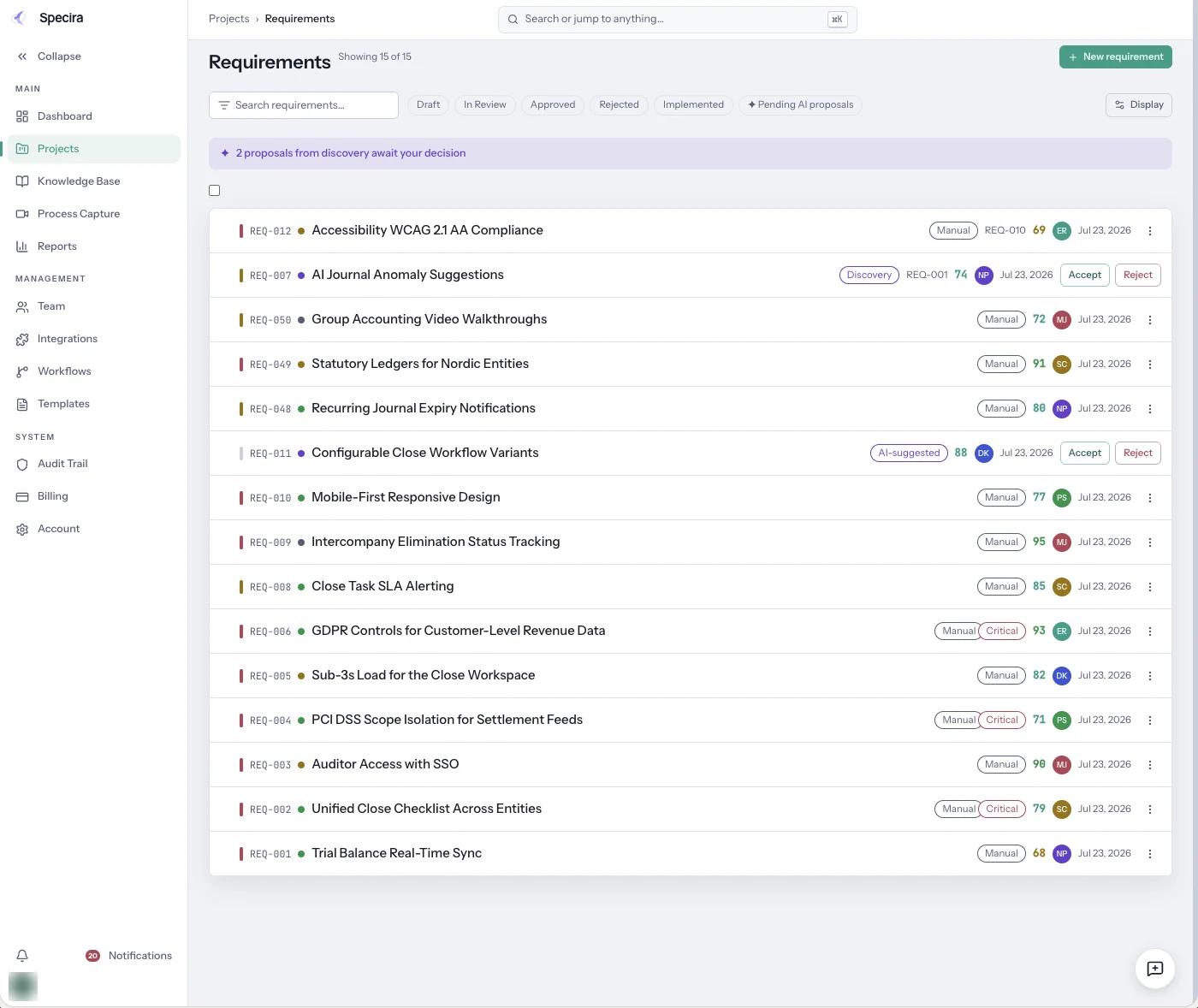
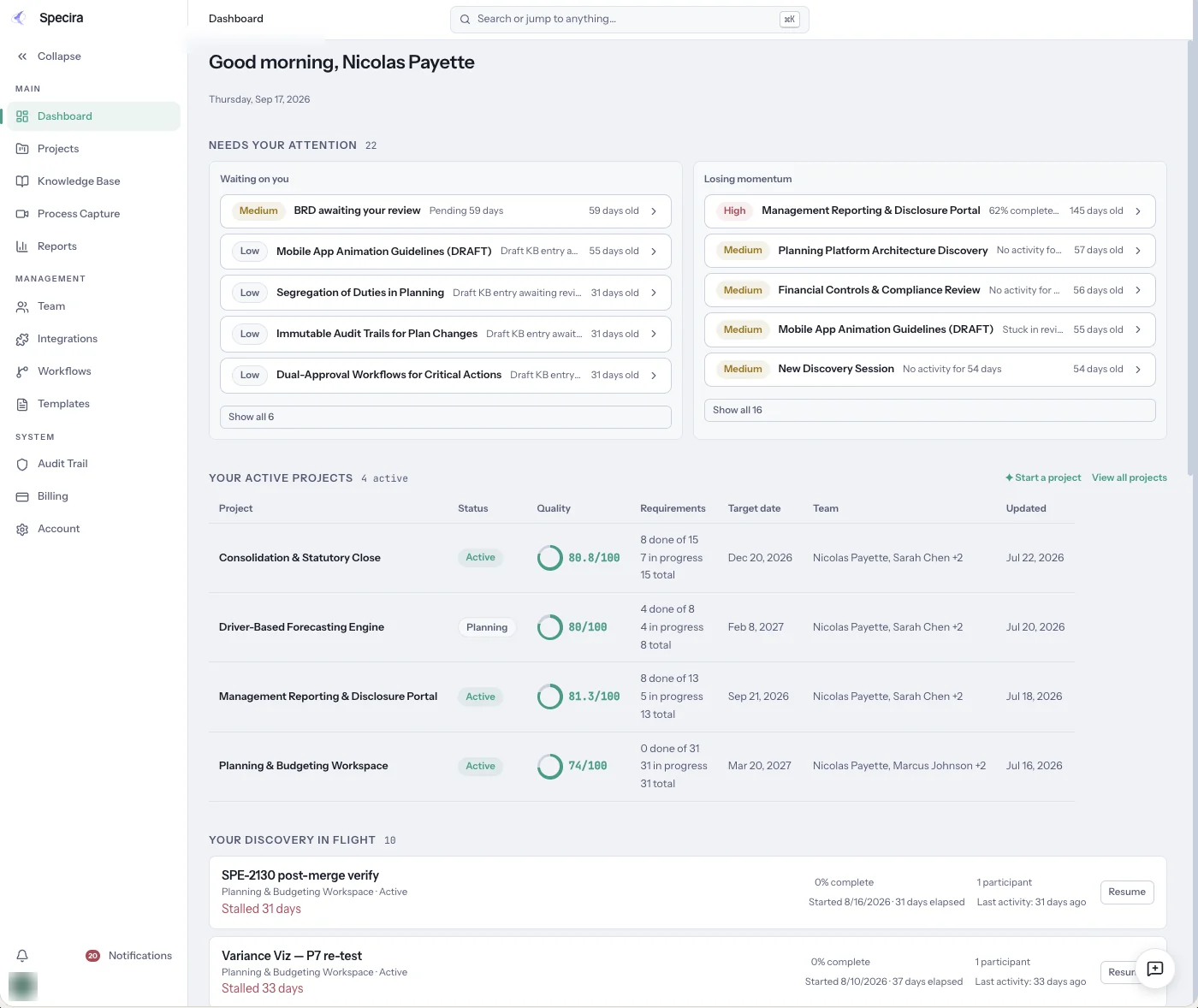
What you are looking at. The project overview counts the requirements and approvals behind a project, the requirements list scores each line, and the dashboard shows which projects lost momentum while the commits kept coming.
Bring your AI coding return slide. We will show you the upstream numbers it does not have a row for.
Book a DemoScreens are from a seeded Specira demo workspace; counts and scores are sample data.
What are the most common questions about hidden AI coding costs?
What is the hidden cost of AI coding tools that most ROI calculations miss?
The subscription fee for tools like Copilot, Cursor, or Kiro shows up on an invoice. What does not show up is the rework cost those tools compound when they accelerate development against ambiguous or incomplete requirements. AI velocity does not reduce the rate of requirements failures. It just means teams reach those failures faster, with more code committed when the problem finally surfaces.
Why does AI coding speed make requirements problems more expensive, not less?
When a team codes faster, they commit more lines before anyone catches a requirements misalignment. The further into development a requirements error goes, the more expensive it is to fix: more code to rewrite, more tests to redo, more integration to untangle. AI tools accelerate arrival at the failure point without doing anything about the quality of the starting requirements.
Does the LinearB 2026 benchmark data confirm AI coding tools hurt delivery outcomes?
Yes. LinearB's 2026 Software Engineering Benchmarks Report, drawn from 8.1 million pull requests across 4,800 engineering teams in 42 countries, found that end-to-end delivery is 19% slower when accounting for the full workflow, even as individual PR volume increased. Incidents per pull request jumped 23.5% and review times grew 91%. Developers felt faster. The data showed otherwise.
What does the velocity multiplier on requirements debt actually mean in practice?
Every team has a baseline requirements failure rate: a percentage of stories that will need significant rework because the spec was wrong, incomplete, or misinterpreted. AI coding tools do not change that rate. They change the volume of code produced per unit time. So if 20% of requirements lead to rework, and your team now ships twice as fast, you reach those rework moments twice as fast, with twice as much code already written. That is the velocity multiplier.
How do you measure whether your AI coding investment is actually paying off?
Track both sides of the equation. The visible side: subscription costs, PR volume, deployment frequency. The hidden side: sprint rework rate, stories that return from Quality Assurance or staging for requirements reasons, post-release change requests that trace back to unclear specs. If your PR volume doubled but your rework rate held steady, you are not ahead. You are spending more on the hidden side.
What is the difference between this argument and the Copilot Hangover article?
The Copilot Hangover established the general premise: AI coding tools make requirements problems worse. This article goes deeper on the economic mechanism. The Copilot Hangover asks why. This article asks how much. The hidden cost framework explains that requirements debt times velocity equals the true compounded cost that never appears on any invoice or dashboard.