A business requirements document template (BRD) gives a sponsor one place to read the problem as a measured fact, the options weighed against the same criteria, and the option the team recommends. The decision it supports is a funding decision: build, buy or do nothing, with the owner and the date of the benefit written next to it. Specira compiles the BRD from the decisions your discovery session actually resolved, not from a blank page.
Hand-written BRDs drift. The executive summary gets written first and promises things the options analysis never examined, the constraints table is copied from the last project, and nobody can say who agreed to the success criteria or when. Six weeks later the same debate reopens in a steering meeting, because only the conclusion was captured and never the reasoning behind it.
What sections does the business requirements document contain?
The governed default template fixes thirteen sections, each with its own production strategy: prose synthesized from discovery, a table built from typed items, or a cross-reference to a sibling artefact.
| Section | Depth | How it is produced |
|---|---|---|
| Executive Summary | core | Prose synthesized from discovery |
| Business Problem | core | Prose synthesized from discovery |
| Goals & Success Criteria | core | Table from typed items · Goal, KPI, Baseline, Target, Timeline, Owner |
| Business Requirements | core | Table from typed items · ID, Business Requirement, Priority, Acceptance Criteria, Traces To |
| Scope | core | Prose synthesized from discovery |
| Constraints | core | Table from typed items · Constraint, Constraint Impact, Compliance Approach |
| Stakeholder Analysis | standard | Table from typed items · Name, Role, Influence, Interest, Engagement Strategy |
| Assumptions & Dependencies | standard | Table from typed items · Assumption, Risk If Wrong, Validation Plan, Owner |
| Risk Summary | standard | Table from typed items · Risk, Likelihood, Impact, Score, Mitigation, Contingency |
| Decision References | standard | Cross-reference to another artefact |
| Regulatory Mapping | full | Table from typed items · Regulation, Requirement, Control, Status |
| Cost-Benefit Analysis | full | Prose synthesized from discovery |
| Strategic Alignment Matrix | full | Table from typed items · Strategic Goal, Project Contribution, Alignment Score |
How does Specira build the BRD?
The Business Analyst agent owns the BRD. It compiles the document from the session's typed items (business requirements, constraints, stakeholders, assumptions, risks and the decisions that resolved them) while the UX Researcher, Solutions Architect, Security Analyst and Red Team Critic add inline notes during discovery. The Meridian sample shows the mechanism. Its Problem and Opportunity section renders the current dispatch process as a diagram and refuses adjectives, because the template forbids them there. Its Options Considered section scores do-nothing, buy and build on criteria the sponsor agreed before scoring, and every verdict carries who evaluated it, how, and what they found.
Each section declares its required decisions and evidence. If the criteria decision were still open, the options table would render as a named gap instead of an invented comparison. Knowledge base entries such as the union assignment rule are matched with a confidence score and cited in place. Before export, the Red Team Critic runs the readiness gate, which counts decisions resolved rather than pages written; deferred decisions ship in the gap report. Export to DOCX for the sponsor, Markdown or JSON for your own agents, or push to Confluence and Jira.
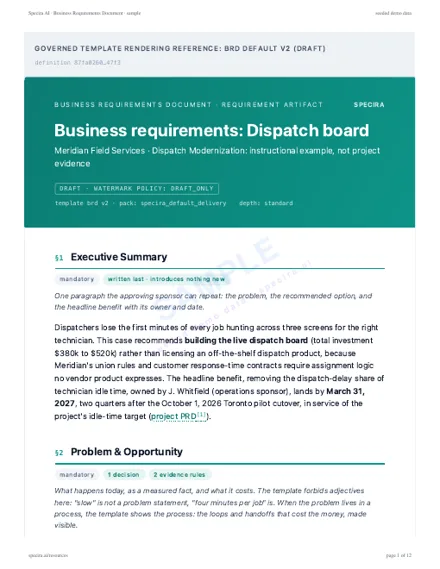
Rendered sample
Rendered from the Specira governed default template on a fictional company, watermarked, with its diagrams. Read it in the browser or take the PDF.
How do teams use the BRD?
- ✓Fund or decline with reasonsThe sponsor reads one options table where the declined options carry their evaluation trace, not just a verdict.
- ✓Keep scope honestThe problem-sizing decision names which slice of the pain this requirement owns and which slices belong elsewhere.
- ✓Trace every requirementEach business requirement row links forward to the product requirements document objective it serves and back to the evidence that justified it.
- ✓Reopen nothing twiceWhen someone asks in October why the vendor product was declined, the answer is on the page with a name and a date.
What does the BRD look like inside Specira?
The screens below follow the dispatch-board business case from the discovery turn where the criteria were agreed to the exported document.
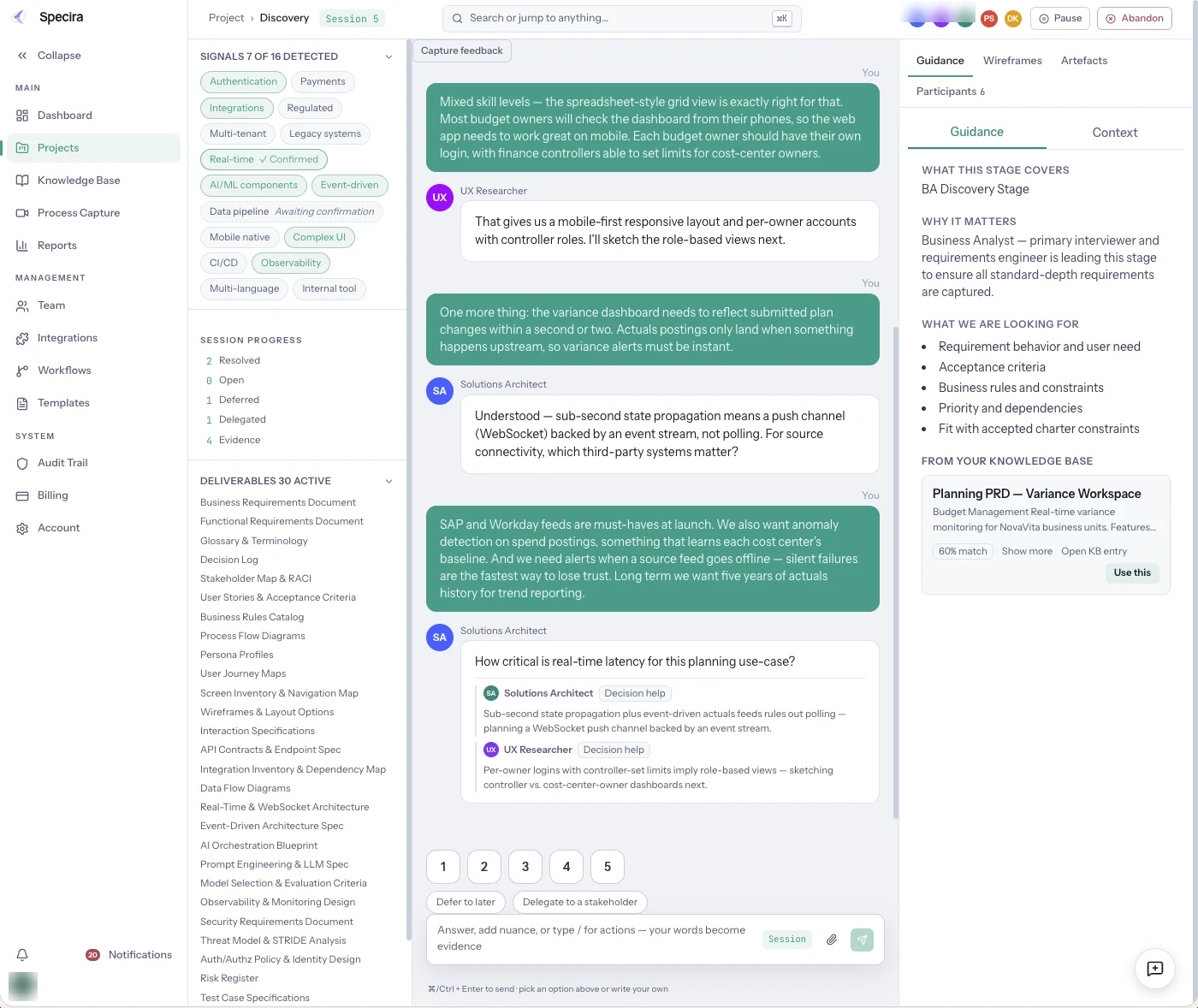
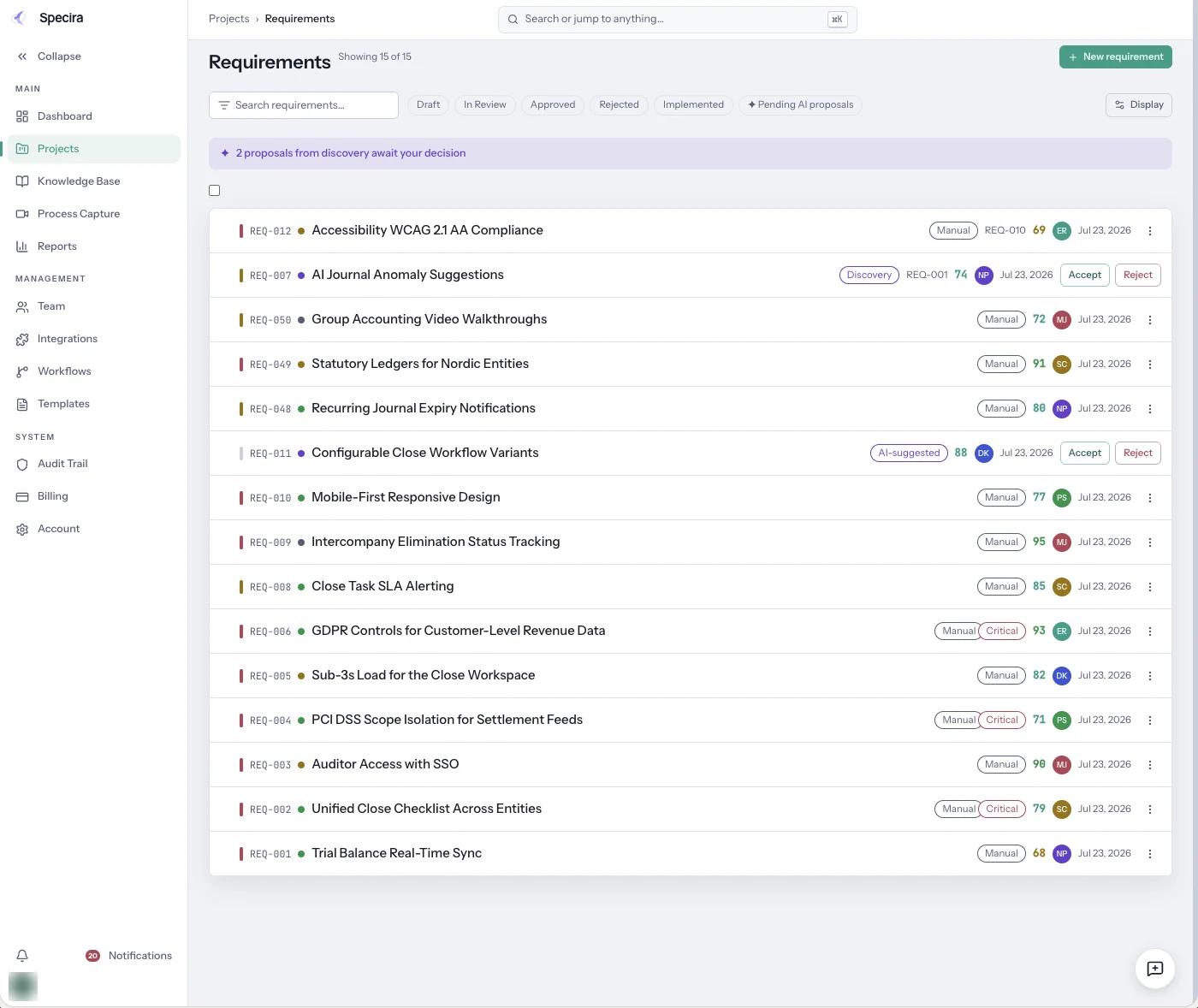
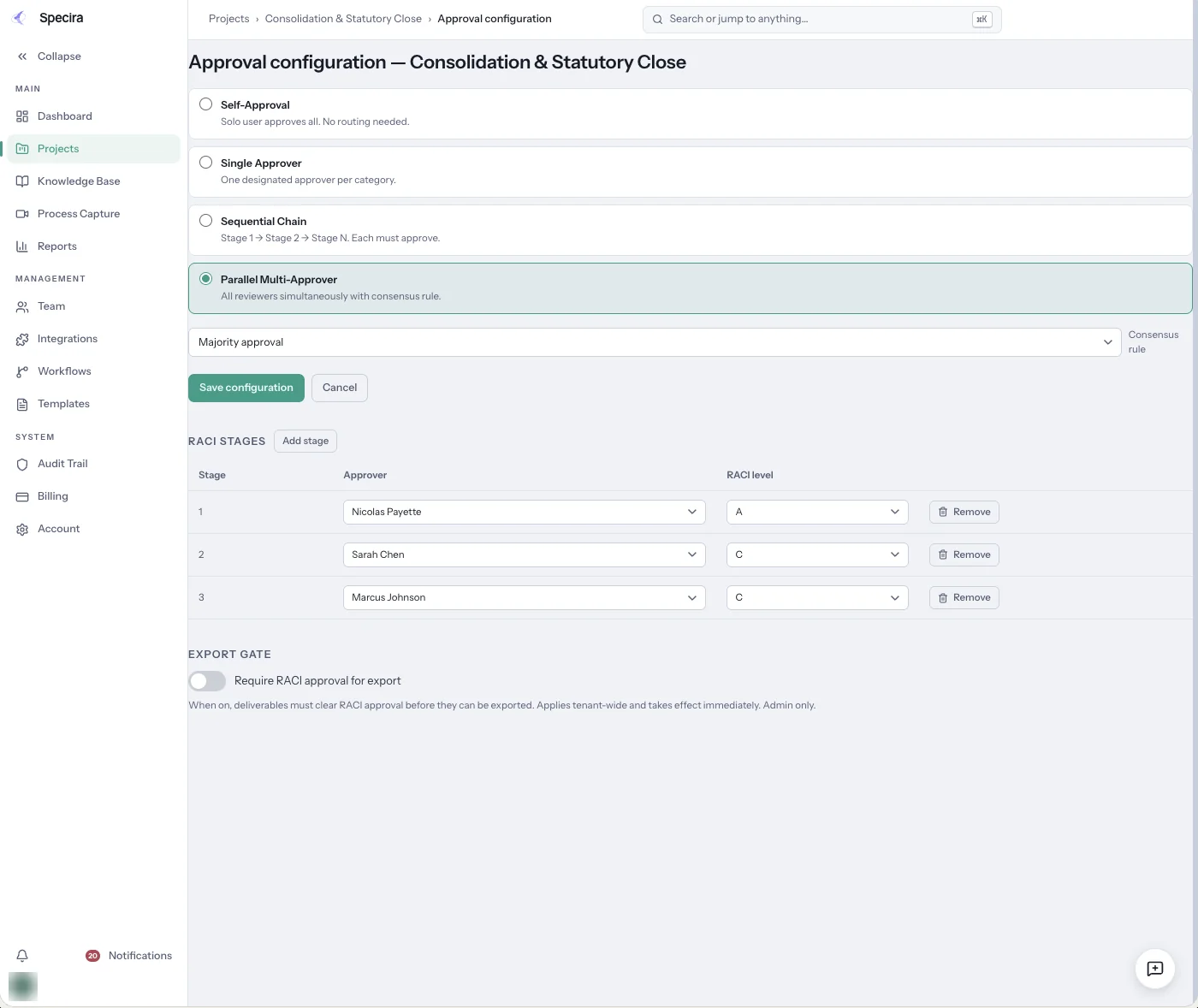
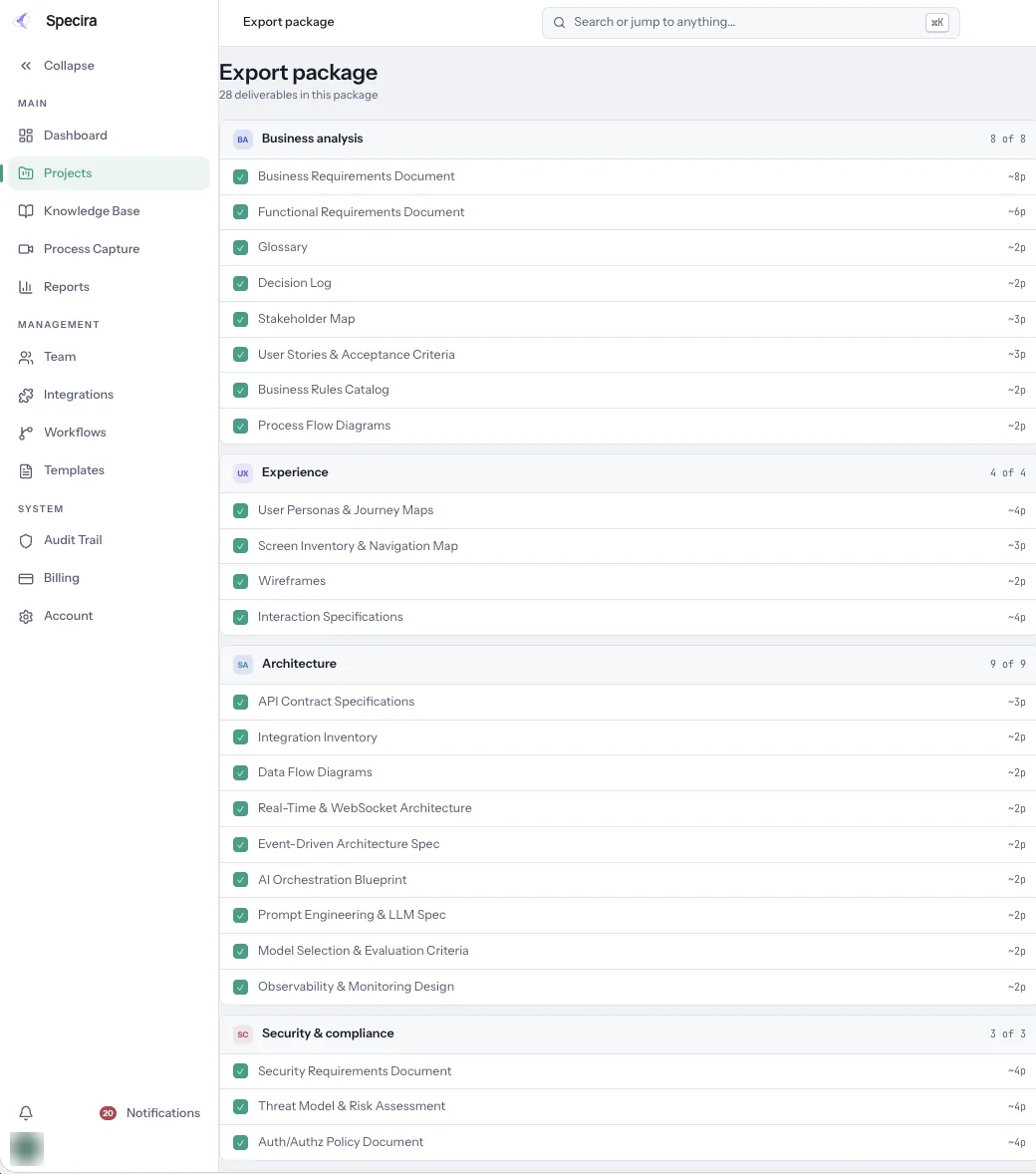
Screens are from a seeded Specira demo workspace; counts and scores are sample data.
Book a demo and watch a business requirements document compile from a live discovery session.
Book a Demo