A product requirements document template (PRD) is where a team commits to the one problem it will solve, for whom, and how it will know it worked. The decision it supports is the commitment itself: which personas are in, which are deliberately out, which metric is the north star and what makes a guardrail trip. Specira renders the PRD as the project-level artefact that every requirement-level document cross-references instead of restating.
Written by hand, a PRD becomes a feature wish list with a vision paragraph on top. Personas are invented in the author's chair, success metrics have no baseline or capture method, and the edge cases are discovered by the tester. The sponsor reads solution language in the problem section, and nobody notices that the scope quietly grew between the first draft and the last.
What sections does the product requirements document contain?
The governed default template covers vision, users, features, workflows, metrics, edge cases and constraints, each section either synthesized from discovery or tabulated from typed items.
| Section | Depth | How it is produced |
|---|---|---|
| Product Vision | core | Prose synthesized from discovery |
| Target Users | core | Prose synthesized from discovery |
| Feature Inventory | core | Table from typed items · Feature, Description, Priority, Complexity, Objective |
| User Workflows (Key) | core | Prose synthesized from discovery |
| Success Metrics | core | Table from typed items · Metric, Baseline, Target, Method |
| Detailed User Workflows | standard | Prose synthesized from discovery |
| Edge Cases per Feature | standard | Table from typed items · Feature, Edge Case, Expected Behavior |
| Notification Requirements | standard | Table from typed items · Event, Channel, Recipient, Template |
| Reporting Requirements | standard | Prose synthesized from discovery |
| Competitive Analysis | full | Prose synthesized from discovery |
| Release Strategy / Phasing | full | Prose synthesized from discovery |
| Risks & Mitigations | standard | Prose synthesized from discovery |
| Out of Scope (Not Doing) | standard | Prose synthesized from discovery |
| Timeline & Milestones | standard | Prose synthesized from discovery |
| Non-Functional Requirements | standard | Table from typed items · NFR Metric, NFR Target, NFR Measurement |
| Wireframes & Prototypes | standard | Cross-reference to another artefact |
| Analytics & Instrumentation | full | Table from typed items · Event, Properties, Dashboard, Alert Threshold |
How does Specira build the PRD?
The Business Analyst agent owns the PRD, with the UX Researcher weighing in on personas and workflows and the Solutions Architect, Security Analyst and Red Team Critic adding inline notes on constraints, risks and scope. The document is compiled from typed items: requirements, decisions, stakeholders, assumptions and risks. In the Meridian sample, the Problem and Product Vision section quotes a dispatcher interview and carries three recorded decisions, including the problem-framing decision that names the single problem the project commits to. The Target Users section describes Dana, Priya and Marcus by name, cites the discovery sessions they came from, and records which groups were deliberately excluded and why.
The Success Metrics section demands a baseline, a target date, a cadence and a signal type for every measure; an unresolved metric renders as a named gap rather than a plausible number. The template also enforces that no solution language appears in the problem section. Every row carries provenance, and knowledge base entries such as exit-interview themes are matched with a confidence score and cited. The Red Team Critic gates the export on decisions resolved and ships deferred ones in the gap report; the result exports as DOCX, Markdown or JSON, or pushes to Jira, Confluence, GitHub and Linear.
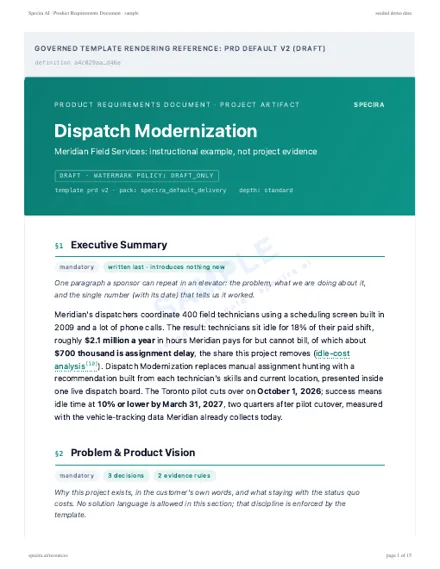
Rendered sample
Rendered from the Specira governed default template on a fictional company, watermarked, with its diagrams. Read it in the browser or take the PDF.
How do teams use the PRD?
- ✓Agree the scoreboard firstProduct, engineering and the sponsor sign the metrics table before a feature is sized, with baselines and capture methods attached.
- ✓Anchor every requirementEach business requirement, functional requirement and story set references the PRD objective it serves by cross-reference.
- ✓Say who is excludedThe persona-priority decision records who the product is not for in this release, so scope conversations start from a written line.
- ✓Hand agents a structured specThe JSON export gives coding agents and analytics tooling the same commitments a human reads in the DOCX.
What does the PRD look like inside Specira?
The screens below follow a PRD inside Specira, from the project overview and the discovery session that feeds it to the rendered document and the export package.
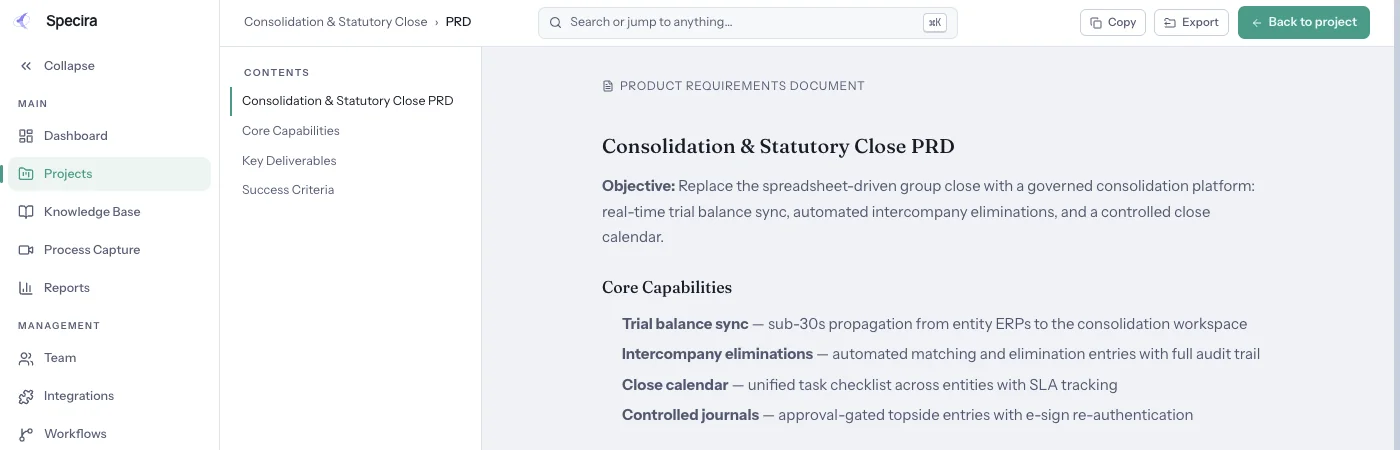
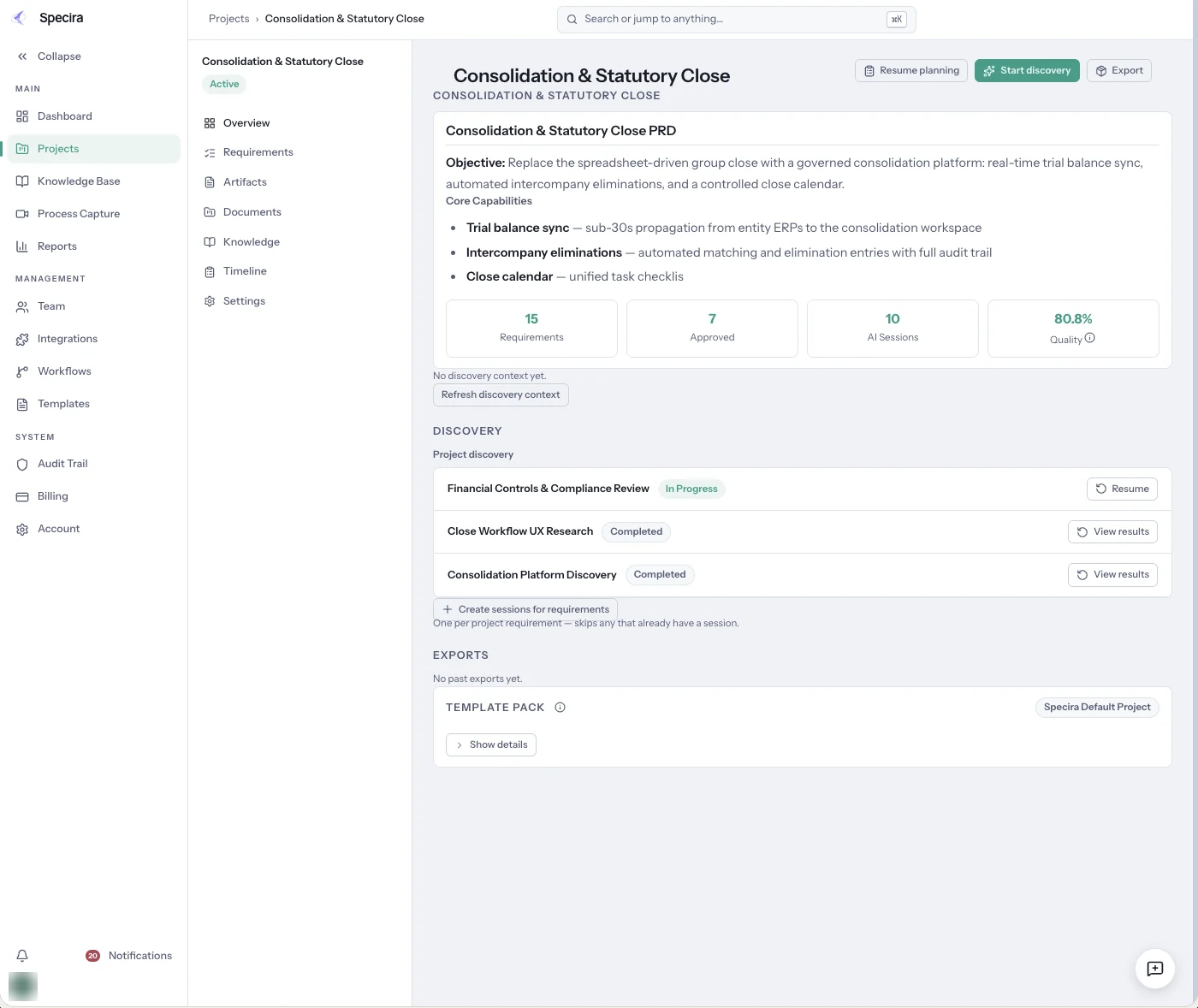
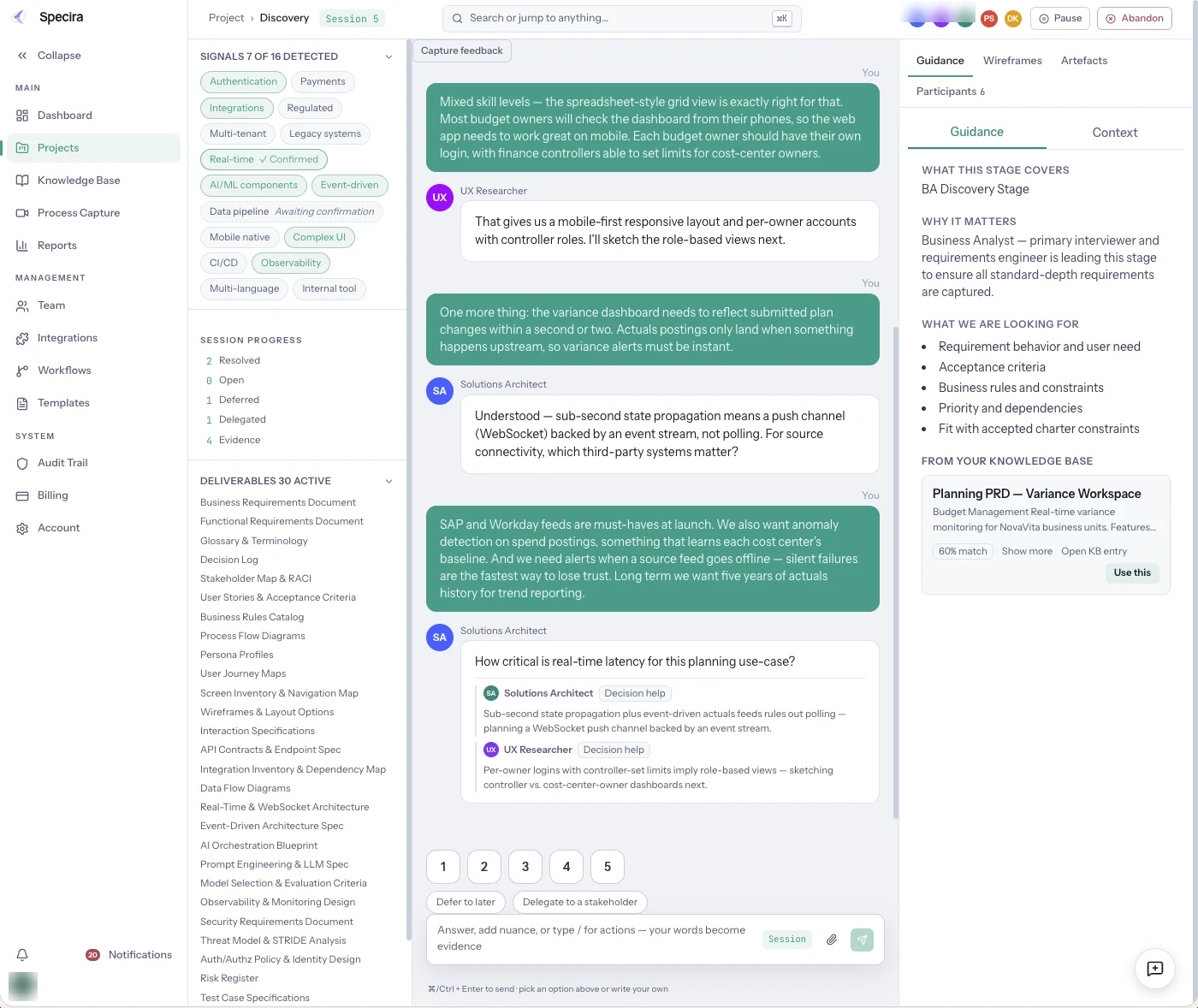
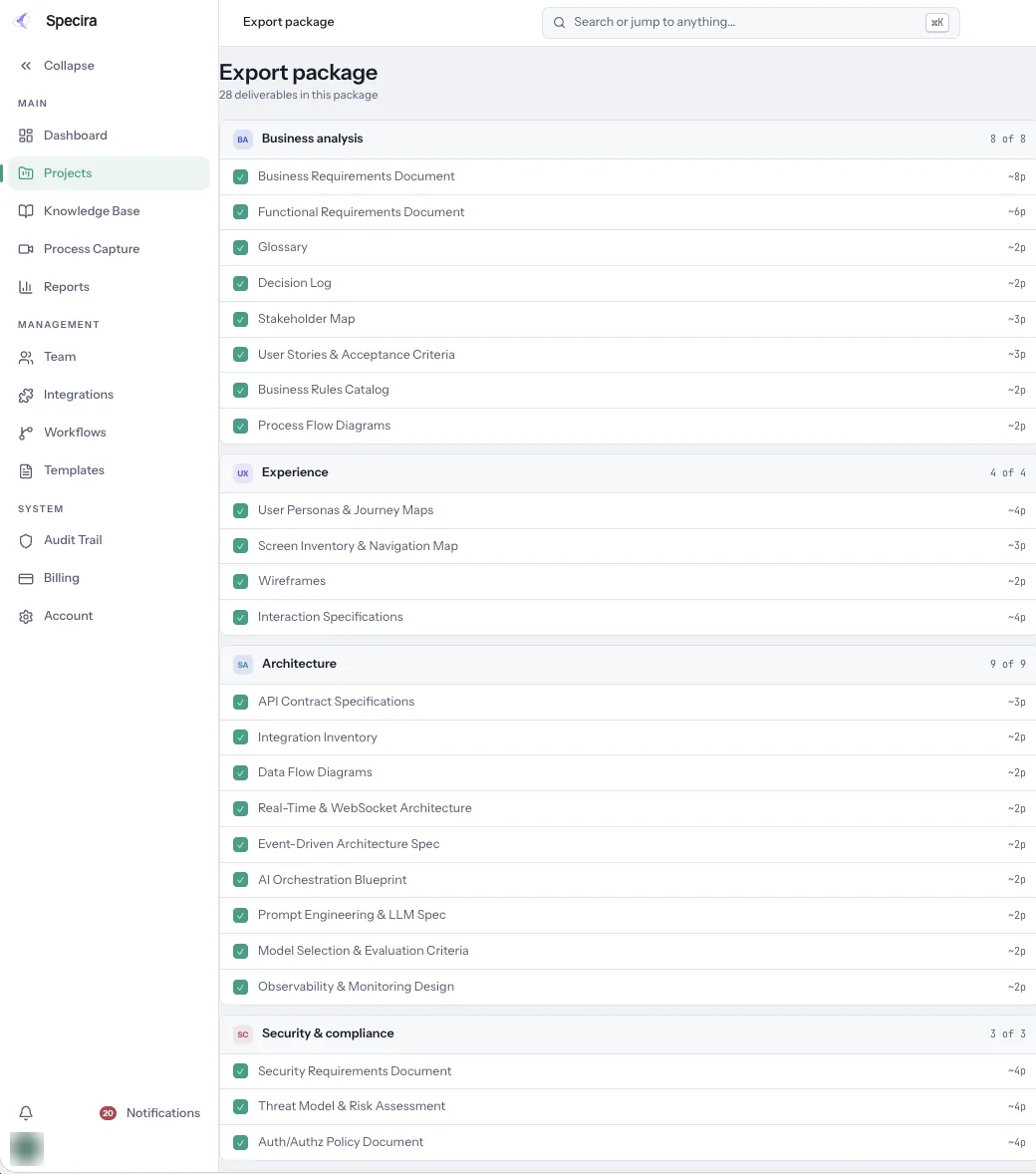
Screens are from a seeded Specira demo workspace; counts and scores are sample data.
Book a demo and watch a product requirements document compile its metrics table from your discovery session.
Book a Demo