A functional requirements document template (FRD) turns a committed feature into numbered statements of what the system shall do, each with a fit criterion and a verification method. The decision it lets a team make is the specification boundary: which behavior this document covers, which belongs to a sibling specification, and which branches of the logic are closed. Specira compiles the FRD from the requirements, business rules and decisions typed during discovery.
A hand-written FRD hides compound requirements inside long sentences, leaves a branch marked to be decided, and describes a permission without saying what the refusal looks like. The sequence diagram in one section disagrees with the error catalog in another. Engineering inherits the technology choices the author slipped in, and testers cannot say what would prove a statement false.
What sections does the functional requirements document contain?
The governed default template runs from roles and permissions through numbered requirements, business rules, error handling, validation, workflow and state diagrams, and interface specifications.
| Section | Depth | How it is produced |
|---|---|---|
| User Roles & Permissions | core | Table from typed items · Role, Description, Permissions |
| Functional Requirements by Module | core | Prose synthesized from discovery |
| Business Rules (Key) | core | Table from typed items · ID, Rule, Trigger, Exception |
| Error Handling (Summary) | core | Prose synthesized from discovery |
| Data Validation Rules | standard | Table from typed items · Field, Rule, Error Message |
| Workflow Definitions | standard | Generated diagram |
| Input/Output Specifications | standard | Table from typed items · Endpoint/Screen, Input, Output, Validation |
| State Machine Diagrams | standard | Generated diagram |
| Batch Processing Rules | full | Prose synthesized from discovery |
| Calculation Formulas | full | Table from typed items · Calculation, Formula, Inputs, Precision |
| Localization Requirements | full | Prose synthesized from discovery |
| Backward Compatibility | full | Prose synthesized from discovery |
How does Specira build the FRD?
The Business Analyst agent owns the FRD, drawing on inline notes from the Solutions Architect on interfaces and states, the Security Analyst on roles and refusals, and the Red Team Critic on unclosed branches. It compiles the document from typed requirements, business rules, constraints and the decisions that closed them. The Meridian sample shows the discipline: the Functional Requirements section lists FR-010 through FR-013 as single-behavior statements, each with a priority, a fit criterion (the one sentence that could prove it false) and a verification method from a closed set. The Roles and Permissions section pairs every may-not row with a named entry in the error catalog, because denial is behavior too.
The Behavior and Decision Logic section carries a branch-closure validator: an open branch renders as a named gap, never as a guessed default. The Use-Case Flows section produces the sequence and state diagrams through the same diagram service the exports use, and the template checks that exception flows agree with the error catalog. Each statement cites the business requirement it traces to and carries its provenance. The Red Team Critic runs the export gate on decisions resolved, and the FRD ships as DOCX, Markdown or JSON, or pushes to Jira, GitHub, Linear and Confluence.
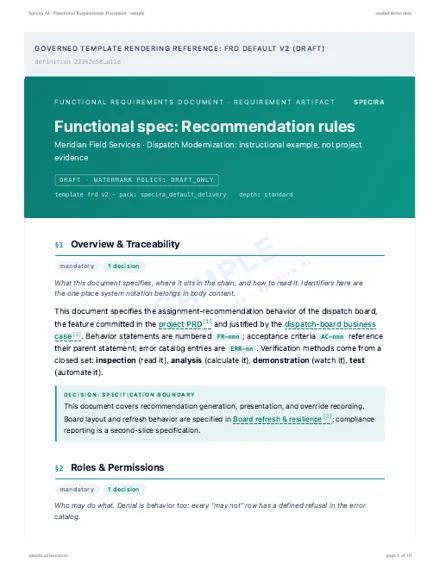
Rendered sample
Rendered from the Specira governed default template on a fictional company, watermarked, with its diagrams. Read it in the browser or take the PDF.
How do teams use the FRD?
- ✓Write tests before codeEvery statement's fit criterion and verification method tell the tester what to automate, demonstrate, inspect or calculate.
- ✓Keep design out of requirementsStatements say what the system does and name no services or vendors, so the Solutions Architect keeps the freedom to choose.
- ✓Give agents atomic statementsThe Markdown and JSON exports hand coding agents one behavior per identifier instead of a paragraph to interpret.
- ✓Settle boundary disputesThe specification-boundary decision records which behavior lives in a sibling FRD, with a cross-reference rather than a duplicate.
What does the FRD look like inside Specira?
The screens below follow the recommendation-rules specification from the logic-closure decision in discovery to the rendered state diagram.
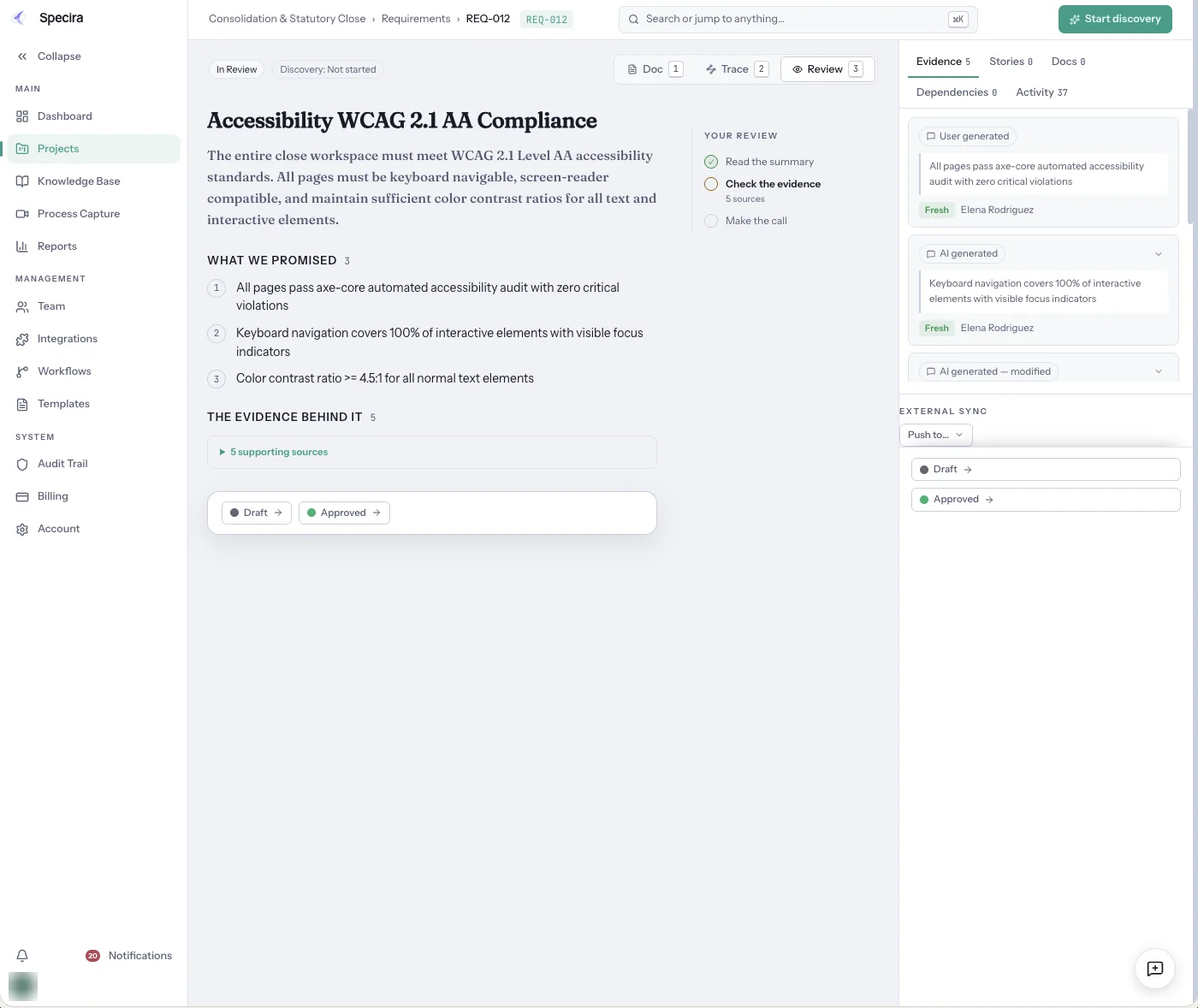
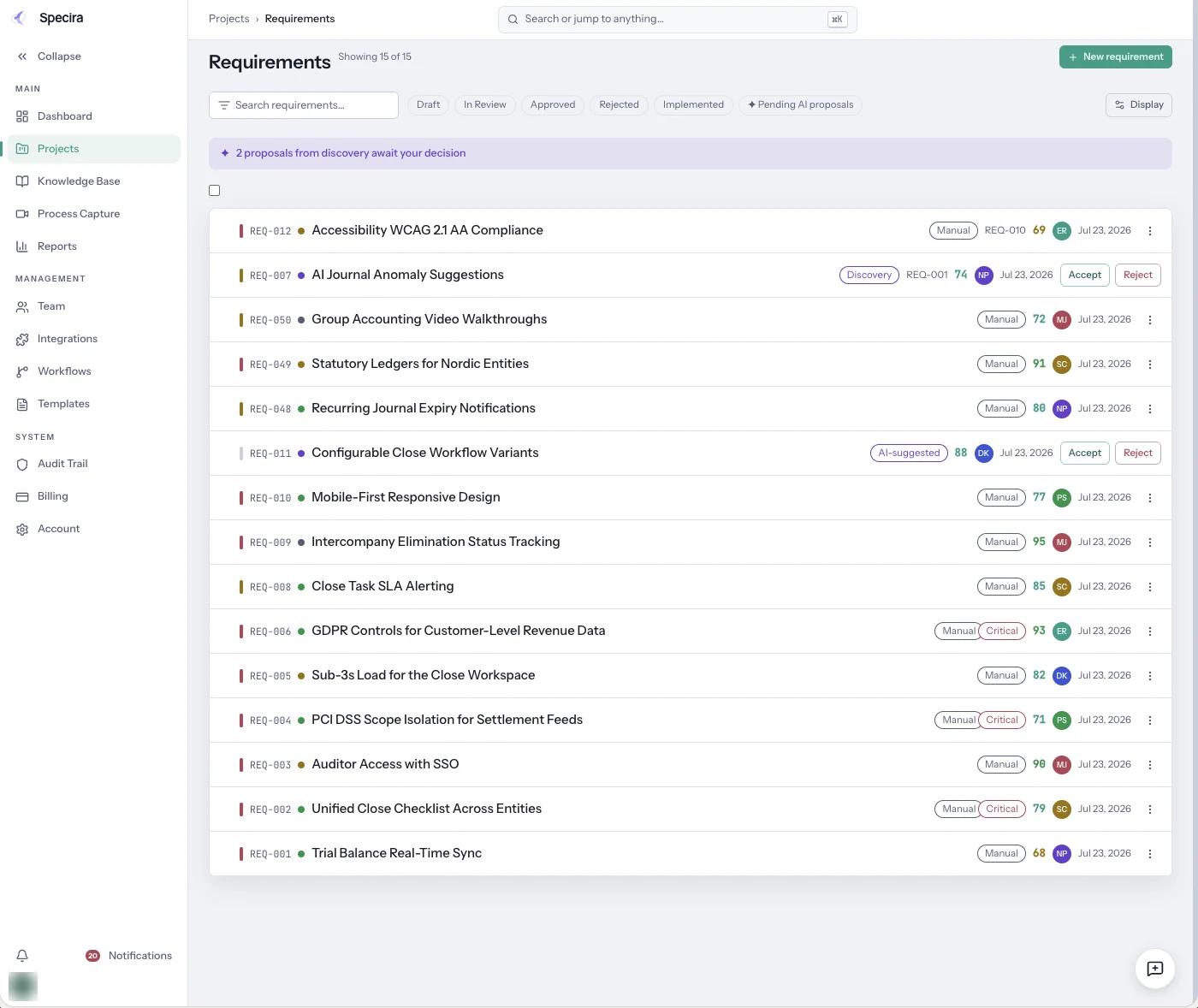
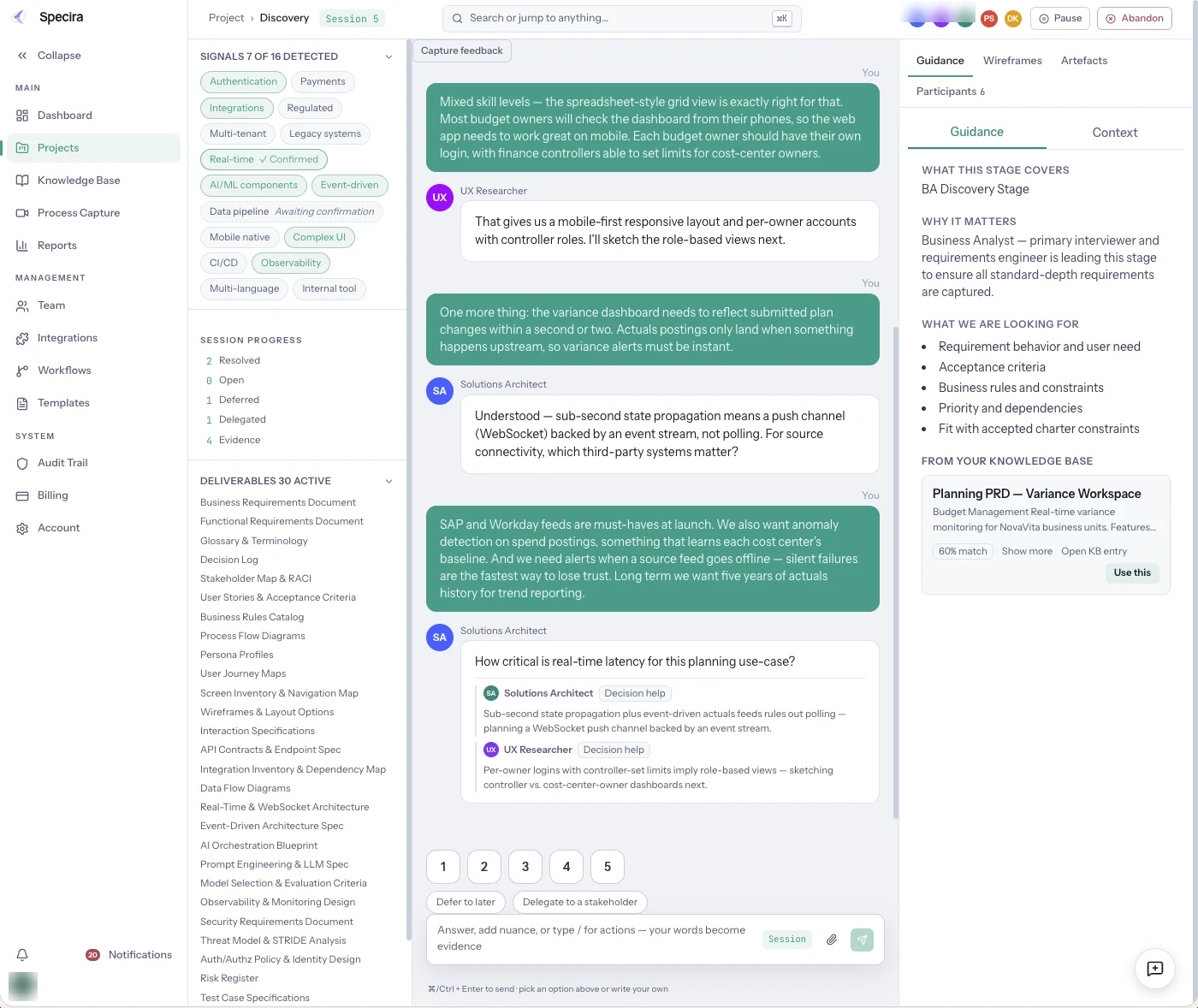
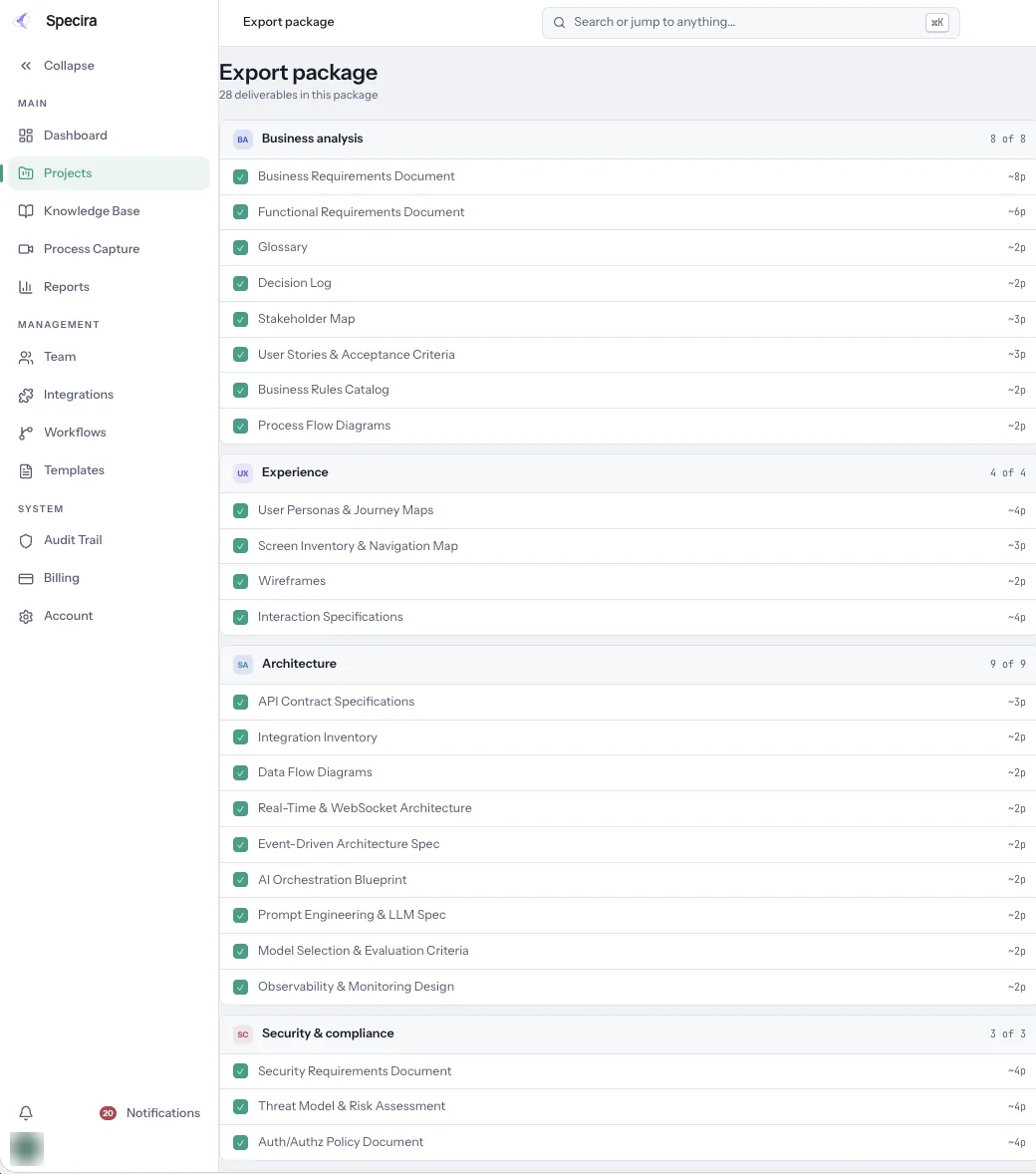
Screens are from a seeded Specira demo workspace; counts and scores are sample data.
Book a demo and watch a functional requirements document render its statements, flows and error catalog from a real session.
Book a Demo