An infrastructure and deployment spec template records how a system is actually run: the hosting choice and its alternatives, the environments, the continuous integration and continuous delivery (CI/CD) pipeline, the container strategy, domains and certificates, the infrastructure-as-code (IaC) outline, the blue/green deployment approach and the cost per environment. It lets a team decide that the operational realization matches the architecture's boundaries and the security requirements. Specira compiles it from the discovery session's constraints, decisions and named integrations, and cites each one.
Hand-written infrastructure documents name a platform class and stop. 'Managed containers in the cloud' cannot be assessed: which region, why that region, what authenticates each caller, what actually moves on each arrow. Those facts live in a wiki page, a Terraform repository and someone's head, and they drift apart within a sprint. When the compliance assessor asks where technician location data rests, three answers come back.
What sections does the infrastructure and deployment spec template contain?
The governed default template fixes eight sections. The environment list and the cost estimate are tables built from typed items; the rest is prose synthesized from discovery decisions and constraints.
| Section | Depth | How it is produced |
|---|---|---|
| Hosting Choice | core | Prose synthesized from discovery |
| Environment List | core | Table from typed items · Environment, Purpose, URL |
| CI/CD Pipeline | standard | Prose synthesized from discovery |
| Container Strategy | standard | Prose synthesized from discovery |
| Domain Configuration | standard | Prose synthesized from discovery |
| IaC Outline | full | Prose synthesized from discovery |
| Blue/Green Deployment | full | Prose synthesized from discovery |
| Cost Estimate per Environment | full | Table from typed items · Environment, Service, Monthly Cost |
How does Specira build the infrastructure and deployment spec?
The Solutions Architect agent owns this artefact, with the Security Analyst's requirements feeding the authentication and encryption columns. It compiles the document from the session's typed constraints, resolved decisions and named integrations. The sample shows the mechanism. Hosting Strategy records the decision as what, why considered, who and how, then states the re-decision triggers as conditions rather than dates, and confirms that every secret is sourced from configuration, never code. Network Topology names the actual provider and region, gives the data residency justification with the security requirement it satisfies, and becomes the project's infrastructure register: a node table where each node states what it runs on, how callers authenticate and the highest data class it holds, and an edge table where each arrow lists the actual payload fields, the protocol and the encryption. The architecture owns the logical boundaries; this artefact realizes them and cites them.
The Red Team Critic consults on every turn and runs the export readiness gate, which measures resolved decisions rather than pages. A blue/green section whose rollback decision is still open renders as a named gap, never as a generic playbook. Every row carries provenance: who decided, when, on what evidence, and knowledge base entries such as regulatory obligations and integration contracts are matched with a confidence score and cited. Export as DOCX for assessors, Markdown or JSON for agents, or push to Jira, Confluence, GitHub or Linear. This artefact is available from the Standard tier, and the template can be cloned and adjusted in the Templates module.
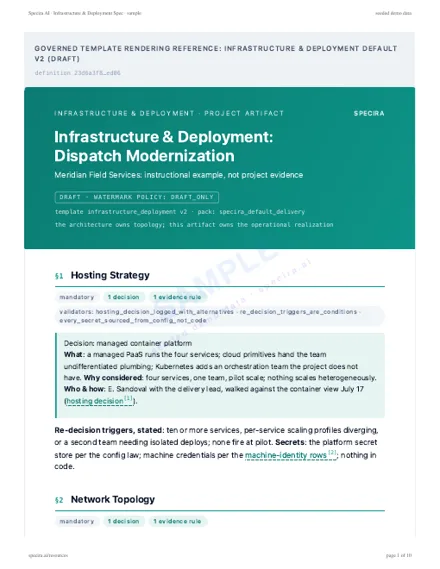
Rendered sample
Rendered from the Specira governed default template on a fictional company, watermarked, with its diagrams. Read it in the browser or take the PDF.
How do teams use the infrastructure and deployment spec?
- ✓Answer the compliance assessorThe residency justification, node table and edge table answer where data rests and how it moves without a second document.
- ✓Provision from a single registerPlatform engineers write the infrastructure-as-code modules against the named provider, region, services and environments.
- ✓Rehearse the rollbackOperations reads the blue/green section for traffic shifting, health validation and the rollback path before the first release.
- ✓Budget each environmentFinance and delivery see the monthly cost table per environment and per service, tied to the hosting decision that produced it.
What does the infrastructure artefact look like in Specira?
The screens below show the Solutions Architect and Security Analyst resolving hosting decisions in a session, the rendered topology register, and the export gate for this artefact.
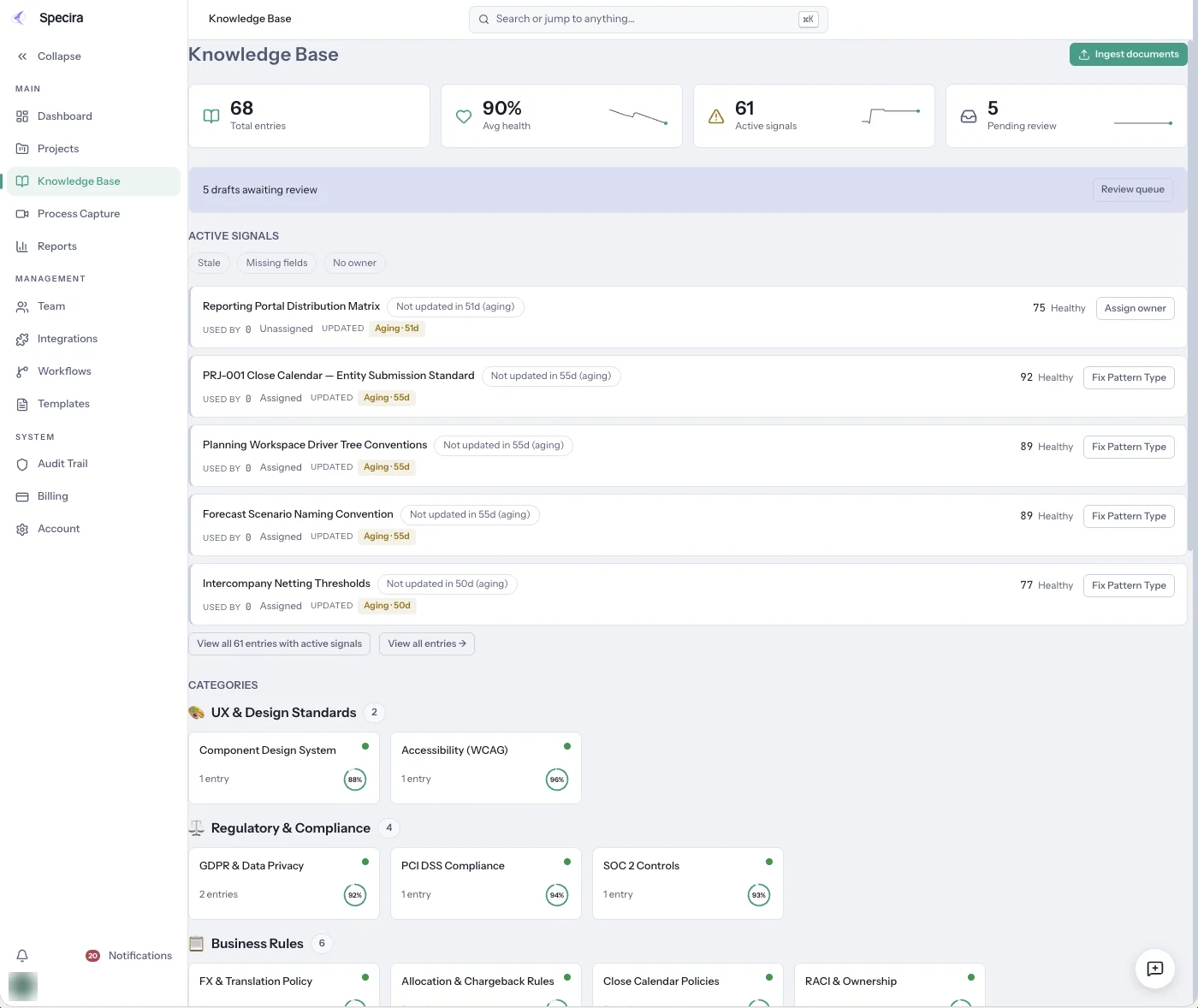
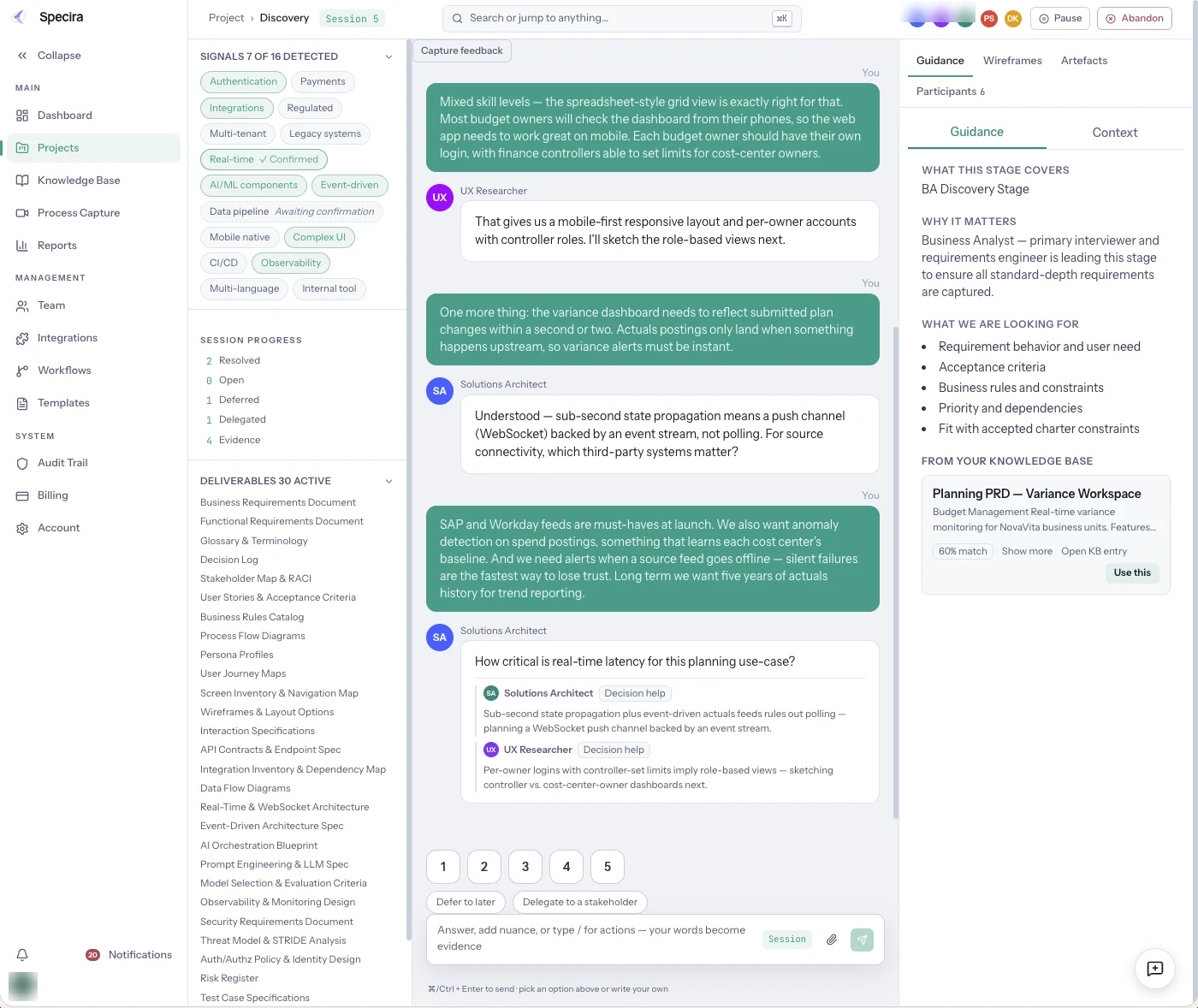
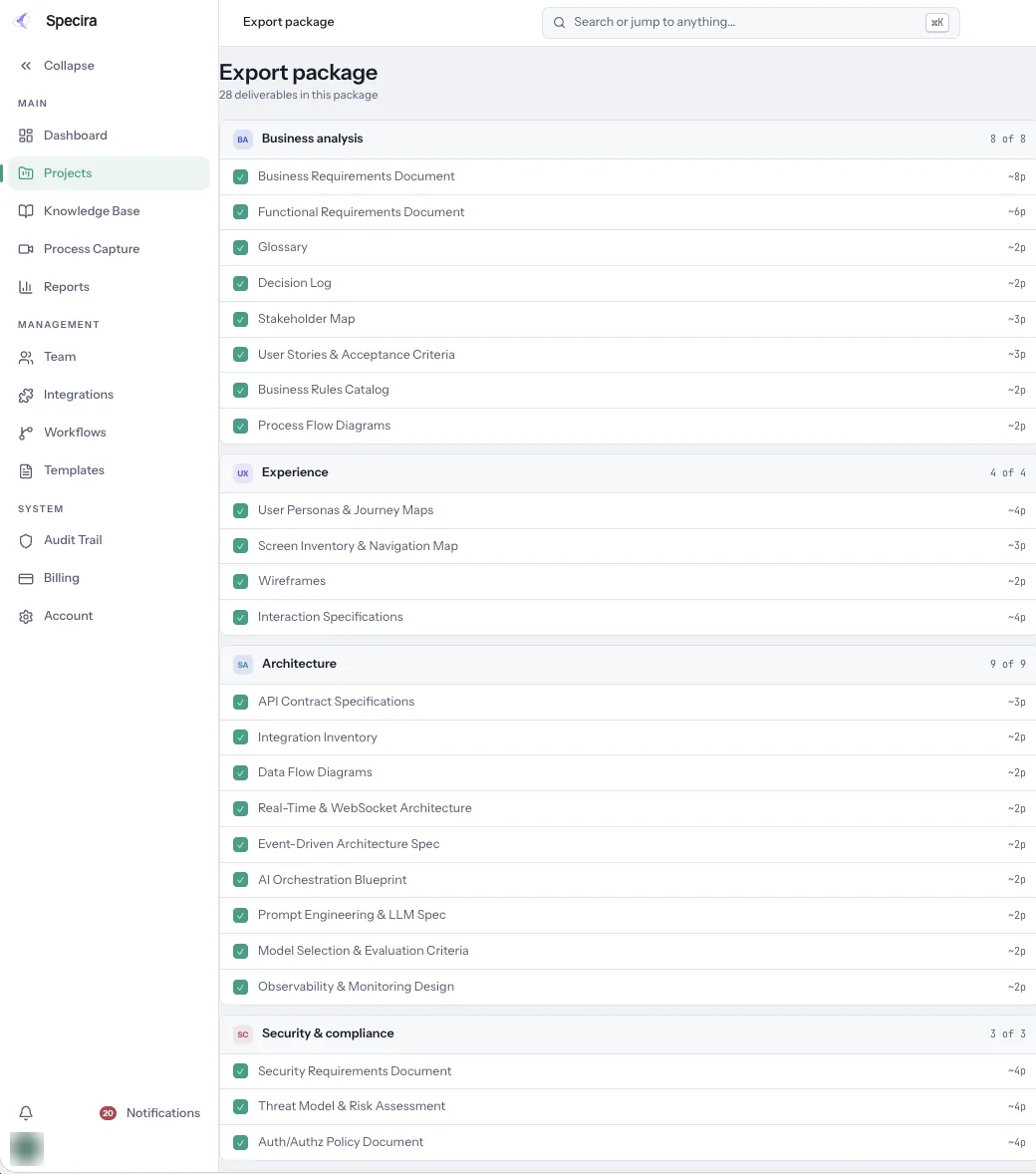
Screens are from a seeded Specira demo workspace; counts and scores are sample data.
Book a demo and see a discovery session become an infrastructure and deployment spec your assessor can sign off.
Book a Demo